Chapter 5 动词分类(一):实义动词与(情态)助动词
5.6 特殊疑问句
5.6 特殊疑问句
特殊疑问句是在一般疑问句的基础上变化而来的,其句式为:“特殊疑问词+一般疑问句+?”。在英语中,特殊疑问词有who, what, which, when, where, why和how等。
5.6.1 不与名词连用的疑问词
一、对人提问——who
1 1) He can sing in English.
2) Who can sing in English?
2 1) I saw him at the party last night.
2) Who did you see at the party last night?
二、对事物或所做的事情提问——what
3 1) I like English.
2) What do you like?
4 1) I am studying English grammar.
2) What are you doing?
5 1) I am studying English grammar.
2) What are you studying?
2) 你在学习什么?
6 1) I'd like to go swimming tomorrow.
2) What would you like to do tomorrow?
三、对时间提问——when
7 1) I was born in 1980.
2) When were you born?
四、对地点提问——where
8 1) He lives in Beijing.
2) Where does he live?
五、对方式提问——how
9 1) He goes to school by bus.
2) How does he go to school?
六、对原因提问——why
10 1) I often study at the library because it's quiet.
2) Why do you often study at the library?
5.6.2 要与名词连用的疑问词
一、which
当说话者提供多种对象供对方选择时,我们就要用which来提问。此时,which的后面通常要接一个名词,意思是“哪一个什么东西”。
1 A: Could you lend me your pen?
B: Sure. I have two pens. This pen has black ink. That pen has red ink. Which pen/Which one/Which do you want?
A: That red one. Thanks.
从以上例句可看出,which的后面也可不接名词,此时which用作代词。
二、whose
whose的后面必须接名词,表示“谁的什么东西”。
2 1) This is his book.
2) Whose book is this?
3 1) I borrowed Jack's car last night.
2) Whose car did you borrow last night?
5.6.3 how的用法详解
一、how可以单独使用
how单独使用时,是对动作的方式进行提问。比如下面的例句是对交通工具提问:
1 A: How do you go to work?
B1: I drive./By car.
B2: I take a taxi./By taxi.
B3: I take a bus./By bus.
B4: I take a subway./By subway.
B5: I walk./On foot.
其他例句如:
2 A: How did he break his leg?
B: He fell off the ladder.
二、how还常与形容词或副词连用
与形容词连用的例句如下:
3 How old are you? 你多大岁数?
How tall is he? 他身高多少?
How big is your new house? 你的新房子有多大?
How far is it from your home to school? 从你家到学校有多远?
与副词连用的例句如下:
How well does he speak English? 他英语说得怎么样?
How quickly can you get here? 你多快能到这里?
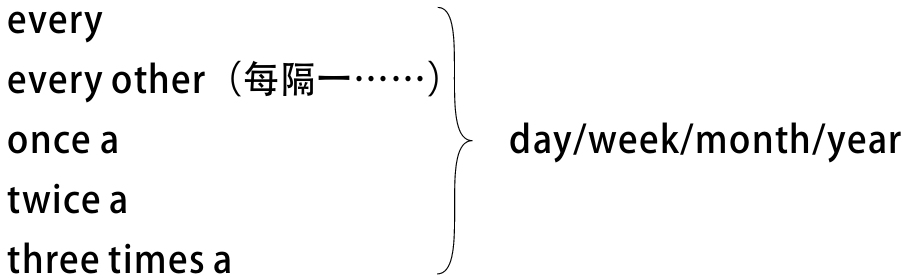
三、对动作发生的频率提问——how often/how many times...?
4 1) I make a phone call to my parents once a month.
2) How often do you make a phone call to your parents?
5 1) I make a phone call to my parents once a month.
2) How many times a month do you make a phone call to your parents?
6 1) I go shopping twice a week.
2) How often do you go shopping?
7 1) I go shopping twice a week.
2) How many times a week do you go shopping?
其他表示频率的短语还有:
思维总结
上面三节讨论了英文句子的三种变化:如何否定一个句子,如何提出一般疑问,以及如何构造特殊问句。这三种句子的变化是与助动词或情态动词密切相关的,所以我们首先应该熟练掌握本章前三节所讨论的动词的分类。
一、将下列句子先改成否定句,然后改为一般疑问句,并做出肯定及否定回答。然后再对画线部分提问一个特殊疑问句。
1. She lives there.
2. Kennex lived there.
3. I'm living here.
4. I often get up at 7: 00 in the morning.
5. He likes swimming.
6. He is reading English.
7. I will graduate next year.
8. I saw Jack at the party last night.
9. George is going to study at his dormitory tonight.
10. I am going to visit my grandmother this summer vacation.
二、which/what辨析。
11. A: ______ do you want to buy?
B: I want to buy a pen.
A: We have a lot of different pens. Their prices vary from 10 yuan to 300 yuan. ______ are you going to buy?
B: That one.
12. A: There are flights to Kunming at 7: 30 A.M., 9: 00 A.M. and 11: 30 A.M.
B: ______ are you going to take?
A: The 7: 30 flight.
三、用why提问下列句子。
Example:
A: I didn't go to school yesterday.
B: Why didn't you go to school yesterday?
A: Because I didn't feel good.
13. I'm going to the bank after class.
14. I need to go to the drugstore.
15. I took a taxi to school this morning.
16. I was absent from class yesterday.
17. I like going to the net café.
18. I am not coming to class tomorrow.
19. I can't come to your party this weekend.
20. I didn't eat breakfast this morning.
21. I don't like the weather in this city.
22. I didn't do my homework last night.
四、对下列活动的频率进行提问。
23. go to a movie
24. go shopping
25. go to a net café
26. play cards
27. write a letter to your parents
28. get your hair cut
29. cook your own dinner
30. dine out