Chapter 7 英文时态(一):一般时态
7.4 一般将来时态——预测、计划和意愿
7.4 一般将来时态——预测、计划和意愿
7.4.1 引言
对于一般将来时(the future simple tense)的讨论,要比前两个时态稍微复杂一些。因为从严格意义上来说,英文里是没有“将来时态”的,而只有现在时态和过去时态这两种时态(Technically, English has no “future tense”, but only two distinct tense forms—present and past tenses.)。读者看到这里,一定开始有点困惑了,且听下面“快快道来”——从四个方面来给出理由。
首先,从时态形式(tense form)的构成上来看。现在时态(present tense)的构成是用动词原形(basic verb form),或遇到单数第三人称主语,谓语动词加-s。过去时态(past tense)的构成则是动词变为过去式(如加-ed或其他特殊变形)。因此,对于现在时态和过去时态,都是在谓语动词的词尾上进行变形。但对于将来时态,在动词的词尾却没有任何变形。对此,读者应该还记得我们在本章一开始的7.1.1小节给出的一般时态的谓语公式,如下:

我们看到,表格中的Tense(时)只有Past(过去时)和Present(现在时),而没有Future(将来时)。通常我们引入一个情态动词will来表示将来时态,但will的引入并不是谓语动词本身的词形变化。正是因为在表示将来时间内发生的事情时,英语谓语动词的词干(stem word)不会发生任何形式的变化,因此“将来时”的说法被看作是不贴切的。所以,从这个结构意义上(in the structural sense)来说,英语中是没有将来时态的。
其次,从表达“将来时态”的各种手段来看。在英文中,表示现在时态,就用动词原形或者加-s;表达过去时态,就用动词过去式变形。但表达将来时态,即人们谈论将来要发生的事情时,事实上,是采取动词形式变化以外的其他方式来达到这一目的的。具体的方式非常多,比如使用情态动词will和be going to,比如使用现在进行时(be doing)表示将来的动作,以及采用其他的句型结构,如be to do或者be about to do等(这些不同的表示将来的手段,都是我们接下来要讨论的重点内容)。由此看来,英文中并不只是用will do表示将来,所以,我们并不能因为will do可以表示将来的动作,就说将来时态的构成就是will do。如果是这样,那么be to do或be about to do这样的结构也是将来时态吗?或者表示将来事情的进行时态也是将来时态吗?当然不能这么认为。从这个意义上来说,英语是没有将来时态的。
再次,从是否成为事实的角度(factual or non-factual)来看。将来的事情与发生在过去或现在的事情是完全不同的,发生在过去或现在的事情都已是确定无疑的,是一个事实(fact)。但谈论将来要发生的事情,就不可能成为一个确定无疑的事实,而只能是表示一种可能性(Situations in the future are treated differently. They are inherently non-factual, but can be considered as either relatively certain or relatively unlikely or even impossible. Thus future events are not treated as facts, hence are only possibilities.)。所以,从核心意义的角度来说,发生在“将来”的事件与发生在“过去”或“现在”的事件不可能有相同的确信度(certainty)。因此,严格地讲,我们无法以事实为基础去报告将来的事件。所以,will用来表示很有把握的预测(prediction),但不是对事实的叙述或报告。比如,我们说:
1 It will rain later. 过一会会下雨。
我们传统上是把这里的will rain看作是一般将来时态,但实际上这里只是情态动词will表示“推测”或确切地说“预测(prediction)”的一种用法。另外,我们还可以用其他情态动词来表示这种预测,比如说:
2 It may rain later. 过会可能会下雨。
3 It might rain later. 过会或许会下雨。
这里的may和might同样可以表示对将来事情的预测,只不过肯定程度是递减的——will比may的把握性大,may比might的把握性大(关于情态动词的用法,我们将在《英语语法新思维中级教程——通悟语法》中讲解)。但是,我们一般就不会认为may do或might do是一般将来时态。
由此可见,典型的一般将来时will do,在本质上只是情态动词will的一种用法而已。从这个意义上来说,同样证明英语里没有将来时态。
最后,从情态意义来看。上文讲过,表示将来时态的will do只是情态动词的一种用法而已,因此表示将来的事件往往是与各种情态意义联系在一起的。比如:预测某事将会发生,计划将来做某事,或表示愿意去做某事。因此,对于将来时态的学习,理解以下三个概念是至关重要的:
1. 预测(prediction):表示说话人认为将来会发生某件事;
2. 事先计划(future plan):表示说话人在头脑里已经做出决定将来要做某件事;
3. 意愿(willingness):表示说话人既不是预计某事将会发生,也不是预先经过考虑决定将做某事,而是在说话的时刻立即做出决断表明他将去做某事。
接下来,我们就以能够表示将来活动情景的各种不同的手段为主线,重点讨论will和be going to的用法与区别,同时结合三大情态意义——预测、计划和意愿,来讨论将来时态的各种用法。
7.4.2 will表示将来——预测
读者对will应该是非常熟悉的,因为它通常被作为一般将来时态的“代言人”,其最典型的用法就是对未来进行“预测”(prediction about the future—something we expect to happen)。下面给出的这些例句,是美国《时代周刊》(Time)曾经在其网站上发布的,是对21世纪做的各种展望和预测(The Visions of the 21st Century),其中的will都是表示“预测”这一典型的用法。内容包括下列四大方面,读起来非常有趣:
一、关于“科技(Science)”方面的预测包括:
1 Will we travel to the stars?(我们能够进行星际旅行吗?)
2 Will we clone a dinosaur?(我们能克隆恐龙吗?)
3 Will a killer asteroid hit the earth?(小行星能撞毁地球吗?)
4 Will the brain understand itself?(大脑能理解自己吗?)
5 Will we keep evolving?(我们人类还能一直进化吗?)
6 Will we travel back or forward in time?(我们能进入时光隧道回到过去或去到未来吗?)
7 Will we live on Mars?(我们能生活在火星上吗?)
8 Will we meet E. T. ?(我们能遇到外星人吗?)
9 Will someone build a perpetual motion machine?(有人能发明永动机吗?)
10 Will we discover another universe?(我们能发现另外的宇宙吗?)
11 Will we figure out how life began?(我们能知道生命是如何起源的吗?)
12 Will we control the weather?(我们能控制天气吗?)
13 How will the universe end?(宇宙会怎样结束?)
14 Will there be anything left to discover?(还有哪些有待于我们去发现的东西?)
二、关于“人类如何生活(How We Will Live)”方面的预测包括:
15 Will women still need men?(女人还需要男人吗?)
16 What will we wear?(我们会穿什么?)
17 Will there be any teenagers?(还会有青少年吗?)
18 Will we still have privacy?(我们还能有自己的隐私吗?)
19 What will our houses look like?(我们的房子会是什么样子?)
20 Will the Internet rule our lives?(互联网能主宰我们的生活吗?)
三、关于“我们的工作,我们的世界(Our Work, Our World)”方面的预测包括:
21 What will our offices look like?(我们的办公室会是什么样子?)
22 What will be the 10 hottest jobs?(十大热门职业会是什么?)
23 How will we fight?(我们如何作战?)
24 What will peace mean for the Middle East?(中东能实现和平吗?)
25 How much will the Internet rule our lives?(互联网将在何种程度上控制我们的生活?)
四、关于“健康与环境(Health and Environment)”方面的预测包括:
26 How hot will it get?(地球将会变得多热?)
27 Will we still eat meat?(我们还需要吃肉吗?)
28 Will we keep getting fatter?(我们会一直变胖吗?)
29 Will we live to be 125?(我们能活到125岁吗?)
30 When will we cure cancer?(何时我们能治愈癌症?)
以上众多例句表明,在一般将来时态中,我们常用will来表示对将来的预测。同时,看完上述预测,我们不禁猜想:
31 I wonder what it will be like in the 21st century. But from the great advances in these past years I assume that we will be entering a new golden age of miracles and wonders. Life will be fantastic in the 21st century.
不知道到了21世纪我们的生活会是什么样子。但从近几年巨大的发展来看,我猜想我们一定会进入一个全新的充满奇迹的黄金时代。21世纪的生活一定非常美好。
网络上还有其他各种对人类未来方方面面所进行的预测(读者可见本小节后面的翻译练习),都大量使用了will一词。读者以后在阅读这类文章时不妨多加注意。
思维总结
在本节中,我们讨论了will的“预测”用法,即表示猜测将来某事发生的可能性。在下一节中,我们将讨论be going to的“预测”用法,并阐述它与will的区别。
翻译下列短文,并体会其中will的预测用法。
用will预测未来电脑在人们生活中的巨大作用(这是20世纪90年代初的文章,当时网络还没有现在这么普及):
1. Many people say that computers will take the place of books in the future. School children will use computers instead of books in class; libraries will keep computer discs, not books, on their shelves. In fact, you will not even need to go to school: a computer on your desk at home will teach you everything you need! Does that mean all our teachers will become computer engineers? I hope not! If so, I won't become a teacher!
Most people think that this will happen, but I wonder!
联合国预测2300年全球人口将达90亿:
2. UN predicts nine billion people by 2300
According to “World Population in 2300”, released by the Population Division of the UN's Department of Economic and Social Affairs(DESA), on Dec. 9, 2003, the world will have around 9 billion people by 2300 from the current 6.3 billion. The reports also predicts that Africa's share of the world's population will rise from 13 per cent this year to 24 per cent in 2300, while Europe's share over the same period will fall from 12 per cent to 7 per cent; India will become the most populous country in the world, followed by China and the United States.
预测外国人讲汉语的人数:
3. For those aspiring television celebrities and planning to sign up for Mandarin classes, you'd better hurry. Maybe in 50 years, there will be 100,000 foreigners speaking such excellent Chinese...they won't be that interesting anymore.
开心一刻
The Future Tense
Teacher: What's the future tense of marry?
Student: Divorce.
Good News and Bad News
A man going through a very troubled marriage went to a palmist to find out how much hope there was for him.
Palmist: I have good news and bad news. The bad news is that your marriage will be troubled for the next ten years.
Man: And the good news?
Palmist: The good news is that you will get used to it after that.
7.4.3 be going to表示将来——预测
除了上一节中讨论的will,我们还可以用be going to来表示“预测”,即我们对未来某件事发生的可能性做出推测。比如:
1 Look at those black clouds! It's going to rain.
2 It's not going to snow again tomorrow, is it? It was supposed to be warm all week.
妙语点睛 以上两句话显然都是说话人在对天气情况做出预测,尤其是第一句,说话人是根据目前明显的迹象,即“黑云密布(black clouds)”来做出“要下雨”的预测的。
在上一节中,我们看到will可以表示“预测”,而上面刚刚又分析了be going to也可以表示“预测”。那一定就会有读者问:“这二者有何区别呢?”我们中国学生遇到这种情况一般都喜欢问区别。所以接下来,我们就来探讨一下二者的区别。通过比较will和be going to,我们可以更加深入地理解二者在做“预测”时的用法。
一、表示“预测”,be going to比will有更多的证据支持,而且事件发生的时间更近
由于be going to是一个现在时态的形式(如am/is/are going to),因此,它所表示的对将来行为的预测往往暗示与“现在”有联系,而且是在说话后不久就将发生的(Be going to has an implication that the future action is related to the present and will occur relatively soon after the time of speaking.)。所以当有现在的证据可以支持预测时,或者说根据目前的明显迹象来推断某件事将要发生时,我们就要用be going to,而不宜用will。请看例句:
3 With all of these typos in this resumé, you are not going to make a very good impression.
妙语点睛 这里的typo即type error的缩写,表示“打字错误”。说话人根据with all of these typos in this resumé这一证据,而预测“你”不会给别人留下好印象。
4 A: Look at the time. I'm going to miss my bus.
B: Don't worry. I'll drive you to the stop. And if the bus has already left, I can get you to your apartment.
妙语点睛 这里的be going to同样表示“预测”,说话人通过look at the time表明时间很晚了,据此推断自己要误车了。
5 The traffic is terrible. We're going to be late. By the time we get to the airport, Bob's plane will already have arrived, and he'll be wondering where we are.
妙语点睛 这显然是说话人坐在车里,看着当时路上拥堵的交通状况,做出了要迟到的“预测”,即说话人是看到the traffic is terrible这一目前的迹象或证据而预测他们要迟到。
6 You look very pale. I am sure you are going to get sick.
妙语点睛 这里的you look very pale是生病的迹象。
7 The figures suggest that we are going to make a good profit this year.
妙语点睛 这里的the figures就是证据。
我们看到,上面表达“预测”的例句都具有“现在的证据支持预测”这个特点。
我们再来看下面这则笑话:
8 A: I think I'm going to lose my job in the flower shop tomorrow.
B: What for?
A: I sent flowers to a funeral with the wrong card on them.
B: What did the card say?
A: HOPE YOU'LL BE HAPPY IN YOUR NEW HOME.
妙语点睛 这里A根据自己所犯的错误,来“预测”自己可能会失去在花店的工作。
我们再看右边这幅图画。
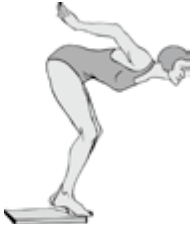
这时我们说:
9 She is going to dive into the water.
而不能说:
She will dive into the water. *
因为这个女子上身向前倾斜的姿势和站在跳板末端的位置等“目前的明显迹象”使我们做出“她要跳水了”这样的推断。
另外,be going to还往往表示当前已有迹象表明说话者无力控制的(uncontrollable)即将发生的行为。比如,如果你不小心失足要掉下去时,你会喊道:
10 Help! I'm going to fall!
但如果说:
Help! I'll fall. *
则听起来比较奇怪。
再比如,若看到一个盲人要掉进马路边的洞里,你要说:
11 He is going to fall into that hole! 他要掉进那个洞里了!
若看到路上的一辆汽车要撞到树上了,你要说:
12 Oh, my dear! That car is going to bump against the tree! 哦,天啊!那辆车要撞到树上了!
再比如上文提到的两个例句:
13 Look at the time. I'm going to miss my bus. 看现在都几点了,我要误车了。
14 The traffic is terrible. We're going to be late. 现在这么堵车,我们要迟到了。
妙语点睛 这里的look at the time显然是表示时间已经很晚了,由这一目前的迹象,说话人推断说“我要误车了”。同样,the traffic is terrible是目前的迹象,据此说话人预测说“我们要迟到了”。所以,这两句同样都具有“目前的迹象表明说话者无力控制的行为”这样的意味。
相比较而言,will则只是表明说话人认为或相信某件事将要发生。比如下面的例句:
15 A: I hear Mary isn't getting much support in her running against Steve in the election.
B: It is not over yet. I think she will make a come back.
妙语点睛 这里用will往往只是表示说话人的主观态度,而并没有多少证据。
16 There will be a lot of rainfall next spring.
妙语点睛 这句话往往只是表示说话人的主观猜测。
或者will用于“在某种条件下某事才会发生”的情况。所以,在带有条件或时间状语从句的主句中,我们通常用will表示预测,而不用be going to。比如:
17 If the crop fails, there will be a famine. 如果粮食收成再不好的话,就会出现饥荒。
18 You'll feel better when you take this medicine. 吃完这些药,你就会感觉好些的。
19 You'll feel better if you take this medicine. 如果吃了这些药,你就会感觉好些的。
20 If much more snow accumulates, the roads will have to be closed. 如果雪继续堆积,道路就得被封了。
下面这篇短文讲到了中国人对老外的种种误解:
21 “People, in general, have some strange ideas about America,” says Jonathan Kos-Read, one of the few full-time Western actors in China. “For instance, Americans don't love their parents and vice versa. Or, if you walk out of your front door in the U.S., 9 times out of 10, you'll see a huge gun battle. That kind of thing...”
我们看到,这里同样是对应于if引导的条件状语从句,主句用will表示预测。
我们现在来看美国电影《特洛伊》(Troy)中的一个场景:在阿喀里斯(Achilles)出战前,他妈妈忒提斯(Thetis)“预测”了他的命运,说:
22 If you stay in Larissa, you will find peace. You will find a wonderful woman, and you will have sons and daughters, who will have children. And they'll all love you and remember your name. But when your children are dead, and their children after them, your name will be forgotten... If you go to Troy, glory will be yours. They will write stories about your victories in thousands of years! And the world will remember your name. But if you go to Troy, you will never come back... for your glory walks hand-in-hand with your doom. And I shall never see you again.
妙语点睛 在希腊神话中,阿喀里斯(Achilles)的母亲忒提斯(Thetis)是海神。阿喀里斯一出生,忒提斯便将他浸泡到冥河(River Styx)中,这样一来,就没有任何武器能伤害到他了。但是,忒提斯是提着阿喀里斯的一只脚踵(heel)将他浸到冥河里去的,因此,如果脚后跟受伤,阿喀里斯就会没命了,这也是为什么英语中的Achilles' heel指“人的弱点”。影片《特洛伊》中没有交代这些,当然最终阿喀里斯的确死于帕里斯(Paris)射出的一箭之下,而这一箭的确射中了他的一只脚后跟。我们可以从以上节选的忒提斯对儿子所说的这段话中感觉出,对阿喀里斯而言,一切似乎都是命中注定的,他妈妈说:...your glory walks hand-in-hand with your doom.(……你的荣耀和你的厄运总是相生相伴的。)
我们看到,在上文中,都是用的will表示“预测”,表达的都是很久以后的事,而并不是眼前即将发生的事。而且这些含有will的句子,归属于三个条件状语从句:If you stay in Larissa, you will find peace... If you go to Troy, glory will be yours... But if you go to Troy, you will never come back... 所以阿喀里斯的妈妈此时是不会说you are going to...*的。
基于以上的分析比较,我们再来看看will和be going to分别出现在同一个句子里的差别。比如:
23 1) I'm going to be sick.
2) I will be sick.
妙语点睛 在例句1)中,说话人相当于说“I'm going to be sick because I feel terrible now.”,意思是“我感觉要生病了,因为我现在很不舒服”,即目前有迹象表明要生病了。在例句2)中,说话人相当于说“I will be sick if I eat any more of this ice cream.”,意思是“我不能再吃冰淇淋了,再吃就要生病了”。这种预测是附带在另一条件之上的。
再比如:
24 1) The bridge is going to collapse.
2) The bridge will collapse.
妙语点睛 在例句1)中,说话人意指目前人或车走在这座桥上面,它都会摇晃,或是看见桥面上有多处裂纹,或是远远地在看这座桥被炸掉,然后说道“这桥马上就要坍塌了”。在例句2)中,说话人意指将来的某一天这座桥会坍塌的,也许是因为他是造桥专家,他知道这座桥的设计明显不合理或工程质量上有问题,是一个“豆腐渣”工程,所以他做出了“桥将会坍塌”这样的推断。而且从时间上来看,will常常是指在较远的或不确定的将来,比如我们这样说:The bridge will collapse in an earthquake.
我们在上一小节中列举的《时代周刊》曾经对21世纪的预测,同样具有较远的或不确定的将来这样的意味,所以那里用的都是will一词。
综上所述,在表示预测时,will 和 be going to有以下两点区别:
1. 用be going to特别意指根据目前的明显迹象来推断某件事将要发生(We can use “be going to” for a strong prediction based on present conditions.);而will则只是表明说话人认为或相信某件事将要发生。
2. be going to 通常用来表示说话人预期所说的事件马上或在相当近的将来就要发生;而will所表示的动作发生的时间可近可远。
此外,be going to往往还表示当前已有迹象表明说话者无力控制的即将发生的行为,这显然与上述两点密切相关。
二、表示“预测”时,will的语气比be going to显得正式
另外,will比较正式,be going to更为不正式,常用于私人谈话中,所以在口语中很常用,而且be going to在口语交流中常被读成be gonna。比如两个朋友在餐馆里吃饭点菜,一个会对另一个说:I'm gonna have the chicken. 但一会儿侍者过来为他们点菜时,这个人可能会对侍者改口说道:I'll have the chicken. 这样以保持一定程度的正式性。
基于此原因,我们在看英文电影时,经常会听到老外朋友之间gonna来gonna去的。比如在《老友记》(Friends)里,有这样一个场景:雷切尔(Rachel)替莫妮卡(Monica)接了一个电话,原来是莫妮卡工作的那家餐馆打电话来问莫妮卡还去不去上班。莫妮卡说不去了,她要去纽约马戏团。请看下列对话:
25 Rachel: Okay, look, the restaurant called, they wanna know if you're gonna be showing up for work.
Monica: Nope. Going to the Big Apple Circus today.
Rachel: Okay, Monica, what are you doing? You're gonna lose your job! This is not you!
妙语点睛 这里有两处gonna,第一个显然是表示“打算”,第二个则表示“预测”,雷切尔是在警告莫妮卡她这样可能会丢掉工作的。
下面也是《老友记》里的一个场景。罗斯(Ross)的宠物猴子马赛尔(Marcel)最近变得很不安分,老是摇晃(hump)东西。后来一位兽医告诉罗斯,这是马赛尔已经性成熟了的表现,而且随着时间的推移,它还会变得更加有攻击性(...he's gonna start getting aggressive and violent.)所以,罗斯只能把它送走(I'm gonna have to give him up.)。众人说难道就没有其他办法把马赛尔留下吗?罗斯无奈地说,没有别的好办法了,因为兽医说性成熟的猴子如果不能定期地monkey love(其实应该是making love,这里罗斯故意利用monkey和making谐音来含蓄地表达猴子需要交配了),它就会愈演愈烈的(...he's just gonna get vicious.)。后来,罗斯为马赛尔找到了一家动物园。在机场的候机大厅里,罗斯和小猴马赛尔告别时,罗斯更是依依不舍,他对马赛尔说:“我会想你的,我不会忘记你的(I'm really gonna miss you, and I'm never gonna forget about you.)”。正说着,这时马赛尔似乎并不领情,又开始不停地用力晃动罗斯的腿,罗斯请求道:“Marcel, please, could you leave my leg alone? Could you just stop humping me for two seconds?!”。但小猴就是不放手。最后,罗斯无奈之下,只好让工作人员把马赛尔带走了。请看这个对话:
26 Ross:(Mortified) Hi.
Chandler and Joey: Hey.
Joey: Where've you been?
Ross: At the vet. She says Marcel's humping thing's not a phase. Apparently he's reached sexual maturity.
Joey:(To Chandler) Hey! He beat ya.
Ross: She says as time goes on, he's gonna start getting aggressive and violent.
Chandler: So what does this mean?
Ross: I'm gonna have to give him up.
Joey: I can't believe it, Ross. This sucks!
Chandler: I don't get it, I mean, you just got him. How can he be an adult already?
Ross: I know. I know. I mean, one day, he's this little thing, and before you know it, he's this little thing I can't get off my leg.
Joey: Isn't there any way you can keep him?
Ross: No, no. The vet says unless he's in a place where he has regular access to some...monkey love, he's just gonna get vicious. I've just gotta get him into a zoo.
(下面是在机场的候机大厅里,罗斯和小猴马赛尔告别。)
Ross: Marcel, c'mere, c'mere.(He sits down and Marcel jumps down and sits beside him.) Well buddy, this is it. There's just a coupla things I want to say. I'm really gonna miss you, and I'm never gonna forget about you. You've been more than just a pet to me, you've been more like a b...(Marcel climbs down and starts humping his leg.) Okay, Marcel, please, could you leave my leg alone? Could you just stop humping me for two seconds?! Marcel, would... okay, just take him away. Just take him away.
妙语点睛 我们看到,上面这个对话当中出现了大量的be gonna的表达。另外,上面讨论的be going to的这些用法和读音特点,读者朋友不妨在口语中模仿使用。
思维总结
本节讨论了will和be going to表示预测时的细微差别。这种差别主要体现在下面三个方面:
第一,用be going to特别意指根据目前的明显迹象来推断某件事将要发生(We can use “be going to” for a strong prediction based on present conditions.);而will则只是表明说话人认为或相信某件事将要发生。
第二,be going to 通常用来表示说话人预期所说的事件马上或在相当近的将来就要发生;而will所表示的动作发生的时间可近可远。此外,be going to还往往表示当前已有迹象表明说话者无力控制的即将发生的行为,这显然与上述两点密切相关。
第三,在表示“预测”时,will的语气比be going to显得正式。
但二者更大的区别体现在,be going to不能像will那样表示迅速的、当机立断的决定,我们将在下一节中对此进行详细的讨论。
根据所给场景提示,选择恰当的表达。
1. 你与朋友们骑车前往公园,这时,你一脚踩空失去了平衡,喊道:
A. Help! I will fall!
B. Help! I'm going to fall!
2. 一名军官与上级交谈。他说:
Well, sir, if our strategies continue to be successful, the war
A. is going to soon be over.
B. will soon be over.
3. 一个害羞的17岁男孩打电话给一个他仰慕已久的女孩。他说:
A. Will you meet me at the show this Friday?
B. Are you going to meet me at the show this Friday?
4. 一个女子站在跳板边缘并向前倾斜,这时我们说:
A. She is going to dive into the water.
B. She will dive into the water.
5. 在大街上,你看到一个人由于胸前抱着一个很大的纸箱而看不见前面的路,这时他前面马路上的井盖正好又被人掀开,他正朝着这个洞口走去,这时你在一旁“幸灾乐祸”地说道:
A. He is going to fall into that hole!
B. He will fall into that hole!
6. 你看到一辆汽车偏离了正常行驶路线而朝着一棵树开去,这时你说:
A. Oh, my dear! The car is going to bump against the tree!
B. Oh, my dear! The car will bump against the tree!
7.4.4 be going to表示“计划”与will表示“意愿”
在上一小节里,我们讨论了be going to和will作为“预测”的用法,并且详细地比较了二者的区别。在这一小节中,我们将详细讨论二者不同的意思——be going to表示“计划或打算(plan or intention)”,will表示“意愿(willingness)”。
对于be going to的用法,相信读者最熟悉的,就是我们常用它来表示“计划或打算(a plan)”。此时,说话人在头脑里已经做出决定将来要做某件事,并且往往还含有已经为这一行动做了某些准备的意思。又因为只有人才能有主观的思维意识去对将来的行为做出“计划”,因此,be going to的这个用法主要是用于人称主语(person subject),而不可能用于非人称主语(non-person subject)。请看例句:
1 Close your eyes. I'm going to give you a surprise.
妙语点睛 在我们打算给对方惊喜时,我们往往会让对方做个准备活动——close the eyes。
2 A: Do you mind if I turn the TV off? I am going to make a long distance call, and it's hard to hear if the TV is on.
B: No, that's fine. I wasn't watching it anyway.
妙语点睛 A要关电视,显然是要为他即将打电话做准备。
3 My grandmother is eighty now, but she is keeping up with the modern technology. She has just bought a computer and she's going to learn how to browse the Internet.
妙语点睛 这位“活到老,学到老”的老人显然已经做好了“要学上网”的决定,并且现在已经为自己“将要学上网”做好了准备——买了电脑。因此,“学上网”显然是一个事先的计划(a plan)。
一、be going to表示“计划”,需要用“人”作主语
我们下面来关注一下be going to在表示“预测”和“计划”时,它的主语的特点。上文强调过,只有“人”才能有主观的思维意识去对将来的行为做出“计划打算”,因此,be going to的这个用法主要是用于人称主语(person subject),而不可能用于非人称主语(non-person subject)。但在表示“预测”时,主语可能是人称,也可能是非人称。换句话说,如果是非人称主语,那be going to不会是表示“计划打算”,而是表示“推测”。比如:
4 Look at those black clouds! It's going to rain.
妙语点睛 这里就不可能是说老天“打算”要下一场雨,而是说话人“预测”要下雨。
另一方面,如果是人称主语,那么be going to可能是表示“计划打算”,也可能是表示“预测”。此时,上下文的语境可以帮助我们很容易地区分be going to是表示“计划打算”还是“预测”。比如下列句子:
5 A: Look at the time. I'm going to miss my bus.
B: Don't worry. I'll drive you to the stop. And if the bus has already left, I can get you to your apartment.
妙语点睛 这里的be going to显然是表示“预测”,而不是表示“计划或打算”,因为不可能是“我打算赶不上公共汽车。”
再比如下面这个场景:
6 The traffic is terrible. We're going to be late. By the time we get to the airport, Bob's plane will already have arrived, and he'll be wondering where we are.
妙语点睛 这显然是说话人坐在车里,看着当时路上拥堵的交通状况,做出了要迟到的“预测”,而不是他“打算迟到”。
下列对话是关于一场篮球比赛的。由于A认为自己上半场的表现不佳,所以决定不再继续参加比赛,但B极力说服他继续参赛:
7 A: I can't go out there again.
B: You just weren't ready. Go back out there! Your team needs you.
A: I am going to make my team lose if I keep playing.
B: No, that is not true. I trust you.
妙语点睛 这里的be going to显然是表示“预测”,而不是“计划”,不是说“我早已计划好故意让我们队输掉比赛”。
8 With all of these typos in this resumé, you are not going to make a very good impression.
妙语点睛 这句话尽管是人称主语,但从上下文来看,be going to在这里是表示“预测”,而不是“计划或打算”,因为原句的意思不是说“你不打算留下好印象”,而是“我认为你可能不会留下好印象”。
我们再来分析下面两个笑话中的be going to的含义:
9 A: I know what you're going to do tonight.
B: All right then. What am I going to do?
A: You're going to sleep, of course!
妙语点睛 该句中的三个be going to都是表示“打算”。
我们再来看下面这个笑话:
10 A: Doctor, help me. My heart is beating very quickly and I feel terrible. I think I'm going to die.
B: Nonsense. That's the last thing you'll do.
妙语点睛 这个笑话该如何理解呢?关键在于对这里的be going to的理解。这里A与B两人对be going to的解释是不一样的。A中的be going to是表示“推测”,这里A的意思是“医生,救救我。我的心脏正跳得飞快,我感觉很难受。我想我要死了。”这正是我们在7.4.3小节中说过的,它表示根据目前的迹象(I feel terrible.)而做出的推测(I'm going to die.)。但是,医生把be going to理解成“计划打算”,因此“I'm going to die.”的意思就成了“我打算去死”,所以接下来医生说“胡扯,那是你最不愿意做的事情。”
通过分析上述例句,我们还可以发现这样一个特点:
在表示“预测(prediction)”时,是说话人做出的预测(the speaker's prediction),而不是句子的主语做出的预测(not the subject's prediction)。比如我们说“It's going to rain.”时,不是天气it在做预测,而是说话人在做预测。同样,上面例句中的“...you are not going to make a very good impression.”是说话者(speaker)的预测,而不是句子的主语you所做的预测,因而原句的意思不是说“你”不打算留下好印象,而是“我认为”你可能不会留下好印象。
但在表示“打算”时,却是句子的主语做出的打算(the subject's intention),比如上面的例句说“...she's going to learn how to browse the Internet.”是表示she即my grandmother自己打算学习上网,而不是说话人的打算。
通过上面的这个观察,也就解释了为什么在表示“预测”时,我们并不要求主语一定是人称,因为此时是暗含“说话人”在做“预测”的意思,已经是“人”在做预测了,所以这时与句子的主语是否是人称无关。但是,在表示“打算”时,是句子的主语在做打算,因而此时句子的主语必须是人称。
二、be going to可以表示“决心”,具有强烈的感情色彩
当be going to的“打算”或“预测”意味进一步升华后,就可以解释成个人的“决心(great determination)”,具有强烈的感情色彩。请看例句:
11 We're going to become the world's leading forwarding company.
妙语点睛 这句话如果是出自一个公司领导之口,就是表明他要把公司发展壮大的决心,翻译时请注意体会,比如它相当于汉语说“我们一定要成为世界上最大的运输公司”。
再比如,我曾经看过的一部电影里有这样一个场景:一个小男孩被别人欺负了,对方把他的头硬塞进马桶里,然后用水冲他,他站起来后恶狠狠地说道:
12 You're gonna be sorry! You're gonna be so sorry!
妙语点睛 首先,这里的gonna是going to的口语表达形式。这里用be going to正是表明这个被欺负的小男孩要报复对方的决心。
下面这段对话来自著名电影《阿甘正传》(Forrest Gump),我们之前也提到过这段对话。阿甘妈妈带着小阿甘去医院检查智商后,他妈妈和医生希尔考克(Mr. Hillcock)之间的对话:
13 Mr. Hillcock: I'm going to show you something, Mrs. Gump. Now here is normal. Forrest is right here. The State requires a minimum IQ of 80 to attend public school, Mrs. Gump. He's going to have to go to a special school. He'll be just fine.
Mrs. Gump: What does normal mean, anyway? He might be a bit on the slow side, but my boy, Forrest, is going to get the same opportunities as everyone else. He's not going to some special school to learn how to retread tires. We're talking about 5 little points here. There must be something can be done.
妙语点睛 这里的第一个be going to(I'm going to show you something.)表示“打算”,是医生打算给阿甘妈妈看阿甘的智商检测报告。
第二个be going to(He's going to have to go to a special school.)表示“预测”,是说话人“医生”的预测,而不是句子的主语he的“预测”或“打算”。这个医生因为阿甘的智商低而预测阿甘只能去残障学校上学。
第三个be going to(...but my boy, Forrest, is going to get the same opportunities as everyone else.)以及第四个be going to(He's not going to some special school to learn how to retread tires.)表示“决心”,表明阿甘妈妈决心要让阿甘接受正式的教育,而不能因为智商低而被歧视。通过be going to这个表示“决心”的用法,体现了一位母亲对儿子深深的爱。在她的话语中,我们还能看到其他同样体现了这种伟大的爱的用词,比如她用might这种非常不肯定的情态动词说“He might be a bit on the slow side.”,表明她并没有因为儿子的智商比正常人少五个点而觉得有什么大不了的:“他或许是反应慢点,但这并不妨碍我儿子接受和其他所有人一样的教育。”她没有用may(很可能是),更没有用must(一定是),否则会显得她对儿子的前途命运非常悲观。此外,在some special school这个短语里,阿甘妈妈用some来修饰一个单数名词school(一般来说some是要修饰复数名词的),这里的some就是一个特殊的用法(我们在限定词一章里进行了讲解),在这里它可以表示阿甘妈妈对“残障学校(special school)”不感兴趣,甚至是蔑视的态度,从而更加表明她对儿子要接受正式教育的决心!
三、will表示“意愿”,一个当机立断的决定
在上文中,我们讨论了will作为“预测”的用法。现在我们来讨论它表示“意愿”的用法。所谓“意愿”,简言之,就是“当机立断(spontaneous decision)”,而不是事先计划好的(unplanned)。具体来说,说话人事先并不知道,而是在得知新的信息之后,在说话的时刻立即做出决断表明他将去做某事,这是一个当机立断的决定。此时,我们只能用will来表达。比如我们在例句7中讲到过的下面这个篮球比赛的场景,我们现在提供更多的下文:由于A认为自己上半场的表现不佳,所以决定不再继续参加比赛,但B极力说服他继续参赛,A最终被说服,决定再试:
14 A: I can't go out there again.
B: You just weren't ready. Go back out there! Your team needs you.
A: I am going to make my team lose if I keep playing.
B: No, that is not true. I trust you.
A: OK, I'll give it one more shot, but I'm not sure how good it will be.
B: Now you are talking!
妙语点睛 首先,我们前面分析过,这里的be going to显然是表示“预测”,而不是“计划”,不是说“我早已计划好故意让我们队输掉比赛”。接下来的“I'll give it one more shot.”,其中的’ll即是will的缩写,这里的will表示“意愿”,是一个当机立断的决定,因为A本来并不想继续打比赛了,但被B说服了之后而做出决定要再试一次。所以这里他并不是事先计划好的,因而不能说“I'm going to give it one more shot.”*最后一个will(...but I'm not sure how good it will be.)是表示“预测”,这从主语it也可以看出来,因为表示“意愿”的主语往往都是人称。
这种说话人当机立断的决定,表达的是说话人的“意愿(willingness)”,此时我们只能用will来表达。它既不是说话者“预测”某事将会发生,也不是说话者预先经过考虑再决定将做某事。下面的每一句都表示B事先不知道,而是在说话的时刻做出的当机立断的决定,故都不能用be going to代替will。请看例句:
15 A: The telephone is ringing.
B: I'll get it.
妙语点睛 B要去接电话,既不是他预测要有电话打进来,也不是事先计划好要接这个电话。B是在说话的此刻做出的“要去接电话”这个决定。B是在说“我愿意去接这个电话”。所以,不能说“I'm going to get it.”*一般人不可能“预测”到有人要打电话进来而早早地等在电话机旁“打算”接这个电话,除非有特异功能。若B回答说“That'll be for me.”,则他是在“预测”。
16 A: Oh, no! I've spilled coffee on my shirt.
B: Just a minute. I'll get a damp cloth for you.
妙语点睛 B不可能事先知道A会把衣服弄脏而“打算”给A拿湿布,所以不能说“I am going to get a damp cloth for you.”* B也不是在“预测”将来的事。
在以上的例句中,说话人既不是预计某事将会发生,也不是预先经过考虑决定将做某事,所以都只能用will(We use “will” to talk about future actions without any prior plan or about decision made at the time of speaking.)
关于will表示“意愿”的情况要注意以下几点:
第一,前面讲过,will表示“预测”时,句子的主语往往是无生命的事物(non-animate subject),与此不同的是,当will表示“意愿”时,句子的主语通常是有生命的“人(animate agent)”,如上述所有例子所示。不过,若用“物”作主语则具有拟人的意味,此时说话人往往是在抱怨,而且通常用否定形式的won't。例如:
17 The closet door won't open. Will you try it?
18 My car won't start. Will you give me a ride?
第二,will这种表示“意愿”的意义,若用于第二人称(you)的一般疑问句(Will you?)中,则可以用来提出“请求”(关于“请求”,详见《英语语法新思维中级教程——通悟语法》的内容),如例句17、18中后面的问句即是will表示请求的用法。再比如:
19 A: Will you help me to mail these letters?
B: I'll do it.
20 A: Will you marry me?
B: Of course I will.
21 A: Will you be my girlfriend?
B: Absolutely not. I'm in love with your brother.
第三,关于will的否定,我们先来看下列句子:
22 Paul won't come.
这句话到底该如何理解,这得看具体的说话语境。比如我们再给这句话添上更完整的语境,说成:
1) Paul won't come, because he is too busy.
2) Paul won't come, because he doesn't want to.
妙语点睛 在例句1)中,will作为“推测”的用法,否定词not是重点否定主要的谓语动词come,相当于predict NOT to come。因此,例句1)我们可译成“我想保罗恐怕来不了,因为他太忙了”。在例句2)中,will作为“意愿”的用法,否定词not是重点否定情态动词will,相当于NOT willing to come。因此,例句2)我们可译成“保罗不愿意来,因为他不想来。”
再深入地比较,我们就会发现,例句1)反映的是说话人的一种猜测或预测(the speaker's prediction),而例句2)说“保罗不愿意来”却是表示保罗自己的意图(Paul's intention),而不是说话人的意图或猜测。
由此可知,否定形式的won't在句中会有歧义。不过,一般来讲,我们通常把won't do等同于refuse to do来理解,即表示“不愿意”,而用won't be doing来表达说话人的预测。关于will be doing的用法,请参见8. 4节。
四、比较:will表示“意愿”和be going to表示“打算”
我们现在把will表示“意愿”和be going to表示“打算”作一比较。二者的主要差别是:
1. be going to表示说话人对未来行动的计划或打算,通常是经过事先考虑并含有已经为这一行动做了某些准备的意思。
2. will表示意愿,表示在说话的时刻立即做出决定将去做某事,事先并没有经过考虑,更没有为这一活动做出事先的准备。
请看例句比较:
23 Husband: There isn't any milk left in the fridge.
Wife: I'll buy some after work.
妙语点睛 用will,表明这是当机立断的决定,意指她丈夫先发现没有牛奶,告诉她之后,她才决定去买牛奶。如图所示:
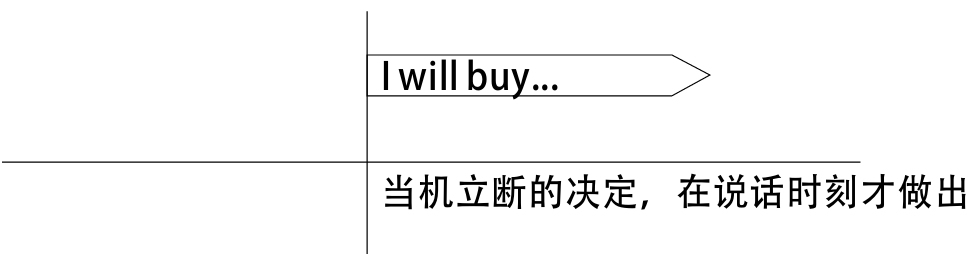
24 Husband: There isn't any milk left in the fridge.
Wife: I'm going to buy some after work.
妙语点睛 用am going to,表明这是预先计划好的决定。意指她先发现没有牛奶,并已经决定去买牛奶,然后她丈夫才发现。如图所示:
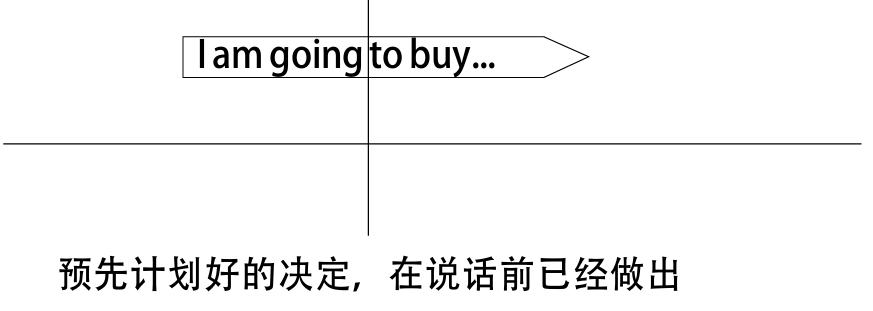
下面的每一句话都含有“预先准备”的明显证据,故都不能用will代替be going to:
25 I have bought a computer and I'm going to learn the computer science.
26 My wife has bought some wool and she is going to knit a sweater for me.
27 A: Why are you taking the camera?
B: I'm going to take some pictures.
下面每一句中的B都表示事先不知道,而是在说话的时候做出的决定,故都不能用be going to代替will:
28 A: Someone is knocking at the door.
B: I'll go and open it.
29 A: The box is too heavy.
B: I'll help you to carry it.
30 A: I've left my watch upstairs.
B: I'll get it for you.
31 A: I am thirsty.
B: I will make you a hot cup of tea.
思维总结
当机立断的决定,我们只能用will来表达,一般表示说话人事先并不知道,而是随着谈话的进展,在得知了新的信息之后才做出的某个决定。这不是在“预测”,也不是在“预先计划”。
到这里,我们讨论完了will和be going to的意义和用法。现比较总结如下:

不论是will还是be going to ,在表示“预测”时,都是说话人做出的预测(the speaker's prediction),而不是句子的主语做出的预测,因而对句子的主语没有特殊的要求,句子的主语可以是人称或非人称。而be going to的“计划打算”和will的“意愿”的用法则都是句子的主语做出的,又因为只有人才会“计划打算”以及表达“意愿”,所以,此时句子的主语必须是人称。
一、用will或be going to的适当形式完成下列对话。
1. A: Have you made any vacation plans?
B: Well, I've decided on one thing—I __________ go camping.
A: That's great! For how long?
B: I __________ be away for a week. I only have five days of vacation.
A: So, when are you leaving?
B: I'm not sure. I __________ probably leave around the end of May.
A: And where __________ you __________ go?
B: I haven't thought about that yet. I guess I __________ go to one of the national parks.
A: That sounds like fun.
B: Yeah. Maybe I __________ go hiking and do some fishing.
A: __________ you __________ rent a camper?
B: I'm not sure. Actually, I probably __________ rent a camper—it's too expensive.
A: __________ you __________ go with anyone?
B: No. I need some time alone. I __________ travel by myself.
二、比较下列对话中B的不同回答方式的含义区别。
2. A: The seller hasn't received the documents.
B: I'll send them.
B: I'm sending them next week.
B: I'm going to send them next week.
7.4.5 现在进行时表示将来
现在进行时可以表示对最近的将来做出计划或安排(definite future plans)。下面的例句都是表示将来确定的安排,所以都要用现在进行时:
1 A: The summer holidays are coming soon, Jack. What are your plans?
B: Well, Mike, I am taking my girlfriend to Qingdao. She is a beach person, you know.
2 I am flying to Beijing next Monday.(表示机票已买好) 我下周一要飞往北京。
3 I am taking a makeup test tomorrow.(表示学校已安排好明天的补考) 我明天要参加一次补考。
4 We are meeting the supplier on Tuesday. 我们周二要见那个供货商。
请读者再看下面笑话中的进行时态,都是表示将来的动作:
5 A: We're sending our son to a holiday camp next week.
B: Oh! Does he need a holiday?
A: No, but we do!
6 A: I hear you're moving to London next week.
B: Yes, I have to because of my job.
A: Are you working for the same people?
B: Yes—my wife and our six kids!
7 A: What are you giving your baby brother for Christmas this year?
B: I don't know.
A: What did you give him last year?
B: Measles, I think.
8 A: We're advertising for a new cashier in next week's Morning Post.
B: But you hired a new cashier last week!
A: I know, but he isn't honest.
B: But you can't judge people by their appearance.
A: I'm not. I'm judging him by his disappearance!
用现在进行时表示将来的动作要注意以下几点:
一、必须带有表示将来的时间状语
用现在进行时表示将来的动作,动作发生的时间必须指出或在前文中已经指出,否则就可能会造成现在进行动作与一般将来动作相混淆。
9 A: What are you doing next Sunday?
B: I'm not going out. I'm staying at home.
妙语点睛 B的回答中虽然没有出现具体的将来时间,但因为将来时间next Sunday在上文中已给出,所以B中的现在进行时态是表示将来。
二、必须是人称主语
现在进行时表将来的这种用法,通常是表示说话人已计划安排好的活动,如果不是,则不能这样用。例如不能说:
It's raining tomorrow. *
因为像rain, snow或storm等这样的活动是人们无法事先计划好的。
三、与一般现在时表示将来的区别
1. 一般现在时要比现在进行时听起来更正式,个人主观色彩要淡些。请比较:
10 1) I am leaving tonight.
2) I leave tonight.
妙语点睛 在例句1)中,进行时态表达的个人主观色彩要浓些,一般含有“我自己决定今晚走”的意味。在例句2)中,一般时态更加客观,比如可能是“公司安排了我出差,给我安排的是今晚动身”。
所以说“Our shop opens next week.”比“Our shop is opening next week.”要好,显得更正式。
2. 如果是一系列预定的将来的安排,比如旅游行程安排,用进行时态显得较累赘,而用一般时态则较简洁。比如:
11 We leave Beijing at 9: 00 tomorrow morning, arrive in Kunming around 12: 00 and then we tour the World Horti-Expo Garden. 我们明天上午9点离开北京,大约12点左右抵达昆明,然后就参观世博园。
四、用be going to表示计划与进行时态表示计划的区别
总的来说,be doing表达的将来计划要比be going to的计划更确定(more definite)。请比较下面的例句:
12 1) I'm taking my holiday in April.
2) I'm going to take my holiday in April.
妙语点睛 在这个场景中,am taking表示比am going to take更确定的将来计划,可以这样来解释:
在例句1)中,说话人已经得到公司批准的假期了(Approval has already been given.)或已经和旅行社订好了行程。所以,我们可以把它译成比较确定的汉语,比如“我四月份要休假了”。在例句2)中,说话人只是表达自己的一个打算或想法意图(intention),但目前并没有得到公司的准假,更没有和旅行社订好行程。这句话相当于汉语说“我打算四月份休假”,这就没有“我四月份要休假了”听起来确定。
我们可以想象这样的一个场景:你在和公司老板商量你的年假安排,这时,你应该是以商量的口吻和老板说“I'm going to take my holiday in April.”,而不应该是很明确地、自作主张地告诉老板你已做出的决定“I'm taking my holiday in April.”。然而,你可以和你家人或朋友说“I'm taking my holiday in April.”。
我们还可以为上面这两个句子提供一个更大的语境。比如:
13 I'm going to take my holiday in April, although I have not yet had my boss's approval.
上面这句话就要比这么说:
I'm taking my holiday in April, although I have not had my boss's approval.
听起来更为自然。后者有你非要和老板对着干的意思。
再比较下列例句:
14 1) I'm flying to Shanghai next Monday.
2) I'm going to fly to Shanghai next Monday.
妙语点睛 同样,例句1)听起来比例句2)的计划更确定。比如在例句1)中,表示“我现已买好机票”,“周一飞往上海”将是确定无疑的。而例句2)只是表明你将来的一个打算,比如你在和航空公司订机票时,对方问你要什么时候的机票,你告诉对方说“I'm going to fly to Shanghai next Monday.”(我打算下周一飞往上海。)
两种将来的表达之所以有上述确定程度(degree of certainty)方面的差别,原因可能还在于这两个时态本身。进行时态be doing给人的感觉是事情马上就要发生了,因而应该是确定无疑的;而be going to因为有表示“将来预测”的意味,这就给它带来了不确定性。
所以,我们看到,be doing往往表示将来的活动是确定好的计划,是你工作安排的一部分,已做出决定,并已写入你的时间安排表中了(You use this tense if the action is part of a schedule or it's a definite plan. Use it when you have already made a decision, and have “put it in your diary”.)相比较而言,be going to do更多的是表达一种不确定的未来计划,或者说是一种个人的意图或打算,不过这听起来要比hope to do和would like to do要更为确定些(When we talk about things in the future that are not definite, we use “am going to+verb”. This is more certain than expressions like “hope to...”, “might...” or “would like to...”.)。综合上述,用be doing谈将来的计划往往比be going to do更确定。
另外,相关内容读者可以参见8.2.5小节。
7.4.6 一般现在时表示将来
详见7.2.5小节,在此不再赘述。仅举下面几个例子。请看下面三个笑话:
1 A boy was up an apple tree stealing apples. A policeman came along and caught him. He looked up at the boy in the tree and said, “When are you coming down, young man?” “When you go away!” replied the boy.
妙语点睛 这里when are you coming down中的现在进行时态是表示将来的动作。第二个句子when you go away中的一般现在时态是表示将来的动作,即前面讲过的,在when引导的时间状语从句中,要用一般现在时代替将来时。
2 A: I begin to work at the Swan Laundry on Monday.
B: That's wonderful! But tell me, how do you wash a swan?
妙语点睛 这里的一般现在时begin表示将来的动作,句中的on Monday是表示将来的时间。
3 A: My daughter gets married at three o'clock in St. Mary's Church on Saturday.
B: How do you feel about it?
A: Well, I'm losing a daughter but I am gaining a telephone!
妙语点睛 这里的一般现在时态gets married是表示将来的动作,表示时间表上的安排,所以下文给出了确切的时间at three o'clock...on Saturday。另外,进行时态I'm losing...am gaining...是表示将来的动作。
7.4.7 其他表示将来的句型结构
一、be to do
1. 表示已安排好要在将来发生的事,是比较正式的用法
请看例句:
1 They are to go on a strike on July 8th. 他们定于7月8日举行罢工。
2 She is to be married next month. 她预定在下个月结婚。
3 The Premier is to visit Australia next month. 总理将在下个月对澳大利亚进行访问。
2. 表示强烈的命令,相当于must, should,如:父母对孩子、上级对下级或法律条文中的规定等
请看例句:
4 You are to finish your homework before you go to play. 你出去玩之前一定要把作业完成了。
5 The form is to be filled out in ink and returned this week. 该表格须用钢笔填写,并于本周交回。
6 These tablets are not to be taken orally. 这些药片禁止口服。
7 The parties involved are to sign the agreement. 有关当事人一定得签署协议。
8 If it doesn't rain within the next few weeks, the crops will have to be watered if they are to survive.
以后的几个星期如果还不下雨,则须对庄稼进行灌溉,以便庄稼能够存活。
9 If he's to succeed in his new profession, he must try harder. 他如果想获得新事业上的成功,就必须更加努力。
二、be about to do
这一结构用来表示即将发生的动作(比如通常在5分钟之内就会发生),意思是“正要,马上就要”。请看例句:
10 The train is about to leave. 火车马上就要开了。
11 Jack is holding a fly swatter and staring at a fly on the kitchen table. He is about to swat the fly.
杰克手里正拿着苍蝇拍,眼睛盯着厨房桌上的一只苍蝇。他正要拍这只苍蝇。
12 Sally has her hand on the doorknob. She is about to open the door. 萨莉握住门把手,正要开门。
三、be on the point/verge/brink/eve of doing
这一结构与be about to do的意思差不多,但其动作发生的时间比be about to do还要快一些。请看例句:
13 He was on the point of killing himself when she stepped into his room. 她走进房间时,看见他正要自杀。
14 The child was on the verge of laughing, but he held back. 这孩子差一点笑出声来,但还是忍住了。
一、判断下列各句黑体部分的谓语时态的含义。
1. I’ll do whatever I can to help.
2. I’ll give you a lift if you like.
3. The agreement will expire in 8 months' time.
4. Commodity market analysts think that the price of rubber will keep on rising.
5. She says she’s going to apply for the new job.
6. I’m having lunch with Janice tomorrow.
7. We’re going to become the world's leading forwarding company.
8. The train leaves at 6 pm.
9. A: What are you going to do during the summer break?
B: I'm not sure what I’ll do. I hope to watch TV and enjoy myself. That's what I want to do, but I think my parents will make me study. What do you intend to do?
A: I’m going to visit my grandparents in Beijing. I’m going to stay with them for about 4 weeks.
B: I love the summer break, but I think it's too short!
10. A: Today is the sports meet. I’ll be in a relay. I'm so nervous!
B: Why are you nervous?
A: I don't want to do badly and let my teammates down.
B: Oh, I think you’ll do a great job. Don't worry. You've practiced hard for the race, and I think you can win. I’ll be there to cheer you on.
11. A: I hear Mary isn't getting much support in her running against Steve in the election.
B: It is not over yet. I think she will make a come back.
12. A: Look at the time. I’m going to miss my bus.
B: Don't worry. I’ll drive you to the stop. And if the bus has already left, I can get you to your apartment.
二、阅读下面的幽默对话,并判断其中黑体部分的谓语时态的含义。
13. A: Darling, I want to see the world!
B: I’ll give you an atlas (地图集)for your next birthday, then.
14. A: I am going to buy one of those small Japanese radios.
B: But how will you understand what they are saying?
15. A: Waiter, there's only one piece of meat on my plate.
B: Just wait a minute, sir, and I’ll cut it in two.
16. A motorist ran over an old lady's cat and killed it.
“I'm very sorry,” said the motorist. “I’ll replace your cat, of course.”
“Very well, but I hope you're good at catching mice.”
17. A: What are you doing with that gun?
B: I am going to shoot you.
A: Why?
B: Because you look like me.
A: I look like you?
B: Yes.
A: Then shoot me!
18. A: How old are you now, Billy?
B: Seven.
A: And what are you going to do when you are big like your mother?
B: Stop eating chocolate!
19. “Mummy, mummy! Where are you?” cried a little boy at the beach.
“You poor boy,” said an old woman. “Come with me and I’ll get you an ice cream and then we’ll go and look for your mummy.”
“I know where your mother is,” said a small girl. “She's sitting...”
“Be quiet,” said the boy. “I know as well, but this way I get a free ice cream!”
20. A: I have some good news for you and some bad news.
B: Tell me the bad news first, doctor.
A: I am going to amputate your legs.
B: And what is the good news?
A: The man in the next bed wants to buy your shoes.
21. “The British are planning to travel to the sun in a rocket next year,” said a British scientist.
“But,” said an American scientist, “as you get near the sun the heat will melt the rocket.”
“We are not stupid,” said the British scientist. “We are going to travel at night.”
22. A: Waiter, will my pizza be long?
B: No, I expect it will be round as usual.
23. A: Tomorrow my name will be up in lights in every cinema in the country.
B: How are you going to do that?
A: Easy. I'm changing my name to Emergency Exit.
24. Two fish were swimming together in a river.
“Look,” said the first one. “It's starting to rain.”
“Quick. Let's swim under the bridge,” said the second fish, “or we’ll get wet.”
25. A: The television will never replace the newspaper.
B: Why?
A: Because you can't swat a fly with a television.
三、用适当的将来时态形式填空。
26. A: This letter is in French, and I don't speak a word of French. Can you help me?
B: Sure. I ______(translate) it for you.
27. A: It's cold in here.
B: I agree. I ______(turn) the heater on.
A: That's a good idea.
28. A: Clint is in hospital.
B: Oh really? I didn't know. I ______(go) and visit him.
B: Yes, I know. I've bought some flowers and I ______(visit) him this afternoon.
29. A: Do you mind if I turn the TV off? I ______(make) a long distance call, and it's hard to hear if the TV is on.
B: No, that's fine. I wasn't watching it anyway.
30. A: Why do you have an eraser in your hand?
B: I ______(erase) the board.
31. A: The ceiling in this room doesn't look very safe, does it?
B: No, it looks as if it ______(fall) down.
32. A: Did you post that letter for me?
B: Oh, I'm sorry. I completely forgot. I ______(do) it now.
33. A: Where are you going? Are you going shopping?
B: Yes, I ______(buy) something for my breakfast.
34. A: Why are you filling that bucket with water?
B: I ______(wash) my car.
35. A: I've got a headache.
B: Have you? Wait here and I ______(get) an aspirin for you.
36. John: Would you call a taxi to take me to the airport, Joe?
Joe: Call a taxi? I ______(take) you myself. What time is your flight?
John: 8 o'clock this evening.
Joe: Ok, we ______(leave) at about 6 o'clock.
Later that day, Ann offers to take John to the airport.
Ann: Do you want me to take you to the airport, John?
John: No, thanks. Joe ______(take) me there.
四、用will或be going to的适当形式完成下列对话。
37. Dave: So, Stella, do you have any vacation plans?
Stella: Well, I ______ paint my apartment. The walls are a really ugly color. What about you? Are you going to do anything special?
Dave: I ______ rent a car and take a long drive.
Stella: Where are you going to go?
Dave: I'm not sure. I ______ probably visit my sister Joanne. I haven't seen her in a long time.
Stella: That sounds nice. I always like to visit my family.
Dave: Yes, and maybe I ______ go to the mountains for a few days. I haven't been hiking in months. How about you? Are you going to do anything else on your vacation?
Stella: I ______ probably catch up on my studying. I have a lot of work to do before school starts.
Dave: That doesn't sound like much fun.
Stella: Oh, I am planning to have some fun. I ______ relax on the beach. I love to swim.
写给读者的话
一、本章学习思路
一般时态是英语学习者最早接触到的英文时态,看似简单,其实不然。一般时态包括一般现在时、一般过去时以及一般将来时。正如在前面7.1.1小节中说过的,一般时态只有“时”的变化,没有“体”的变化,是“零”体态动作,所以这三个时态之间没有共同的“体态”特征,因而各自用法比较独立,联系不大。因此,读者在学习本章时,不需要对三个时态进行横向比较,而只需要掌握三个时态的各自意义和用法即可。
二、本章重点及难点
重点要掌握下列频繁使用的时态含义:
1. 对于一般现在时态:
1)表示不受时间限制的科学事实、客观真理、谚语格言,常用于概括、结论、观点等(见7.2.1小节)。
2)表示经常发生的活动,常用来谈论日常生活习惯(见7.2.2小节)。
2. 对于一般过去时态:
这是最容易被中国学生忽略的一个时态,尤其是在口语中。因此,对于一般过去时,最关键的是要真正能够根据上下文语境灵活使用(见7.3.8小节)。比如下面常见的口语语境中的一般过去时用法:
1)“我不知道”——“I don't know” or “I didn't know”? (见7.3.5小节)
2)“我忘记了”——“I forget” or “I forgot”?(见7.3.6小节)
3)“我以为”——“I think” or “I thought”?(见7.3.7小节)
此外,要掌握一般过去时的两个基本用法:
1)过去发生的短暂动作或状态(见7.3.2小节)。
2)过去发生的重复或延续活动(见7.3.3小节)。
最后,要求读者要能够分辨一般过去时和现在完成时用于“for+时间段”的区别(见7.3.4小节)。
3. 对于一般将来时态:
重点是搞清楚will与be going to 的用法区别,即掌握下面三节内容:
1) will表示将来——预测(见7.4.2小节)。
2) be going to 表示将来——预测(见7.4.3小节)。
3) be going to表示“计划”与will表示“愿意”(见7.4.4小节)。
此外还要求掌握在口语中常用现在进行时表示将来(见7.4.5小节)。
最后,建议读者了解一下7.1节的内容。
三、本章学习时间安排
建议读者用10天左右的时间来研读本章内容,并做完所有的练习。
一、用适当的时态形式填空。
1. A: Nobody told me that Bill was in the hospital.
B: Sorry. I ______(mean) to give you a call when I ______(find) out but it ______(slip) my mind.
2. A: Do you know if George is coming to the meeting?
B: Oh, no. I ______(be) supposed to tell you that he is sick and can't come.
3. A: I thought you said you were going to call me last week about that car I'm selling.
B: Oh, I'm so sorry. It completely ______(slip) my mind.
4. I'm sorry, Cathy. Just one more thing. I ______(forget) to ask you if you could give me a ride to school tomorrow.
5. I almost ______(think) you ______(be) someone else with that short haircut.
6. A: Look, I'm sorry to bother you about this, but that music's really loud.
B: I ______(not, realize) you could hear it.
7. A: Oh, no! I've spilled coffee on my shirt.
B: Just a minute. I ______(get) a damp cloth for you.
8. I ______(be) ready to confront him but when I saw how big he was, I ______(get) cold feet.
9. I ______(jog) every morning for the past two years.
10. A: Have you decided what to do during the summer break?
B: Oh, yes. Everything is planned. I ______(take) a holiday for a few weeks and then I ______(take) a grammar course in New Oriental School.
11. A: Do you want to go shopping with me? I ______(go) to the shopping mall downtown.
B: Sure. What time do you want to leave?
12. A: Oh. I've just realized. I haven't got any money.
B: Haven't you? Well, don't worry. I ______(lend) you some.
13. A: I've decided to repaint the room.
B: Oh, have you? What color ______ you ______(paint) it?
14. A: This composition class ______(not, be) supposed to be hard.
B: But it sure turned out to be, didn't it?
15. A: What would you like to buy, Sir?
B: I am going to buy a T-shirt for myself.
A: What do you think of this white one?
B: Oh, good! That's just what I want. I ______(take) it.
16. A: Which color ______ you ______(prefer), red or blue?
B: I ______(like) blue better than red. Why?
A: According to this magazine article I am reading right now, people who ______(prefer) blue to red ______(be) calm and ______(value) honesty and loyalty in their friends. A preference for the color red ______(mean) that a person ______(be) aggressive and ______(love) excitement.
B: Oh? That ______(sound) like a bunch of nonsense to me.
17. On April 14, 1912, the “unsinkable” luxury ship Titanic ______(hit) an iceberg and ______(sink) to the bottom of the sea. Its final resting place ______(remain) a mystery for 70 years. You probably already ______(know) that tragic story. But ______ you ______(know) the whole story? Do you know who finally ______(discover) the wreck of the Titanic?
二、把下列中文句子译成英文。
18. 我就知道你能得到这份工作。恭喜了!
19. 我就知道你会考得很好。干得漂亮!
20. 那是个星期天,而我在星期天是从不早起的,有时还会在床上一直躺到吃午饭时间。上个星期天我就起得很晚。
21. A: 我本来打算下学期上日语课——but now it's been cut.
B: I hear the university's going to double the tuition, too.
22. A: 我以为萨姆病了。
B: 我也是。But he seems to have recovered very quickly. He certainly doesn't seem to be sick now.
23. 我弟弟每天上网,他要花大量的时间浏览许多不同的网站。