名词
1 浅谈英语名词的“单、复数”
1 浅谈英语名词的“单、复数”
只要学过一点英语的人,都知道英语名词和汉语名词不同,前者有所谓“单、复数”,后者似乎没有“单、复数”。其实,这种说法是不够确切的。“单、复数”指什么而言呢? 指单、复数概念呢? 还是指单、复数形式呢? 二者是一回事吗? 单、复数形式也就是单、复数概念吗? 这些问题,在词典里,在教学中,几乎都没有解决。
应该指出,“单、复数”这一说法是该澄清的时候了。它说明不了什么,它太笼统了。譬如: news(消息)是单数还是复数呢?crossroads(十字路口)是单数还是复数呢? goods(货物)是单数还是复数呢?
因此,我们认为不论在辞书中,或是在文章中,或是在教学中,不应再笼统地说“单、复数” 了,除非有言在先,明确说明自己所用的“单、复数”是指名词的单、复数形式,或是指名词的单、复数概念。
为什么要把名词的数的形式与概念区别开来呢? 理由很简单: 因为它们不是一回事。你可能会反问道: 为什么不是一回事呢? 难道book, pen, pencil不是既具有单数形式又具有单数概念, books, pens, pencils不是既具有复数形式又具有复数概念吗?
要回答这些问题,首先必须把名词的数的形式(以下简称数形)与名词的数的概念(以下简称数念)这两个范畴的含义搞清楚。
什么是数形呢? 数形专指名词的数的形式而言。英语里有两种数形,即单形与复形,如:
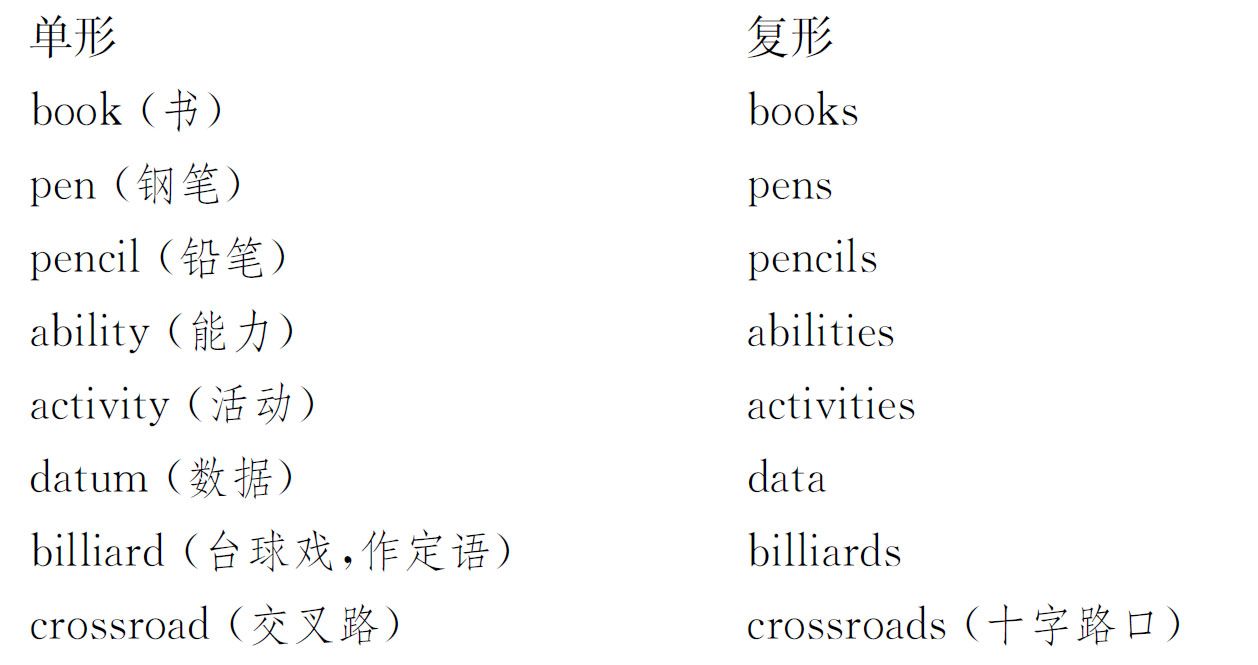
还有一些名词的单形与复形相同(有人把它们叫做通形名词),如:Chinese(中国人),Japanese(日本人),Butchers(人名),Parsons(人名),deer(鹿),sheep(羊),swine(猪),aircraft(飞机),species(类属),horsepower(马力)等。
什么是数念呢? 数念乃指名词所表的数的概念或意念或意义而言。英语里有三种数念, 即单念、复念与零念。
单念表“一个”、“一种”、“一部分”、“一阵”等,如:one mile(一英里), a book(一 本书), a disease(一种疾病), a smoke(抽一根烟, 指动作), a knowledge(一种知识), a works(一个工厂), a crossroads(一个十字路口), the movies(电影院), the woods(那个树林)等。
复念表“多个”、“多种”、“多量”等,如: three miles(三英里), many books(许多书), all attempts(一切企图), several fortunes(几笔财产), waters(大片的水), goods (货物), family(家庭成员), team(球队队员), committee(委员会的委员们), day and night(日日夜夜)等。
零念表“无单复念”,如: water(水), news(消息), honesty(诚实), music(音乐), carefulness(小心), billiards(台球戏), draughts(西洋跳棋), nerves(神经紧张), manners(礼貌), oats(燕麦), measles(麻疹)等。
从以上单词可以看出,表单念的除单形名词外,还有复形名词works, crossroads, movies 和woods等。表复念的除复形名词外,还有单形名词family, team, committee等。表零念的既有单形名词,又有复形名词。
上面谈的大都是单词。如果从句法的角度来看,数形与数念的区别就更加有趣了。先看一些单形名词表复念的情况吧:
(1)Are you a member of a book club?
你参加读书俱乐部了吗?(单形名词book在此表复念)
(2)During the car race, the leading car skidded and overturned.
在汽车大赛中,那辆领先的汽车打滑翻倒了。
(第一个单形名词car在此有复念)
(3)Can man be free if woman is a slave?
女人若是奴隶,男人难道会自由吗?
(man与woman两个单形名词皆表复念)
(4)The whole house laughed.
剧场的观众都笑了。(单形名词house在此指观众,故表复念)
(5)Oak and beech began to take the place of willow and elm.
橡树与山毛榉开始代替了柳树与榆树。(这里的四种树都有复念)
再请看一些复形名词表单念和零念的情况:
(6)Paul is friends with Bill.
保罗和比尔很要好。( 复形名词friends在此相当于形容词,表零念)
(7)He's just small potatoes.
他不过是个无足轻重的人物。(small potatoes 相当于形容词,表零念)
(8)Billiards is a very interesting game.
台球是一种很有趣的游戏。(复形名词billiards表零念)
(9)The barracks is quite new.
这营房相当新呢。(复形名词barracks表单念)
(10)The steps form a landing stairs from the river.
那些踏级构成了上岸的台阶。(复形名词stairs表单念)
由此可见,名词数的形式与数的概念的的确确是两码事,不是一码事。而我们常听到看到的笼统而言之的“单、复数”委实应代之以“单、复形”或“单、复念”了,不是吗?
2 浅谈英语名词的可数性
笔者曾浅谈过英语名词的数形与数念的问题。本文则想谈一谈一个与名词的数形与数念十分密切相关的问题——名词的可数性问题。
名词的可数性问题也就是名词“可数”与“不可数”的问题。这个问题,和名词的“单、复数”一样,也常使中国学生感到困惑。许多词典和语法书都似乎未为之做过系统而详尽的论述。这篇短文自然也做不到这一点,但却想试图澄清一些有关概念的问题。
我们认为,名词之所谓“可数”,应严格意谓: 可被基数词one或more than one或与它们相当的词所修饰;名词之所谓“不可数”,亦应严格意谓: 不可被基数词one或more than one或与它们相当的词所修饰。事实上,这也是一般英语词典对“可数”(countable)与“不可数”(uncountable)所下的定义。如one horse中的horse与two horses中的horses,皆属可数;water与music则不可数。
然而,名词之是否可数,不应单从词法的观点去看,还应从句法的观点去看。换言之,名词的可数性,不单单是一个词法问题,而且也是一个句法问题。试再以horse一词为例:
(1)He is on a horse.
(2)He takes pride in his horses.
上述两例中的horse与horses显然都是可数的,但请看:
(3)The horse is a useful animal.
(4)Horses are useful animals.
这两句中的horse与horses并不是“一匹马”和“许多马”的意思,所以就是不可数的了。
如果上述两个论点能成立的话,那么,我们就可以澄清下面几个经常遇到的问题:
1.一些著名的英语学习词典不是将名词划分为“可数名词”与“不可数名词”吗? 这些词典不是明明将horse标为“可数”吗? 是的,它们这样做是完全从词法角度看问题的结果。事实上,许多像horse这样的名词,既可用作可数名词,也可用作不可数名词。上述(1)、(2)、(3)、(4)诸例就是很好的证明。
2.上述例(3)中的horse不是有单数概念吗? 例(4)中的horses不是有复数概念吗? 怎么能说它们是不可数呢? 这是把数念与可数性混为一谈了。是的,例(3)中的the horse确有单念,例(4)中的horses也确有复念,但它们并不意味着可数。这里的单念与复念的含义是什么呢? 我们认为应该把the horse的单念看作表“马类”或“马这一类”,把horses的复念看作表“各种各样的马”,但皆不可数。
3.许多英语词典和语法书将冠以不定冠词a(n)的名词一律看作可数名词对不对呢? 不完全对。这种看法是将单数概念与可数性混淆了。当然,冠以a(n)的名词往往确是可数,但这种说法只能在a(n)等于或近似于基数词one的条件下才站得住,如:
“He bought a car.”中的car,确是既表单念,又为可数,但在“She looked at him with a glare.”中的名词glare尽管有单数概念,却不能说是可数的了。再如名词living(生计), 亦不可数,但也可与不定冠词a连用,如make a living,而它也被词典看作可数了。其实,这种冠以a(n)而不可数的名词为数并不少,如a rest,
4.有一些复形名词,如attentions(殷勤),fetters(枷锁),fidgets(烦躁),folks(家人),oats(燕麦),provinces(地方, 与首都相对),returns(盈利),remains(尸体),rigours(严厉), 甚至measles(麻疹)等, 被许多词典或标之以“复数”,或标之以“可数”,这是为什么呢? 难道它们真的可数吗? 为什么不把它们标为“不可数”呢? 上述复形名词一般都不可数。其中有一些也有被某些词典明确标为“不可数”的,如measles与rigours等。但多数词典确是都标之以“复数”甚至“可数”。这样做的原因可能有很多,但其中一个重要原因就是将名词的复数概念与名词的可数性混淆了。有的英语词典明确解释说,所谓“复数”就是须用复形动词之意。但这只能说明上述复形名词确有复念,并不能说明它们是可数的。所以,比较全面的看法应该是: 上述复形名词虽多有复念(measles并无复念,oats有时亦无复念),但一般都不可数。
关于名词的可数性,对学习英语的中国人来说,还有下列几点值得注意:
1.我们一般都认为被many和these这两个词所修饰的名词是可数的,其实这两个词有时亦可修饰少数不可数名词,如many goods(许多货物)与these vermin(这些害虫)等。
2.有些名词虽然可以和基数词连用,但只限于十、百、千等整数。如我们可以说twenty cattle,或five hundred cattle,或three thousand cattle, 但一般不说two cattle或three cattle,应该说two head of cattle或three head of cattle。其他类似cattle的群体名词也大都如此。
3.我们常说a thousand thanks或a thousand pities,但这里的数词a thousand只是一种强调语气的手段,并不说明它所修饰的thanks和pities是可数名词。
4.在名词的可数性上,英语与汉语并不完全一致,例如duty, sleep, jelly(果冻)在英语里可用作可数名词,可以说three duties, one of those sleeps, twenty jellies,而在汉语里它们给人的印象则往往是不可数的。反之,汉语里的“肥皂”、“烤面包”、“设备”是可数的,而在英语里soap, toast和 equipment则一般是不可数的。两种语言之间这种可数性不一致的情况还有不少,需要我们一一牢记。
最后必须申明,英语名词的可数与不可数不是绝对的,而是相对的。如名词sky一般是不可数的,但在特殊情况下则可用作可数名词,如有一位英国作家写过这样的句子:
(5)We've got to live, no matter how many skies have fallen.
3 有关名词单、复数的用法问题
有一读者问道: 名词的单、复数是个令人捉摸不定的问题,如下列词句中的名词为何用复数而不用单数:
(1)Admissions Department
(2)suggestions box
(3)an awards ceremony
(4)They will never be intimidated by war threats.
(5)He has no objections to the plan.
(6)This event was an important part of the celebrations.
英语名词的数,对中国学生来说,的确是一个难点。现将这一问题分三点试答如下:
1.关于复数名词用作定语问题,语法上并无一定规则可循,往往需要个别牢记。总的说来,用单数名词作定语的情况仍较普遍,但在当代英语中,似乎有逐渐采用复数名词作定语的趋势。用复数名词作定语有时是必需的,如:
(7)an alms-house
(8)a goods train
(9)arms race
(10)a savings-bank
有时则为了具体明确,避免歧义,如上述例(1)、(2)、(3)。
此外,正式英语似乎常用复数名词作定语,如:
(11)the Contagious Diseases Act
(12)the Diplomatic Services Bureau
(13)the Highways Committee
(14)the Samples Depot (但必须说a sample room)
用作定语的复数名词也常见于结构松散的复合词中, 如:
(15)the cigars bill
(16)the equal terms policy
(17)the grasslands deal
(18)some critical materials shortage
应该指出,有些复合词用单形或复形皆可,如:
(19)student(s)group
英、美习惯有时也不一样,如:
(20)a brains trust (多用于英国)
(21)a brain trust (多用于美国)
2.上述例(4)、(5)中的war threats与objections皆系泛指,有复念,但不强调其可数性(故不可译作“许多”或“一些”)。这种表泛指的复数名词为数甚多,这里仅举一二例如下:
(22)He likes reading books. (books泛指“书”)
(23)Horses are useful animals. (horses与animals泛指“马”和“动物”)
3.上述例(6)中的the celebrations专指一些多种多样的具体活动,有复念,也不强调可数性。复数名词的这种用法也很普遍,再如:
(24)I enjoyed my travels in Europe.
4 作定语的名词的单、复形问题
有人问到为什么用作定语的名词有的是单数,如:
(1)language teachers
(2)room numbers
(3)tooth-brushes
有的则用复数,如:
(4)mathematics students
(5)men servants
(6)women doctors
首先应该指出,用作定语的名词与中心词(即被定语所修饰的名词)没有数的一致问题,我们既可以说language teachers,也可以说a language teacher。换言之,用作定语的名词的数与中心词的数没有相互关系。
那么,为什么有的“定语名词”用单数而有的“定语名词”却用复数呢? 这牵涉到一个历史发展的问题。本来名词如是单形,用作定语时亦应用单形,现在大多数情况仍是如此,如上述例(1)、(2)、(3)。再如:
(7)a coal mine
(8)reference books
(9)school children
(10)a train ticket
(11)a village teacher
(12)book shelves
(13)apple trees
(14)stamp collecting
名词如是复形,用作定语时亦应用复形,如上述例(4),再如:
(15)electronics industry
(16)a goods train
(17)the works manager
(18)arms race
(19)a customs officer
(20)a savings-bank
但当今有一种用复形名词作定语的趋势,这就需要我们个别牢记了,如:
(21)sports page
(22)a brains trust (美国英语用单形brain)
(23)a games period
(24)parcels post
(25)students groups (亦可用单形student)
关于上述例(5)、(6)中的men servants与women doctors,则是属于一种由单形变复形的情况。这里之所以用men和women,简言之,是因为这两个复形名词不以-s结尾因而不会被误会为's的缘故。如果复形名词以-s结尾,如ladies,即不可用作定语,否则在口语中就有被误会成ladies'的危险。
5 一些单、复形名词之比较
有一读者要求对名词的单、复形举例进行一番比较,现在我们举一些比较有趣的例子如下:
(1)After breakfast the baby had egg all over his face. (a)
Don't boil the eggs hard. (b)
(a)句中的单形名词 egg 意谓鸡蛋中的蛋黄与蛋白,不可数,是物质名词。(b)句中的复形名词eggs 则是类名词,可数。
(2)He has no ears for slander or gossip. (a)
He has no ear for music. (b)
这里ear 的单、复形皆用在固定词组之中,不可更易。 (a)中的ears 用于比喻,has no ears for 意谓“拒绝听 (没有听的兴趣)”或“不屑于听”。(b)中的ear 是抽象名词,不可数,意谓“听力”或“欣赏力”。
(3)Ostriches bury their head in the sand. (a)
The ostriches buried their heads in the sand. (b)
(a)句用单形名词 head 是因为主语ostriches 泛指一类事物。 (b)句的the ostriches 是特指,故用复形heads, 指那些驼鸟们各自的头。有的语法家说,复形物主代词 (our, their 等)后的可数名词一般应用复数形式,如属人或动物身体的各个部分,更应如此。
(4)She has grey hairs . (a)
She has grey hair .(b)
单形hair 指头发的总体,有集体概念,不可数,故(b)句的意思是:她已满头白发。复形 haris 指一根根可数的头发,所以(a)句的意思是:她有白头发了。你看,hairs 是复数形式,其所代表的头发反而少于单数形式hair!
(5)It is only in the wisdom of middle age that we lose heart . (a)
In youth we lose our hearts .(b)
(a)句中的lose heart 是一个固定词组,意谓灰心丧气。单形heart 在此是不可数抽象名词,其意等于courage。全句的意思是:我们只有在中年的智虑中才会灰心。(b)句中的复形名词 hearts 是一种比喻用法,具体可数,故前面须用物主代词our。全句的意思是:在青年时代我们则会倾心于人。
(6)Their married life was a singularly happy one. (a)
Their married lives were led under totally different circumstances. (b)
(a)句中的单形life 指一对夫妻的共同生活。(b)句的复形lives 指不同人的各自结婚生活。
(7)Movement 's painful when one's hurt one's back. (a)
He is very old, and his movements are getting slower and slower. (b)
这两个句子中的单形movement 与复形movements 皆指一个人的活动或动作。但(a)句中的单形不可数,是“活动”的总称。 (b)句中的复形可数,指一个个具体的动作。
(8)He had nerve but no nerves .
句中的nerve 与nerves 皆不可数,但意义不同。单形nerve 在此意谓“胆量、勇气”,复形nerves 则意谓“神经紧张”。
(9)We sleep at night . (a)
I can't sleep at nights . (b)
(a)句中的 night 不可数,是“夜”的总称。 (b)句中的 nights 可数,有复数概念,在此有“数夜”或“许多夜”含义。全句可译为:我夜里经常睡不着。 (a)句是说我们的习惯,(b)句是讲一种暂时情况或病症。
(10)The police have worked out a plan to catch the thief. (a)
Have you made any plans for your holidays? (b)
(a)句中的单形plan指一种经过深思熟虑的方法或想法。 (b)句中的复形plans 则强调具体打算或一项项安排。
(11)1 centimetre=0.3937 inch . (a)
1 centimetre =0.3937 inches . (b)
一般语法书多告诉我们,可数名词与小于1的数词连用时(即被小于1的数词所修饰时),该名词须用单形,如(a)句中的inch, 但事实上不尽如此。在正式英语中,这种名词的确应用单数形式,但在口语中则多用复数形式,如(b)句中的inches.
(12)A cornucopia is a horn-shaped ornamental container overflowing with fruit , flowers, grain, etc., used in art as a sign of plenty. (a)
A cornucopia is a representation in painting, sculpture, etc. of a horn overflowing with fruits , flowers and grain. (b)
这两句话乃摘自两本不同的英语词典。两本词典给同一个词cornucopia下定义, 但一本词典用单形fruit, 另一本却用复形 fruits。原来这两本词典属于两个不同的国家。(a)句抄自一本英国出版的词典,而英国人多用单形fruit 表复数概念 (除非强调种类)。 (b)句抄自一本美国出版的词典,而美国人则不管表种类与否,只要是表复数概念,就多用复数fruits。
英语名词的单、复形用法比较复杂,限于篇幅,先谈这些,仅供参考。
6 有关名词的另一些问题
某读者在阅读中遇到这样一句话:
(1)Some (ecologists)believe that without drastic measures Europe's lands and forests would one day become acidic wastelands.
他问句中的Europe's可不可用其形容词形式 European 来代替?
Europe's 是名词所有格形式,强调欧洲的地理概念。而这正是上述句中所需要的含义。European是形容词, 强调欧洲的品质、特点,与别的洲的比较,所以上述例句中的 lands and forests 之前不应用European。
基于上述理由,下列句中皆应用 Europe's:
(2)One of Europe's last remaining great wildernesses, the Park of Donana, is fighting against indiscriminate use of pesticides by farmers.
(3)He is the owner of Europe's largest chicken farm.
(4)Europe's investment in China is only a small part of its overall investment.
(5)In the women's event, Chinese players led the victory by fifteen match wins to Europe's eight.
基于同样的理由,下列句中皆应用 European:
(6)He knows many European languages.
(7)He is fond of European literature.
(8)She was once a very popular actress on the European stage.
(9)Is Russia an European or an Asian country?
(10)The European men and Asian women won the team titles in the championships last January.
有时用 Europe's 与European 均可,但往往有区别。试比较:
(11)Europe's agriculture (强调地理观念)
European agriculture (强调特色,与其他洲的农业之不同)
(12)Europe's education (强调地理观念)
European education (强调欧洲教育的特点)
(13)Europe's territory (强调地理观念)
European territory (强调不是其他洲的领土)
有时有常见与不常见之别, 如Europe's trade 要比 European 普通。有时则无甚区别,如:China's capital 与 the Chinese capital。
以上说明亦适用于国家与地区。
有的读者还问到表示国家的名词 (如China)用作定语时与其形容词 (如 Chinese)有何不同。
表示国家的专有名词, 如 China, Japan, India 等,用作定语时比较简短,所以颇受人们欢迎。但其使用范围不及形容词广。下面举几种常见的用法,以见一斑:
(14)Japan table (固定说法,意谓涂以日本漆的桌子)
(15)China bean (固定说法,意谓豇豆)
(16)India rubber (固定说法,意谓橡皮)
(17)the United States envoy (=the envoy of the United States)
(18)his China visit (=his visit to China)
(19)the Japan Open (在日本举行的公开赛)
(20)the China Association for the Blind and Deaf (中国盲人聋哑人协会)
(21)the China team (似乎没有 the Chinese team 正式)
(22)China Town (唐人街或中国城,也是一种固定说法)
表示国家的专有名词的形容词,如Chinese, 其用法较广,一般词典都有释义与例句,这里就不赘述了。但有两点必须指出: 一是它与名词可互换使用,如上述例(19)、(20)、(21)等,但在其他例句中则一般须用名词形式,不用形容词形式。二是形容词形式亦有固定说法,如: Chinese linen (夏布), Chinese lantern (灯笼), Chinese indigo (蓝靛),Chinese cabbage (白菜)等。至于the Chinese people, the Chinese language, Chinese literature, Chinese culture 等表示人、语言、文学、文化等的说法,更是需要用形容词了。
有人问 stomach 变复数形式时为什么不加-es而只加-s?
这是因为stomach 是以/k/音而不是以 /tʃ/音结尾的缘故。构成名词复数形式时应由单形名词词尾的读音而定,不应由其字母形式而定,这是一般语法书上都写明了的。
又问可否用carbohydrates, crude proteins, crude fats 等复数形式?
可以。有些特质名词用作种类时,是可以有复数形式的,再如foods, teas, wines, tobaccos, wheats, liquids, grasses, inks, fertilizers。
有读者来信提到这样一道选择题:
(23)I have made_________with him. (friends, friend, a friend )
答案是friends, 但他说从意思上讲应用a friend, 因为全句的意思是“我和他交了一个朋友”,可为什么不用呢?
这是复形类名词的一种比较特殊的用法。这类名词虽是复形,但在一定结构中却可以表单数概念,这种结构的主要动词多用make, change, swap 等,其后可跟表单数概念的复形类名词。例(23)中的make friends with 即是一种常见的结构。再如:
(24)I changed places with John. (复形类名词places 在此表单念)
(25)You have to change trains at Tianjin. (trains 在此表单念)
(26)Never swap horses while crossing the stream. (horses 在此表单念)
但如不强调 “交换”,change 之后即可用单形名词,如:
(27)We want to change our classroom.
(28)He wants to change his job.
(29)He took off his coat and changed his shirt.
有时用单形或复形均可,如:change foot (feet), change gear(s)等。
有读者问是否只能说There is some fish on the plate 而不可说 There are some fish on the plate?
这两个句子都对。第一句中的fish 是物质名词,不可数,意谓“鱼肉”;第二句中的fish是类名词,可数,意指一条条的鱼。第二句亦可用复形fishes, 但似乎不及fish 普通。
又问复合名词变复数形式时词尾 -s应放在何处? 有的放在整个名词的末尾,如ten-year-olds, 有的则放在第一个词的末尾,如passers-by,到底有没有什么规律?
一般说来,复合名词的-s应放在其中主要名词之后,这个主要名词如在末尾, -s即应放在它的末尾,如film-goers, tooth-brushes; 主要名词如在句首,-s 即应放在句首名词的末尾,如你所举的passers-by, 再如comrades-in-arms, daughters-in-law等。但不含有名词的复合名词, 其 -s则一般放在全词的末尾,如grown-ups, stand-bys 等。有些复合名词的复数形式尚不固定,所以其-s既可放在第一个词的末尾,亦可放在全词的末尾,如attorneys-general 或attorney-generals, courts-martial 或 court-martials。 至于你所提到的ten-year-olds则是由名词化的形容词词组 ten-year-old变来。而用作名词的词组变为复数形式时,和前面提到的不含有名词的复合名词一样,一般都将-s放在整个词组的末尾,再如good-for-nothings, forget-me-nots等。
7 漫谈复形物质名词
在复形名词中,国内学生最感困难的大概就是复形物质名词和复形抽象名词了。在他们心目中,许多物质名词如 bread, water, vegetable, fog 等,许多抽象名词如 ability, study, research, friendship 等,都似乎不应该有复数形式。然而这些名词却都有复形,分别变为 breads, waters, vegetables, fogs, abilities, studies, researches, friendships。这是为什么呢?这无疑是值得探讨的。本文拟只谈复形物质名词。
首先,应该指出,有不少物质名词之所以有复数形式,是因为它们是可数的,如 bricks, bronzes (青铜器), cakes, chocolates, clouds, coals (烧红的煤块), colours, crops, fields, foods (指种类),hairs, ices (冰激凌), jellies (指一份一份的果冻或肉冻), liquids, seeds, sounds, wines (指种类)。由此可见,并非所有物质名词都是不可数的。
但我们必须承认,确是有一些物质名词是不可数的,但却可用复数形式。怎样去理解这种复形物质名词呢?换言之,它们既然不可数,为什么要用复数形式呢?我们的答案是:它们虽不可数,但它们却有复数概念(或复数意念,皆可简称之为复念)。
什么是复数概念呢?复数概念有两层意思:一是指数目(number)上是复数,一是指数量(quantity)上是复数。数目上有复念的名词即可数,数量上有复念的名词则不可数。所谓不可数的复形名词就是表各种数量的名词。不可数的复形物质名词也是一样,是表示各种数量的物质名词。
不可数的复形物质名词表示什么数量呢?我们说,它表示的是“多量”或“若干量”,或者说“多个部分”或“若干部分”。它可分为几种不同情况,让我们分别举例说明如下:
第一种情况是表 “多种类” 或 “若干种类”, 意指 “各种” 或 “种种”, 如:
(1)Black Dobson sold breads and rolls. (breads 指各种面包)
(2)They came to a dirty shopwindow in a dirty street, which was made almost opaque by the steam of hot meats , vegetables and puddings. (meats 指各种肉食。其实,从句法观点来看, vegetables 与 puddings 在此亦不可数,分别指各种菜食与各种布丁)
(3)Nothing was astir there but the smell of coffee, wine, tobacco, and syrups . (syrups 指各种糖浆)
(4)Our college has also experimented with producing soaps , perfume and cosmetics that help prevent the disease. (soaps 指各种肥皂)
(5)There are accessible to you, in libraries, any number of books and treatises about different kinds of woods . (woods 在此指各种木头)
第二种情况只表“多量”或“若干量”(amounts), 如:
(6)Ashes were all that remained of her books after the fire. (ashes 指若干量的灰烬)
(7)He owns lands in Scotland. (lands 意味着“若干地产”)
(8)Morning dews glitter in the sun. (dews 指大量的露水)
(9)We are now determined to travel that road when the snows thaw. (snows 在此意味着大量而深深的积雪)
(10)He has shaved off his whiskers . (whiskers 指连鬓胡子,有“多量”的含义,其单形 whisker 已较古旧。)
表“多量”或“若干量”的不可数复形物质名词还有下列几小类(其单形多已不用):
1.表衣服的有clothes, furs (皮衣), silks (绸衣), woolens (毛料衣服), rags (破烂衣服)等。
2.表衣料的有cottons (棉织品), woolens (毛织品)等。
3.表渣滓碎物等的有 dregs, grounds, smithereens, 此外还有许多以 -ing 结尾的如 combings, droppings, fillings, peelings, pickings (采摘物), sharings 等。
4.由形容词变来的不可数复形物质名词亦应属于这一类,如 goods (源自 good things), greens (青菜)等。
第三种情况乃指连绵不断的大量的或若干量的事物,如 waters, rains, floods, sands 等, 实例如:
(11)I looked up at the stately pagoda under the setting sun and down at the waters of the Yanhe River. (waters 指连绵不断的水)
(12)We had flooding because of last week's heavy rains . (rains 是大量的连续不断的雨)
(13)If it continues to rain like this we shall have floods . (floods 指大量的连续不断的洪水。此处亦可用单形 flood, 但不及 floods 生动)
(14)The children are playing on the sands . (sands 指由大量的连绵不断的沙土构成的沙滩)
第四种情况指阵阵发生的大量的或若干量的事物或现象,如 winds, fogs, mists, frosts, sweats 等,实例如:
(15)Winds blowing at ninety miles an hour toppled trees and cars. (winds 在此不可数,指阵阵的大风。注意 winds 常有修饰语,如此处的现在分词短语 blowing at ninety miles an hour, 再如 warm southernly winds)
(16)We often have bad fogs on the south coast during winter. (fogs 在此不可数,指一阵一阵的或一场一场的雾)
(17)John Keats, a famous English poet, wrote that autumn was the season of mists . (mists 在此不可数,亦指一阵阵或一场场的雾)
(18)Early frosts spoil the last of the flowers. (frosts 在此不可数,指下的一场场霜)
(19)Every two hours she had sudden sweats . (sweats 指出的一阵阵的汗)
第五种情况指多笔的或一宗一宗的款项等,如 funds, moneys, profits, damages 等,实例如:
(20)I'm short of funds so I'll pay you next week.
(21)The bank has various moneys which it can use for this purpose. (moneys 在此亦有各种款额的含义)
(22)They want us to work hard? But who get the profits ?
(23)The court ordered him to pay 300 yuan damages to the person he had hurt. (damages 意谓赔偿费)
第六种情况指成对的不可数的复形物质名词,常指工具和衣服。工具如 bellows (风箱),binoculars (双筒望远镜), glasses (=eye-glasses 眼镜), goggles (风镜), handcuffs (手铐,亦简称作 cuffs), pliers (手钳), scissors, tweezers (镊子)等;衣着如 braces (背带), drawers (短裤), nylons (尼龙长袜), pajamas, trousers, trunks (男游泳裤)等。这种复形物质名词大都可借助 pair 等量词表出可数性来,如 a pair of trousers。
最后,应该补充说明两点:一是不可数复形物质名词虽然大都表复念,但也有表零念(即既非单念亦非复念)与单念的情况。表零念者如:
(24)Oats is a crop mainly grown in cool climate. (不可数复形物质名词 oats 在此即表零念)
表单念者如:
(25)They are a light victuals . (不可数复形物质名词 victuals 在此即表单念)
二是不可数的复形物质名词,从词源上看,并非都是正经八百的复形名词。比如 alms 与 riches, 它们现在皆被看作复形,并有复念,但它们最初却都是单形名词。它们现在的复形乃是历史演变的结果。
8 几个不可数复形名词例解
英语中复数名词的用法,和英语中冠词、时态和介词一样,也是国内英语学习者的一大难点。以下列举了几个条目,以供参考:
abilities 才能,才干
这个复形名词的单形是 ability, 复形只指智力,单形则可既指智力,亦指体力。复形多不可数,但有复念,表多种特殊的才能或技能,常与物主代词或名词属格连用,如:
(1)From each according to his abilities , to each according to his work.
各尽所能,按劳分配。
(2)You must place your abilities at the service of the people.
(3)Everyone admired his abilities .
(4)We found him work more suited to his abilities .
(5)His abilities were useful rather than splendid.
(6)They never had a chance to develop their abilities .
(7)The doctors say that his thinking abilities and memory have returned.
注意下面一句中的 abilities 与名词 of 属格连用:
(8)His condition baffles the diagnostic abilities of medical men.
abilities 可有修饰语,如上述例(7)与例(8)中的 thinking 和 diagnostic。 汉语中的“听、说、读、写能力”译成英语时,即可将 listening, speaking, reading 和 writing 用作 abilities 的修饰语,如:
(9)listening, speaking, reading and writing abilities
与零冠词连用时,其前一般须有修饰语,如:
(10)Natural abilities are like natural plants that need pruning by study.
(11)God has given you good abilities .
abilities 与其单形 ability 常可通用 (单、复形通用情况在英语里并不罕见),全视说话人或写话人的主观态度而定。如侧重能力的单一概念,就可用 ability; 如侧重种种才能就可用 abilities。 下面只举一二例,即可见一斑:
(12)according to one's ability (或 abilities)
(13)a man of ability (或 abilities)
abilities 一般不可数,但有时却可和 many 连用,如:
(14)a man of many abilities
accommodations 住宿;膳宿 (一般皆指短期)
这个复形名词是美国用语,在美国很少用其单形 accommodation, 一般皆用复形。它虽有复形,但不可数。然而它却有复念。这不仅意味着它用作主语时须用复形动词,如:
(1)The living accommodations were circular huts with walls made of dried mud.
而且有“多”的内涵。此词由“动词 accommodate (提供住宿)+后缀 -ation (表示与动词有关之事物)+ -s ”所构成,故有“种种住宿条件或设备”的含义。如:
(2)He wired the hotel for accommodations .
(3)Can we find accommodations at the hotel for the night?
(4)The hotel has accommodations for one hundred people.
(5)These had accommodations assigned them in the great cabin.
(6)He's coming up here next week. I want to see about accommodations .
(7)The high cost of accommodations makes traveling in the US expensive.
accommodations 还可指火车、轮船、飞机等上面的床铺或座位,这时既可有复念亦可有单念,如:
(8)Can I secure accommodations on the Chicago train today?
下面一句中的 accommodations 则指方便条件,显然表复念:
(9)A telephone is among the passengers' accommodations .
在英国英语里则一般不用复形 accommodations,只用单形 accommodation。
这种美国英语用复形名词而英国英语用单形名词的情况并不罕见,如美国英语常用复形 fruits, 而英国英语则常用单形 fruit。
最后亦请注意 accommodations 可与 the 或名词属格连用,如例(1)与例(9)表“特指”;但也常用零冠词表“泛指”,如例(2)、(3)、(4)、(5)、(6)、(7)、(8)。
accoutrements (美国英语拼作 accouterments)服装、装备;(士兵的武器与军服外的)配备、辎重
这一名词一般只有复形,没有单形,不可数,但有复念。它由“动词 accoutre (装备)+后缀 ment (表手段)+ -s”所构成,所以其复念为“种种装备的手段”。例如:
(1)This man from Paris was now so disguised by his leather accoutrements ...that his closest friend might have passed by without recognizing him.
(2)in order to collect the wounded and their arms and accoutrements
(3)the accoutrements of war
注意下面一句中的 accoutrements 与零冠词连用:
(4)There was no camp filled with plate, jewels, and splendid accoutrements to be devoted to plunder.
actualities 现状
这一复形名词的单形是 actuality, 二者皆属较雅的书面语, 所以有一些初级英语词典未收入词条。在书面语中, actualities 并不罕见。它的意义与 realities (现实)相似或相近, 但它有“异乎寻常而又十分明白的现实”的内涵。它一般不可数, 但有复念, 意味着“种种现存的情况或条件”。它可与零冠词连用, 如:
(1)These distinct possibilities are founded upon distinct actualities .
(2)possible risks which have been seized upon actualities
但更常与定冠词 the 连用,如:
(3)the actualities of politics
(4)Such are the actualities .
(5)He had no choice but to adjust himself to the actualities of life.
(6)Because of his lack of comprehension of the actualities , he was unable to grasp the meaning of this.
(7)What he needed tonight was total escape. A detective story, however bizarre, however removed from the actualities of detection, was the last thing to give it to him.
(8)to look at the actualities of the present and take measure of what is best to be done for the future
顺便提一下, actualities 来自 actuality,而 actuality 又来自动词 act, 但名词 actuality (以及形容词 actual 和副词 actually)并不强调动作,而是强调动作的完成,故而名词有了表状态的“现状”的意义。
advances 主动接近;献殷勤或求爱
作此解的复形名词 advances 是来自表“前进”的单形 advance而后又加以引申了的。它不可数, 但有复念, 有“一系列动作(或行动)或种种尝试(或企图)”的含义。它常与物主代词连用,如:
(1)She didn't respond to his advances .
(2)She refused his advances .
(3)She encouraged his advances .
(4)His advances were rejected.
(5)She had difficulty in escaping his advances .
advances 在成语 make advances 中常用零冠词,如:
(6)Which was the first to make advances ?
(7)He made advances to her.
(8)The association asked me to make advances to the minister.
(9)If you don't stop making advances to all the girls, you'll get your face slapped.
(10)Frederic had some time before made advances towards a reconciliation with Voltaire.
用零冠词的 advances 之前有时可有某些修饰语,如:
(11)Her attitude discouraged all advances .
(12)He looked such a very obdurate butcher...that I thought it best to make no advances .
(13)He made bold advances to a woman sitting next to him.
下面一句中的 first 前当然须用定冠词 the:
(14)Frank made the first advances toward making up the quarrel with Jack.
注意advances作 “挺进”、“进展” 和 “预支” 解时则可数或不可数, 如:
(15)after many advances and retreats
(16)Science has made great advances in the last 50 years.
(17)She made large advances to me. (这句话的意思不是“她向我大献殷勤”,而是“她预支了许多钱给我”)
9 关于人名所有格的一个问题
有人问以-s结尾的人名,如Jones, 其所有格如何拼写?
以-s结尾的人名的所有格,有下列几种构成法:
1.在人名之后加's,如Charles's(读作/'tʃɑ:lzIz/),Denis's (读作 /'denIsIz/),Doris's (读作 /'dɔrIsIz/)
2.在人名之后加's或只加省字号“ ' ”,如Jones's 或Jones' (一般皆读作 /'dʒəUnzIz/), St James's 或St James'(一般皆读作/'dʒeImzIz/), St Thomas's 或St Thomas' (一般皆读作 /'tɔməzIz/)
3.在一些名人的人名之后一般只加省字号,如名诗人Keats' (读作/ki:ts/或/'ki:tsIz/),名诗人 Yeats' (读作 /jeIts/或/'jeItsIz/)
4.在古希腊、古罗马等的人名之后只加省字号,而读音不变,如Socrates' (仍读作/'sɔkrəti:z/), Archimedes' (仍读作  ), Brutus' (仍读作/'bru:təs/),Cervantes' (仍读作/sɔ:'væntIz/)
以上构成法皆指一般情况而言。实际上,人们并不完全照此行事。比如古希腊哲学家Socrates 的所有格除Socrates' 外,也有人将它写作Socrates's, 并读作 /'sɔkrəti:ziz/。甚至有的名作家在同一作品中对同一个以 -s 结尾的人名竟有两种不同的写法。另外,在美国似乎有一种在单音节人名后一律加's 的倾向,如将Keats' 写作 Keats's 并读作/'ki:tsIz/。由此可见,在现代英语里,对于以 -s结尾的人名的所有格的写法与读法,尚无整齐划一的规则可循。
10 名词所有格符号可用于哪些无生命事物?
有人问: 名词所有格符号用于无生命的事物时,它仅限于时间、地点和距离吗?
一般语法书在这个项目上仅举了用于时间的所有格 (如today's paper)、用于地点的所有格(如China's capital)和用于距离的所有格(如two miles' walk),但这只是对初学者而言的。实际上,'s所有格也可用于表示价值的无生命名词,如two dollars' worth of stamps。 有时汽车、飞机、轮船等无生命名词亦可用's 所有格,如the car's exhaust, the plane's engines, the ship's propeller。
此外,还有不少固定说法中的表无生命事物的名词也必须用's所有格,如: keep somebody at arm's length, at death's door, the earth's surface, for goodness' sake, to one's heart's content, journey's end, nature's pleasures, treason's charge等。
11 有关“名词所有格+同位语”
有人问到这样一道题:
(1)We called at _____.
A. Peter's the doctor's clinic
B. Peter's, the doctor's clinic
C. Peter's, the doctor, clinic
D. Peter, the doctor's clinic
应选哪一项?
应选B。D中的Peter之后如无逗号,亦属正确。上述两类皆属正确的“名词所有格+同位语”结构。此外,还有一种“名词所有格+名词+名词所有格的同位语”结构,如:
(2)He joined his cousin's company, Mr. T. R. Benson.(Mr. T. R. Benson与his cousin's同位)
12 名词属格用作定语时的单、复形
有人问: 在students' book, students' domitory中的属格均用复数形式,但teacher's book, teachers' reading-room中的属格却分别用单数形式与复数形式,请问有无一定标准?
一般说来,用作定语的名词属格如指复数概念,不论其中心词(即其所修饰的名词)是单形或复形,均应用复数形式,如:
(1)a children's doll
(2)children's dolls
(3)the students' book (但也常用the student book)
(4)the students' domitories
但有些情况比较特殊, 尤其当用teacher的属格时。如下面两种说法都对:
(5)the teacher's book
(6)the teachers' book
但二者稍有不同。上述例(5)中的teacher表示教师这一类人,故整个说法的意思为“教师用书”;例(6)中的teachers则较为具体,意指具体教师们,故整个说法的含义为“供教师们使用的书”。据此,the teachers' reading-room则应用复形teachers为好。关于用作定语的名词属格既可用单形亦可用复形而意义不变的情况还有如:
(7)teacher's college
(8)teachers' college
(9)printer's errors
(10)printers' errors
有的则由于二者发音相同,故而同义,如:
(11)a lover's quarrel
(12)a lovers' quarrel
(13)a wasp's nest
(14)a wasps' nest
13 两句中's之前的词语皆表人
有人问: 应如何理解下面两句中的's?
(1)The man you introduced me to's wife is a teacher of English.
(2)I forget what is his name's address.
上述两句中的's仍是名词所有格符号,即省字号。只不过上述句(1)中的短语the man you introduced to和句(2)中的句子what is his name被名词化了。二者皆表人:前句意为“你将我介绍给的那个人”,后者意为“那个某某人”。what is his name相当于另一说法what-d'you-call-him,二者皆为忘记某人名字时所用。
14 an apple的相应复数形式是什么?
有一读者问道: 有人说an apple的复数形式是some apples, 这是为什么?
这样说不够全面。应该说,当an apple中的an强调数量相当于数词one时,其复数形式才是some apples,如:
(1)I'd like an apple.
我想吃一个苹果。(an在此=only one)
(2)I'd like some apples.
我想吃一些苹果。(some在此指数量,是an的复数形式,如不用some,这句话就不合习惯了)
但另一方面,当an apple不表数量而表确定是什么 (identity)时,其复数形式则不可用some apples而须用apples,如:
(3)This is an apple.
这是(一个)苹果。(an在此回答“什么”,不表数量)
(4)These are apples.
这些都是苹果。(apples在此亦用以回答“什么”,其前不可用表数量的some)
15 谈谈art和arts
抽象名词art 的意义较多,有“艺术、美术、艺术品、文科、学问、人工、技艺、计谋、做作”等。它有单、复形,并有可数和不可数之分。其前可用零冠词、定冠词或不定冠词。现将art 的单、复形的各种意义及用法分别说明如下:
单形art有可数与不可数之分。但多用作不可数名词,其前用零冠词,如:
(1)Art lies in concealing art.
艺术在于无雕琢。
(2)Chinese opera art fascinates the world.
中国戏曲艺术吸引全世界。
(3)Nell is studying art and music.
内尔在学习美术和音乐。
(4)Art is long, life is short.
学海无涯,人生短促。 (格言)
(5)The beauty of these gardens owes more to art than to nature.
这些花园之美赖于人工多于自然。
(6)There is no art in doing that.
做此事并无诀窍。
单形不可数名词 art 具有 “艺术品”或“图片”的意义时则有复念,如:
(7)For the past decade, speculation in primitive art has created a profitable market for American Indian artifacts.
近十年来,原始艺术品的投机生意已产生一个专售美洲印第安人手工艺品的有利可图的市场。
(8)Is there any art with this story?
这本故事书有插图吗?
单形art 用作可数名词时,其前常有定冠词或不定冠词,其意义多指艺术、技术等,如:
(9)Writing compositions is an art ; grammar is a science.
作文是一种艺术,语法则是一门科学。
(10)The art is now extinct.
这项技术现已失传。
复形art 亦有可数不可数之分,但大都用作可数名词,其前常用零冠词与定冠词,如:
(11)Differences in cultural levels determine different people's choice of arts .
不同的文化水平决定不同的人对艺术的选择。
(12)She liked painting best of all the arts .
在各种艺术中她最喜欢绘画。
(13)Painting is one of the fine arts .
绘画是美术的一种。 (fine arts 是一固定词组,其前一般须有定冠词the)
(14)He is keen on martial arts .
他喜爱武术。
意谓“文科”和“诡计”时一般必须用复形arts, 如:
(15)History and literature are among the arts .
历史与文学皆属文科。(the arts =the liberal arts, 意谓文科,前须有定冠词 the, 但有例外,如Bachelor of Arts )
(16)In spite of all his arts , the young girl was not attracted to him.
尽管他耍尽计谋,那个年轻姑娘仍不为他所动。
复形名词 arts 用作不可数的情况较少,下面两例中 arts 不可数都是从句法观点来看的:
(17)She took an arts course at Redmond College.
她在雷德蒙学院选了一门文科课程。
(18)He always gained his ends by arts .
他总是靠耍弄诡计达到其目的。(by arts 是一固定词组)
最后,在理解与运用 art 和arts时,有下列几点值得注意:
1. 单形art 可指“艺术”,亦可指“美术”,应由具体的上下文而定。但a man of art, a school of art 等习语中的art 皆指“美术”。
2. the fine arts (美术)通常只包括绘画、雕刻和建筑。但有时也包括音乐、舞蹈以及诗歌和戏剧。
3. 意谓“技术”的art 有时亦可译为“艺术”,如the photographical art (摄影艺术), the arts of living (生活的艺术)等。
4. 试比较下列一些说法的含义:
Chinese art 中国艺术 (总称)
the Chinese art (某一种)中国艺术
the Chinese arts (多指)中国美术
5. 试比较下面一对说法的含义:
the art of war 作战艺术
the arts of war 各种战术
6. 试比较:
by art 靠人工
by arts 靠诡计
7. arts and crafts 是一固定词组,意谓“工艺美术”(也有人译作“美术工艺”)。
16 谈谈brain 和 brains
有不少英语课本、词典和语法书概略地将单形名词 brain 解作 “脑(子)”,而将复形名词brains 解作“智力”。但对于已有一定英语水平的人来说,上述解释就远远不够了,或者说,就过于简单化了。
先说单形名词 brain。 它有可数与不可数之分。作为可数名词,它意谓一种动物的器官,可译为“脑”或“脑子”,如:
(1)An average child of four years old has a brain twice as large as that of an adult gorilla.
一个4岁的普通孩子的脑子要比成年的大猩猩大一倍。
作为不可数名词,它则表示一种物质,可译为“脑质”或“脑(子)”,如:
(2)Brain is heavier than water.
脑重于水。
值得着重指出的是,单形名词 brain 亦可用以指“智力”,常可译作“头脑”等,如:
(3)He has a good brain .
他头脑灵敏。(brain 在此相当于mind, 可数)
(4)She has fascination, resource, brain .
她有魅力、智谋、头脑。(不可数,用于庄重文体)
关于单形名词的含义一般如上述。现在让我们再看复形名词 brains。brains 亦有可数与不可数之分。如属可数,则可与上述例 (1)和例 (3)中的brain 相对应,如:
(5)As the result of the careful weighing of more than 900 human brains , Professor Wagner states that one-half weighed between 1,200 and 1,400 grams.
华格纳教授仔细称过 900多个人脑的重量之后,他说有一半的重量在1,200克与1,400克之间。 (指动物的器官)
(6)Two brains are better than one.
人多智广。 (指人的智力)
下面一句中的brains (指人)当然亦属可数:
(7)He's one of the best brains in the country.
他是国内最有才智的人之一。
brains 作为不可数名词,其含义一般有二。一是意指 “智力”, 也就是一般词典里所给予brains 的意义。一般说来,作“智力”解时,复形名词 brains 要比单形名词 brain 普通而且生动,如:
(8)He has no brains .
他没有脑子。 (亦可用brain)
(9)Use your brains .
用用你的脑子吧。 (亦可用brain)
(10)She hasn't much brains .
她没有多少头脑。(亦可用brain)
(11)He wants brains .
他缺乏智力。
(12)You have got more brains in your little finger than any baronet's wife in the county.
就连你小指的智慧也高于郡中任何一位准男爵夫人。
brains 作“智囊”解时亦不可数,如:
(13)He is the brains of the firm.
他是公司的智囊。
复形名词 brains除指“智力”外,还可指食物,不可数,如:
(14)calf's brains 牛脑
sheep's brains 羊脑
由于brain 的单、复形在意义上有交叉现象,所以有一些成语用 brain 或brains 均可,如:
(15)rack one's brain(s) 绞尽脑汁
cudgel one's brain(s) 绞尽脑汁
puzzle one's brain(s) 令人迷惑
但下列成语中的brain 或brains 则固定不变:
(16)dash (knock, blow)out a person's brains 击碎人的脑袋
have something on the brain 狂想某事
turn one's brain 冲昏头脑
在复合名词中,多用单形brain,如:
(17)brain child (某人的)构想或创造
brain drain 人才外流
brain storm 心血来潮
但“智囊团”的英语在美国为 brain trust, 在英国则多用brains trust。
17 cattle和sheep, deer等不是同一类名词
有人问: 有的书上说,单复数同形的名词cattle,sheep, deer等用作主语时,其谓语动词的单复数应按句意而定。可是也有人讲这些名词后皆跟复数动词。请问cattle, sheep等可后跟单数动词吗?
上述几个名词并不属于同一类。sheep, deer等确是单复同形名词。其后跟单数或复数动词应由句意决定,如:
(1)A sheep is an animal.
(2)Sheep are animals.
但cattle是无单数形式的集体名词,与people(人,人们), police属于同一类。这一类名词只有复形,皆表复数概念,故须用复数动词,如:
(3)Cattle were sold for nothing.
这种名词还有一个特点,即其前可用数词作为修饰语,如80 cattle (=80 head of cattle)。再如:
(4)People often say such things.
(5)Three people were present.
(6)The police are on his track.
(7)Several hundred police are on duty.
18 a cold与colds的区别
有人问: a cold与colds有何区别?
have (take, get, catch)a cold指一次性的感冒,如:
(1)I have a cold . 我患了感冒。
复形colds则用于经常或有时感冒,如:
(2)Do you have colds ?
复形colds也可用于多人一次性感冒,如:
(3)Many pupils are absent with colds .
19 covering 与 cover 的区别
有读者问道:下面一句中的 covering 可否用 cover 来代替?
(1)Soon he has a thick covering of fat and fur.
名词化的动名词 covering 的意义有时与名词 cover 相似,但用法不尽相同。 covering 在此有“覆盖着的一层”的含义,可数,常用于“a+形容词+covering+of ”结构中,再如:
(2)a thick covering of dirt
(3)a light covering of snow
(4)a thin covering of ice
cover 则一般不用于这种结构。
20 为什么不说 cow's hide?
有人问为什么可以说 cow's milk 而不可说cow's hide?
是的,我们不可以说 cow's hide,而须说cowhide。 同样,我们说lamb's wool, 但须说sheepskin。这是因为 cow's milk 中的cow 与lamb's wool 中的lamb 都是活着的动物,而 cowhide 与sheepskin 中的cow 和sheep 都是已被屠宰了的动物。换言之,在英语里,如动物尚在生存,即尚有生命,与其身体部分组合成复合名词时,其后一般应加所有格符号's,再如 a bird's eye view, bird's nest, from the horse's mouth, cat's paw 等。如动物已不存在,即已无生命,与其身体部分构成复合名词时,其后一般不加所有格符号,再如horseflesh, horsehair, ox-tail soup。
但也有例外。前者如horseback, 后者如dogear。
21 如何分析这里的a crack?
有人问: 有这样一个句子:
(1)The window was open only a crack.
如何分析这里的a crack?
a crack是一名词短语,在此用作状语,修饰表语open,再如:
(2)Open the door a crack .
(3)She opened the door just a crack to listen to the conversation.
(4)When she opened her bedroom window a crack she could hear the angry sea below, crashing against the rocks.
22 这里应选days
有人问到这样一道选择题:
(1)It was very difficult to build such a great wall in the old _____.
A. year B. time C. days D. day
答案是A,但我觉得应选C,对吗?
你是对的。in the old days是一现成说法,“昔日,旧时”,再如:
(2)He told us about his hard life in the old days.
in the old year的意思是“刚过去的一年或即将过去的这一年”,与句意不合,故不可选。
23 这里为什么用复形degrees?
有这样一句话:
Water freezes at 0 degrees.
这里为什么不用单形degree?
这里可以用复形degrees, 也可以用单形degree, 正如我们表“零时”时既可用zero hours亦可用zero hour一样。
24 这里不可用复形difficulties吗?
有一读者问到这样一个句子:
(1)He had no difficulties in translating this article.
有人说这是一个错句,应改为:
(2)He had no difficulty in translating this article.
但我认为句(1)也不错,不知你以为如何?
have (no)difficulty in doing something (有时in可省去)是一常用说法,其中的difficulty是一不可数名词。句(1)也不错,其中的difficulties是一复形可数名词,意指这样或那样的困难,再如:
(3)In the mirror he could see a blue Merc having difficulties in keeping up, unable to overtake.
25 English, Englishman, American
有人问: 有这样一种说法,English作“英国人”讲时,单、复数同形;American单、复数同形。而我们的老师却说English作名词时是不可数名词,American的单、复数不同。谁是谁非,请给我一个满意的答复。
English作“英国人”或“英国民族”解时是一无单数的集体名词,其前须冠以the。表示个别的可数的“英国人”须用Englishman(单形)和Englishmen。American作“美国人”解时是一可数的有复形Americans的专有名词。表“(统指)美国人”须用the Americans。
与the English相仿的还有the French, the Dutch等;与Englishman和Englishmen相仿的还有Frenchman和Frenchmen, Dutchman和Dutchmen等。
与the Americans相仿的还有the Australians, the Italians等;与American和Americans相仿的还有Australian和Australians, Italian和Italians等。
26 如何解释that first evenings?
有人问: 有这样一句话:
(1)I didn't pretend I loved you that first evenings.
为何用that而不用those?
说话人将这里的first evenings看作了不可分割的一整段时间,故而用that,再如:
(2)I haven't done anything that two weeks.(that two weeks被当作一整段时间)
(3)When will you repay that twenty dollars?(that twenty dollars被看作一整笔款)
27 为什么不说 a five-years-old boy?
有人问: 为什么只可以说 a five-year-old boy 而不可以说 a five-years-old boy?
这的确是一个有趣的问题。我们知道,在复合名词中,第一个名词一般多用词根形式,亦即单数形式,即使具有复数概念,亦是如此,如:
(1)a book-shelf
(2)a tooth-brush
(3)an apple-tree
(4)a cigar-box
如果第一个名词之前有一数词,二者构成后一个名词的定语,第一个名词一般仍多用单数形式,如:
(5)a five-pound note
(6)a five-year plan
(7)a three-act play
(8)a three-volume novel
(9)a two-horse carriage
(10)an eight-hour day
(11)a five-foot rope
但定语结构如果是“数词+名词+形容词”,情况就复杂一些了。就多数而言,定语中的名词应用复数形式,如:
(12)a four-months-old child
(13)his seven-years-dead friend
(14)a four-months-long winter
(15)a three-thousands-feet-high building
但定语中的名词如是year, 同时形容词又是old,在现代英语里则多用单形year, 如你所举的a five-year-old boy。 这是什么缘故呢? 有一位语法家说这可能由于古时year 一词的单、复形相同所致。除“数词+year+old”外,“数词+mile+long”结构中亦常用单形mile, 如:
(16)the two-mile-long lines
28 为什么不说 a four-houred trip?
有一读者问:为什么可以说 a four-legged table 而不可以说a four-houred trip呢?
-ed 在此是名词的一种后缀,常表示“具有” 。 a four-legged table 即a table having or with four legs。 同样,a talented musician = a musician having talent; a nine-headed bird = a bird having nine heads; a many-sided figure = a figure with many sides。 但-ed 有时也具有别的含义,如honeyed = sweet like honey; wooded = covered with growing trees; stockinged = in stockings; dogged = obstinate, tenacious; a four-wheeled carriage = a carriage on four wheels。
a four-hour trip 的four-hour 含义则与上述的-ed 不同。此处 four-hour = four-hours', 是用作定语的一种名词生格(genitive)。 国内一般语法书不介绍生格,只介绍所有格(possessive), 其实所有格不过是生格中的一种,表示“所有”。除去所有生格(possessive genitive)外,还有起源生格、主语生格、宾语生格、物质与构成生格、描绘性生格(其中又分为特征生格与计量生格)、同位生格、部分生格等。 a four-hours' trip 中的four-hours 乃是一种计量生格 (genitive of measure)。 再如: a five-minutes' talk, a three-hours' delay。 在当代英语里,我们往往不用上述说法中的定语部分的词尾s', 而简单地只说 a four-hour trip, a five-minute talk, a three-hour delay。 在其他方面的计量中,也是一样,如: a two-mile walk, a five-pound chicken, a five-litre can, a ten-foot pole等。
在这种“数词+计量名词(通格、单形)+名词”结构的影响下,前面所说的那种“数词+
名词-ed+名词”结构也往往将名词后缀-ed 脱落掉,使其具有了与前者相同的形式,如:a one-horse chaise, a four-post bed, a four-leaf clover。 我们常遇到的与barefooted 同义的barefoot, 亦属于这一类。
29 a friend of Mary's mother与a friend of Mary's mother's含义不同
有人问到这样一道题:
(1)Miss Smith is a friend of _____.
A. Mary's mother's
B. Mary's mother
C. mother's of Mary
D. Mary mother's
当然选A,但B对不对呢? 我曾在Pickwick Papers (by Dickens)中见到过:
(2)I believe you are a particular friend of Pickwick, the defendant, are you not?
请释疑。
上述句(1)可选A,亦可选B,但二者的含义不同。a friend of Mary's mother's表部分概念,意指“Mary的母亲的朋友当中的一个”;a friend of Mary's mother表二者的友好关系,意指“和Mary的母亲很友好”。上述句(2)中的a particular friend of Pickwick也表一种友谊关系,其意为“和Pickwick有一种特殊的友好关系”。
总之,上述“a+名词+of+名词属格”(这里的“of+名词属格”即所谓的“双重属格”)强调部分概念;“a+名词+of+名词通格”结构强调两个名词之间的某种关系,具体是什么关系,则由第一个名词的性质而定。试比较:
(3)a student of Lu Xun's (鲁迅的学生之一)
(4)a student of Lu Xun (一位研究鲁迅作品的人,二者是动宾关系)
(5)a picture of Li's (李所有的照片之一)
(6)a picture of Li (李的一张肖像,二者是同位关系)
此外,在运用上述两种结构时还应注意以下几点:
1. 介词of后的名词所有格多代表有生命之物。
2. 介词of后的名词所有格常特指某一个人,很少泛指人们。
3. 介词of后的名词所有格不用表复数概念的复形名词和表集体概念的单形名词。
4. 介词of后可用mine, yours, his, hers, ours, theirs等名词性物主代词,但不可用its。
5. 介词of之后不可用me, him, us, them, you, her等人称代词宾格,例如只可说a friend of mine, 不可说a friend of me。
30 为何选用a hole three feet deep?
有一读者问到这样一道选择题:
To plant the tree, we must dig _____.
A. a three feet deep hole
B. a hole three feet deep
C. three-foot-deep a hole
D. a three-feet deep hole
答案是B,为什么?
three feet deep须置于a hole之后。如置于hole之前,则须用连字符,如a three-foot-deep hole(多用foot,但也有人用feet)。A和D未用连字符或未全用连字符,故不妥;C中的a的位置不对,应移至整个名词短语之首。
31 home与homes
有人问到课文中有一句是这样的:
(1)Such would be our home.
为什么不用复数homes?
这里的our home乃指“我们每一个人的家”,再如:
(2)Every day more than 4 hours are wasted on commuting between our home and factory. (between our home and factory意为“在我们每一个人的家与工厂之间”)
(3)Write out the plural form of the following nouns. (the plural form指下面每一个名词的复数形式)
一般不可说our homes或the plural forms of the following nouns, 因为前者会意味着“我们每一个人有一个以上的家”,后者会意味着“下面的每一个名词有一种以上的复数形式”。
32 knowledge常应看作不可数名词
有人问到这样一句话:
(1)She has a good knowledge of English and not much knowledge of English history.
从这句话看来,knowledge既可用作可数名词,也可用作不可数名词,对否?
从上述句(1)只能看出knowledge是一不可数名词,而这也是knowledge的一般用法。请注意:前面冠以a的名词不一定都是可数名词,虽然仍具有单数概念(如“一种”、“一阵”等)。例如下面句中的物质名词和抽象名词皆不可数:
(2)He was in a sweat .
(3)It may be used as a food for sick people.
(4)China extends a welcome to visitors from every land.
(5)Now I need a rest .
像上述句(1)中a good knowledge这样的“a+修饰语+物质名词或抽象名词”结构更是屡见不鲜。实例再如:
(6)A heavy dew fell.
(7)Hang the picture in a good light .
(8)He has a keen intelligence .
修饰语亦可后置;如:
(9)A contagion of fear seems to be spreading all through the city. (修饰语为of fear)
(10)Helen's is an admiration that I value greatly. (修饰语为that从句)
名词knowledge偶尔也有复数形式,但这是一种特殊情况,不足为训。
33 这里用language或languages皆可
有人问到我曾见到这样一句话:
(1)English is more widely used than any other languages.
这里用了复数名词languages,为何不用单数language?
这里用单、复形皆可。any other language意指其他任何一种语言,any other languages=every other language (其他每一种语言)。再如:
(2)Have you any other book(s)on this subject?
下面的说法都是正确的:
(3)She is cleverer than any other girl in her class.
(4)She is cleverer than any other girls in her class.
(5)She is cleverer than any of the others in her class.
34 谈谈law 和laws
抽象名词 law, 从其词义来讲,有“法律、法规、法学、法律业、法治、法院、诉讼、警察、法律、规则”等。在这篇短文中,我们只谈其与“法”有关的含义。
从语法来讲,law 有单形与复形之分,也有可数与不可数之分;其前可用零冠词、定冠词或不定冠词。
让我们先谈单形名词 law。它有可数与不可数之分。单形不可数名词law 的用法主要有下列三种:
1.“零冠词+law”, 其含义有很多,例如:
(1)The rule of law is a lesson learnt from centuries of human experience.
法治是许多世纪的人类实践的教训。(law 在此是法律的名称)
(2)He reads law .
他学法律。(law 在此意谓法律专业,reads law 的目的是毕业后任律师)
(3)The police maintain law and order.
警察维护法律与秩序。(law and order 的含义相当于“治安”)
(4)I guess law pays better.
我看做律师的收入要多些。(law 在此指法律业)
(5)He determined to go to law about it.
他决定为此提出诉讼。(go to law 是一固定词组,law 在此指法院)
2. “零冠词+修饰语+law”, 表某一范围或某一方面的法律总称,如:
(6)English law is different from French law .
英国法律不同于法国法律。
(7)This is a wanton trample on the norms of international law .
这是对国际法准则的肆意践踏。
其他还有state law (国法)、civil law (民法)、criminal law (刑法)、common law (习惯法)、martial law (戒严法)等。
3.“the +law”, 表某一国或某一时期的法律总体,如:
(8)All citizens of the People's Republic of China are equal before the law .
中华人民共和国的全体公民在法律面前都是平等的。(the law 在此指我国法律总体)
(9)I learnt some useful facts about the church and the law in the eleventh century.
我获得了一些有关11世纪教会和法律的有用资料。 (the law 在此指某一时期的法律总体)
the law 还可指法学和法律业,如:
(10)He was designed to the study of the law .
他被期望学习法律。(the law 在此指法律专业)
(11)Now popular careers include the law , accounting, medicine and engineering.
现在受欢迎的职业有法律、会计、医药和工程。(the law 在此指法律业)
在非正式的口语中,the law 还可指警察 (一个或一个以上),如:
(12)The law came just in time to catch the armed robber.
警察及时赶来抓获了那个武装强盗。
单形可数名词law 常指具体的一项法律,如:
(13)The Bill has become a law .
这项议案已变为一项法律。(与不定冠词连用)
(14)This can be largely blamed on the lack of a bankruptcy law .
这主要归咎于没有一项破产法。(前有a和修饰语)
(15)My reading of the law is that we needn't pay.
我对这项法律的理解是我们不必付款。(与定冠词the连用)
(16)When a vendor tries to dodge taxes, the tax law should be invoked against him.
当有商贩试图逃税时,就应援引征税法惩罚他。(前有the 和修饰语)
现在再谈复形名词 laws。它也有可数不可数之别。复形名词 laws 指具体的一项项法律,故多属可数,如:
(17)Since then, the country has promulgated over 80 laws concerning such cooperation.
从那时起,国家已颁布了80多项有关这种合作的法规。 (与数词连用)
(18)The newspaper urges that laws be drafted to end the malpractices.
这家报纸敦促拟订法律以消灭这些不法行为。 (与零冠词连用,laws 在此有“一些”的含义)
(19)Traders involved in this scheme will be punished in accordance with the laws .
从事这种贩卖活动者将依法加以惩处。 (与定冠词连用,the laws 指有关的某些法规)
(20)He called on foreign investors to use the Chinese laws to combat the red tape and inefficiency.
他吁请外国投资者运用中国法律打击文牍主义与办事效率低的现象。(前有the和修饰语)
复形名词 laws, 从句法来看,亦有不可数的情况,如:
(21)Those who seriously violate discipline and laws in abuse of power must be severely punished.
在滥用职权方面严重违反纪律与法律者必须予以严惩。 (laws 在此泛指法律)
(22)Game laws protect wild life.
狩猎法是保护野生动物的。 (laws 前有修饰语)
最后让我们比较一下下列各组说法的含义:
(23)marriage law (a)
the marriage law (b)
二者皆可译作“婚姻法”,但(a)中的law 是一总称,不可数,无与其他法律对比之意;(b)
中的law 指具体的一种法律,可数,有与其他法律相对比之意。
(24)a general knowledge of law (a)
a general knowledge of the law (b)
二者皆可译作“法律常识”,但 (a)中的law 范围很广,泛指一切法律,是法律的总称。(b)中的the law 则仅指一国或某一历史时期的法律,是一国或一时期法律的总称。注意这里的law 与the law 皆不可数。
(25)study the law (a)
study law (b)
这里的the law 与law 皆指法学或法律专业,但(a)多用于英国,(b)多用于美国。
再看看下面一句中的law 与the law 有何不同:
(26)The letter of law should harmonize with the law .
这句话中的law与 the law 皆可译为“法律”,全句的意思是:法律的文字应符合法律的精神。但law 和 the law 的含义并不相同。 law 的含义很清楚,它显然是法律的总称。the law 则有歧义: 它可能指一特定的一项法律;也可能指一国或一时期的法律总体;而更可能指的是一特定范畴,即法律范畴,以区别于其他非法律范畴。
35 meannesses是笔误吗?
有人问: 我发现不用复数形式的抽象名词有时竟用了复数形式,如下面句中的meannesses:
(1)He was guilty of vanity of several meannesses.
请问这是否作者的笔误?
句中的several meannesses 是正确的地道的英语,并非笔误。诚然,meanness 一词一般是没有或不用复形的。但这是相对而言。从理论上讲,任何名词都是有其复数形式的。实际上,也有不少一般不用复形的名词在一种特殊的情况下用了复形,上述例 (1)中的meannesses 只是其中一例而已。再如:
(2)We must determine the relative value of knowledges .
(3)All early capitalisms suppressed trade unions.
(4)They kept intelligences with one another.
(5)Two people's happinesses were in his hands.
(6)Now there are thousands of young people who have good educations or are self-educated.
(7)The Ministry of Communications' moves to curb the growing number of accidents came at a time when members of the Congress criticized the bureaucracies of the Forestry Ministry.
上述六例中的knowledges, capitalisms, intelligences, happinesses, educations, bureaucracies 皆属一般无复形名词的复数形式,但在这里却易令人接受。但仍有不少人反对这样打破常规的用法。有一位英国语法学家说过(大意):knowledge 的复数形式最好留给说英语的本族人使用。不消说,其他像 knowledge 这样的名词的复数形式,我们作为外国人也都应避免使用。
36 medicine不可用作可数名词吗?
有人问到一道填空题:
(1)She has taken a lot of different _____, but she feels even worse.
答案为medicines。请问为何用复数形式?medicine难道是可数名词吗?
物质名词medicine(药)可用作不可数名词,如:
(2)The cough will pass away without medicine .
(3)Take two spoonfuls of cough medicine at bed time.
但也可用作可数名词,表示种类,上述句(1)即是一例,再如:
(4)One of my medicines tastes of strawberries.
(5)She has a cupboard full of different medicines .
像medicines这样表种类的复形物质名词,还有wines, liquids, teas, wheats等。顺便提一下,形容词different之后常接可数复形名词,这也算是上述句(1)应用medicines的理由之一。
37 关于mistake和noise的可数性
有人问: mistake和noise到底是可数名词还是不可数名词?
mistake和noise都是抽象名词。抽象名词多不可数,如honesty, admiration, music, carefulness。但mistake和noise却有所不同。mistake常用作可数名词,例如:
(1)Sorry, I made a mistake .
(2)We all make mistakes sometimes.
(3)There are many spelling mistakes in your composition.
然而,它有时却不可数,如:
(4)I took your coat by mistake .(by mistake是固定词组)
(5)Nor are the most conscientious compilations of Natural History...free from the same heinousness of mistake .(摘自美国名著Moby Dick)
noise常被用作不可数名词,如:
(6)Try not to make so much noise .
(7)I hate noise .
但也常被用作可数名词,如:
(8)Dolphins produce a great variety of noises .
38 这里可用months与feet吗?
有读者问:《英语沙龙》一期中举例有a two-months-old baby和a three-hundred-feet-high building,皆用复形months与feet,不知何故?
这种结构中的度量名词一般皆应用单形。但也有例外,如a four-months-long winter, 再如a three-feet-long stick。美国口语似乎也用a two-months-old baby。
39 为何不用单形名词movement?
有人问到一道填空题:
(1)He's very old, and his_________are getting slower and slower.
答案为movements,请问为何不用movement?
抽象名词movement(动作)有可数不可数之分。用作不可数名词,如:
(2)He stood there without movement .
(3)For a long time after the accident, he had no movement in his legs.
用作可数名词,如:
(4)His movements are easy and dignified.
(5)When people shiver, their uncontrolled muscular movements produce heat and so keep them warm.
由于上述句子所表的是身体的具体动作,所以应用可数的复形名词movements。
40 a good news不是标准英语
有人问到这样一道选择题:
(1)Have you heard _____?
A. a good news
B. an good news
C. good a news
D. good an news
答案为A,这是正确英语吗?
根据我们所拥有的资料,多数学者认为a good news是错误的,只有一位说它是不标准的。我们建议说:
(2)Have you heard any good news?
41 play one's part是一习语
有人问到这样一句话:
(1)In Australia—where an aging population, life-extending technology and changing community attitudes have all played their part—some states are going to consider making a law to deal with euthanasia.
have all played their part在此何义? 为何用单数名词part而不用复数名词parts?
play one's part, do one's part, act one's part皆意为“起其作用”或“尽其本职”。have all played their part在此可看作相当于“都产生了影响”。这里用part而不用parts乃是由于play one's part是一习语,part已抽象化,意为“作用”,故不可改动。这种情况并不罕见,再如:
(2)They can't put their finger on what's wrong. (put one's finger on something是一成语,故their finger不改为their fingers)
(3)They know when to speak and when to hold their tongue. (hold one's tongue是一成语,故their tongue不可改为their tongues)
然而,也不可一概而论,如:
(4)They have turned their backs on us. (这里则用复数名词backs)
42 people的含义是什么?
有人问到这样一句话:
(1)The Chinese people are a hardworking people.
请问前后两个people的确切含义是什么? 是否一定不能把are改成is?
英语里people一词的含义较多,大致有以下几种:
意指persons(一个以上的人),如:
(2)There are many people in the room.
意指persons in general(人们),如:
(3)People will talk.
意指all the ordinary members of a state (人民),如:
(4)Serve the people . (常与the连用)
意指nation(民族),race(人种),tribe(部落)等,如:
(5)the peoples of the world
意指those persons who live in a particular place or have a particular nationality (一地之居民或具有同一国籍之人民),如:
(6)the people of London; the British people
此外,people还可意指家人、教徒等,就恕不举例了。
有许多词典认为句(1)中的people意指nation(民族),有的词典还明确地将the Chinese people译为“中华民族”。但我们觉得: 句(1)中的people与意指nation的people有所不同,前者只有复形,不可数,后者则具有单形people和复形peoples,可数;有一本英国出版的词典所给予的释义those persons who have a particular nationality (具有同一国籍的人民)才是句(1)中people的确切含义。
那么,The Chinese people之后的are是否可改成is呢? 答案是否定的,因为上面已提到,这里的people是一个只有复数形式的集体名词。
你或许对句(1)中第二个people之前有不定冠词a和形容词hardworking也有疑问吧? 要知道“表一类或一种的不定冠词a+形容词”后接一不可数名词的情况是很普通的,如:
(7)The book should appeal to a large public . (a large后接一不可数集体名词)
(8)He slept a long sleep . (a long后接一不可数抽象名词)
(9)A light snow was falling. (a light后接一不可数物质名词)
43 如何解释pieties?
有人问到这样一句话:
(1)I am sick of your melancholy histories, your sentimental pieties, your goddamned unchanging faces.
据我所知piety是一不可数名词,但此处却用作可数名词,如何解释呢?
piety作“虔诚”解的确是不可数名词,所以不少词典将它标作“[U]”。但piety有时亦可意指“虔诚的行为”,这时即可用其复形pieties,而这也正是上述句(1)中pieties的含义。再如:
(2)the small pieties with which they larded their discourse
44 scores of 与 score 有什么不同?
有一读者问:短语 scores of与单词 score 有什么区别?
单形集体名词兼数词 score 只用于较为古旧的文体,在当代英语中已不多见,它和 dozen 很相似,很可能也本纯属名词,后接 of, 后来在很多情况下省去了of,才变作数词。现先将 score 作为名词的用法举例如下:
(1)There were a score of people there.
(2)two (three, four, etc.)score of eggs
score 用作数词的情况较多,如:
(3)There are three score men.
(4)I am a man of three score years.
(5)According to the Bible, we can expect to live three score years and ten.
(6)My servant has seen them together a score times.
(7)A score or more were present at the party.
注意数词 score 之后亦可接 of, 如:
(8)a score of times
(9)two score of them (意谓“他们之中的20人”。这种表“部分”的of之后只可接 these, those, them, us 等代词)
现在让我们再看看 scores。它是单形集体名词 score 的复数形式,不可用作数词,故亦不可与数词连用。它常与 of 构成习语 scores of (意谓“好几十”或“许多”),在英语里较为常见,如:
(10)There were scores of people there, maybe eighty or more.
(11)I have been there scores of times.
(12)She received scores of letters about her radio programme.
但有时 scores 可以独立使用,其后的 of 短语可以省去,如:
(13)Scores died in that epidemic. (scores 在此=scores of people)
最后请注意下面几组中(a)与 (b)的区别:
(14)a score times (a)
a score of times (b)
(a)与 (b)同义,但 (b)较为普通。
(15)two (three, four, etc.)score eggs (a)
two (three, four, etc.)score of eggs (b)
(a)与 (b)同义,但(a)远较(b)普通, 有人说(b)有古义。
(16)a score of people (a)
a score of these people (b)
二者意义不同。(a)的意思是“20人”,(b)的意思则是“这些人中的20人”。
45 复数形式skies应如何用?
有读者来信问到sky的复数形式skies的用法。还问到关于名词复数的用法应查什么参考书 ?
可能有不少读者都有这样的问题。让我们先谈第二个问题,然后再讨论第一个问题,好不好?
关于英语名词复数的用法问题,确实比较复杂。一般语法书只谈名词形式的变化(由单数变复数),对于名词复数形式的用法,或则一字不提,或则寥寥数语。比较全面而系统的阐述,尤其是针对中国学生需要的讲解与分析 ,我们愿冒昧地推荐担编《英语复形名词用法词典》(外研社出版)。
具体到sky一词,我们首先应搞清楚它的本义。根据一般词典的释义,它一是指the upper air,一是指the space surrounding the earth。前者表物质,后者表空间。但在英语里, 表物质的名词也好,表空间的名词也好,它们大都可有复数形式,以表示其部分化、具体化或个别化: 如表物质的复数形式有waters, sands, winds, rains等,表空间的复数形式有spaces, areas, expanses, surfaces等。这些复数形式有的可数,如areas; 有的则不可数,如waters。sky也是一样,它也有复数形式skies,和waters一样,也不可数。
sky如何具体化为skies的,我们知道得不多。究其源,盖与cloud有关。不论如何,在当代英语中,二者在本义上,以及在用法上,区别都不甚大。根据我们的观察,复数形式skies 似乎多用在下面一些场合之中:
1. 复数形式skies多用在富有诗意富有情感的文体中,如:
(1)The skies were tinged with pink.
(2)The west wind came up again. All nature seemed in a rage. The skies were cloudless.
(3)He raised a mortal to the skies , she drew an angel down.
2. 复数形式skies常用来表示天气如何,如:
(4)On the area weather map, most stations in southern Michigan are reporting sunny skies .
(5)The papers forecast clear skies tomorrow.
3. 复数形式skies也常用来表一个国家的领空或上空,如:
(6)They wanted to buy our ports and skies and pay with billions of the American people's money for civil war.
(7)A downed pilot, if he were unharmed, could soon take another plane into the skies .
4. 以上例句中的skies一般皆可与单数形式sky交换使用,但在某些习语中则必须用复数形式,如:
(8)Indeed he was lauded by many persons to the skies .
最后,请注意除上面所举的例(4)、(5)、(6)外,其余各例中的skies皆须与定冠词the连用。
46 speed是一可数名词
有人问到这样一道改错题:
(1)You read different things with different speed.
有人说different speed不可数,故而不错,对吗?
不对。speed在此是一可数名词,故而上述句(1)应改作:
(2)You read different things with different speeds.
复数形式speeds并不罕见,再如:
(3)My bicycle has ten speeds .
(4)This car is capable of reaching speeds of over 110 kilometres per hour.
47 . staff可与数词连用
有人问: 下面词句中的staff与数字连用的用法现已通行否?
(1)“We guarantee a successful application,”boasts one of the staff of the company.
(2)The three young staff of the office busily go about making a living.
(3)consulting one of the staff about his chances
上述词句中集体名词staff与数词连用的用法已不罕见,并已收入词典中(尤其是英国英语词典)。除上述例证外,再如:
(4)She's in charge of about 20 staff .
(5)The salon covers more than 80 square kilometres and employs seven staff .
(6)There were then about 12,000 students and 2,600 faculty and staff .
类似staff以及faculty这种用法的还有crew, personnel, equipment等集体名词,实例如:
(7)four crew 4个机组人员
(8)3,000 military personnel
(9)one of 12 equipment imported from the United States
(10)800 cattle
(11)a staff of six clergy 共有6个牧师的班子
(12)two or three police
48 用stone抑或stone's?
有人问到这样一道选择题:
The beach is a_________throw.
A. stone B. stone's
答案是B,为何不用A?
a stone's throw是一成语,不可改动,其义为“一石之遥”,所以应用属格stone's,表示度量,另如a day's absence。 stone亦可后接名词,如stone wall, 但它在此意谓“石头造的”。
49 如何解释a stores?
有人问到这样一个句子:
They went down the big stairs walking a little a part, like strangers in a stores.
如何解释“a+复数名词stores”呢?
这里的stores意指“百货商店”,系英国用法,相当于美国的department store。这个词为复形,实际上既可表复念,亦可表单念。英语像这样可具有单念的复形名词还有a scissors, a shambles, a sweepstakes, a works等。
50 谈谈study和studies
在这篇短文中,我们只谈名词 study。 作为名词study 有很多意义。除“学习、研究”外,它还意谓“书房”、“试画”、“练习曲”、“意图”、“努力”、“沉思”以及“有关演员背台词的能力”等。我们在此只拟围绕 study 的本义“学习、研究”比较其单数与复数形式。
让我们先看看单形 study 的一般用法。它通常具有如下几种不同的意义:
1. 意谓“学习”或“学业”,不可数,如:
(1)He is fond of study .
他爱学习。
(2)Some parents care only about their children's progress in study .
有些父母只关心孩子学业上的长进。
(3)She said she will go abroad to further her college study .
她说她将出国继续念大学。
2. 意谓“研究”,不可数,如:
(4)He is an expert on Shakespeare study .
他是一位研究莎士比亚的专家。
(5)Scott and Coleridge loved both German and Italian study .
司各特与柯尔律治都喜爱研究德语和意大利语。 (这里如用复形 studies, 则意谓“德国与意大利问题研究”)
3. 意谓“学习与研究”, 不可数,如:
(6)Fellowship means an endowment for support of a graduate student doing advanced study in some field.
研究生奖学金是一项为资助研究生进行深造而捐赠的基金。(study 在此不但具有“研究”的意义,也具有“学习”的意义)
4. 意谓“值得研究的对象”,常与不定冠词连用,如:
(7)His face is quite a study .
他的面孔真有意思。
现在再让我们看看复形 studies 的用法。它通常具有下列一些不同的意义:
1. 意谓“学习”或“学业”,不可数,如:
(8)He applied himself to his studies .
他努力学习。
(9)Students are overloaded with studies , and their eyesight suffers.
学生学习负担过重,有损视力。
(10)His studies broadened his horizon.
他的(这些)学业使他开阔了眼界。 (studies 可以指对一些学科的学习)
(11)He pursued his studies .
他进行学习。(pursue one's studies 意谓“求学”,studies 在此指各种学习活动)
(12)In March 1945 when Wang was 19,he shifted his studies to Hiroshima Normal University to flee the American bombings of Tokyo.
1945年3月,王19岁时,他转学到广岛师范大学,以躲避美国对东京的轰炸。(shifted his studies 意谓“转学”,studies 亦指具体的学习实践而言)
(13)Studies at seven.
晚7时自习。 (这是学校作息时间表上的一句话。 studies 亦指学习活动)
2. 意谓“(对各种问题的)研究”,不可数,如:
(14)His contributions to our geological studies have been really very great.
他对地质学研究的贡献确实很大。
(15)“You wrote a wonderful exam,” Professor Fairbank said.“Have you considered Chinese studies as a career? You ought to begin studying Chinese.”
“你考得非常之好,”费正清教授说道。“你考虑过毕生研究中国问题没有? 你应该开始学习中文。”
(16)Defence studies is not a discipline renowned for semantic exactitude.
国防研究不是一门以语义精确著称的学科。 (studies 在此指对各个方面的研究,但并无复念,故后接单形动词is)
3. 意谓“研究结果”,可数,如:
(17)Some studies indicate that only children generally do better in school than those with siblings.
有些研究表明独生子女的学习成绩一般要优于有兄弟姐妹的儿童。
(18)Many studies by doctors show that anions cannot pass through the skin but large amounts are taken in when a person breathes.
医生们所进行的许多研究都说明阴离子不能通过皮肤,但人可以通过呼吸吸入大量的阴离子。
4. 意谓“学科”或“课目”,可数,如:
(19)A course may mean a complete body of studies in a college or university.
学程可意谓学院或大学的整个一系列课程。
(20)My studies for the first year were English history, English literature, German, Latin, arithmetic and Latin composition.
我在一年级的课程有英国史、英国文学、德语、拉丁文、算术和拉丁文作文。
综上可以看出,单形study 的本义是一抽象概念,是一种不可分割的整体活动——学习。复形studies 的本义则表种种具体的学习实践或活动。根据这一基本区别,亦可看出下面句子中study 单、复形之不同,虽然句中用单、复形皆可:
(21)You don't have to go abroad for advanced study/studies .
你没有必要出国深造。
51 名词support在此有被动意义
有人问到这样一句话:
(1)This is an activity worthy of support.
support为什么不改用被动语态being supported?
英语里有许多动作名词(action nouns)不仅有主动意义,而且有被动意义。上述句(1)中的support即是其中之一。它可意为supporting,如:
(2)This was one of the letters of support she'd received when she was hurt in the accident.
亦可意为being supported,如上述句(1)。再试比较:
(3)We had a long discussion about the question.
(discussion=讨论)
(4)The question is still under discussion.
(discussion=被讨论)
(5)Allied commanders and their staffs worked out detailed plans for the Japanese invasion.
(the Japanese invasion=日本的被攻入)
(6)The Japanese had rounded up high-school boys to fight our invasion. (our invasion=我们的攻入)
有些表状态的动词亦有主动、被动之分,试比较:
(7)Her love for him never wavered. (在此love=爱)
(8)Children need love and understanding.(在此love=被爱)
52 think, thinking, thought 的区别
有人问到这样一道用括号内的单词填空的题:
(1)I have no_________of doing that at all. You'd better do some hard_________before you decide things. (think)
请问如何填空,并请解释 think, thinking, thought 这三个名词的区别。
第一空格应填 thought, 第二空格应填 thinking。粗略地说,thinking 比较强调“思想”的动态,thought 比较强调“思想”的静态。更重要的是要注意它们各自的习惯用法。比如上述句中的 have no thought of doing something 就是 thought 的一种习惯用法,而 do some thinking, 正如 do some washing 一样,是某些动名词常用的一种结构。关于 thought 与 thinking 的其他不同用法与含义则可查阅好的英语词典或英汉词典,这里就不细说了。至于名词 think 则多用在口语中,意谓一次性的“思想”动作,只有单数形式,如:
(2)I'll have a think about it.
53 谈谈thought和thoughts
抽象名词thought 的本义是思想或思维,但在实际用法中则可有许多其他的含义,如思考、思索、考虑、关心、构想、想法、意图、意见、希望、期望等。它有单、复数形式,并各有可数与不可数之分。
可数的单形thought 常表具体的想法、念头、看法、意见等,如:
(1)I've just had a thought .
我恰有一个想法。 (与不定冠词a连用)
(2)I have only one thought .
我只有一个想法。(与数词 one 连用)
(3)The thought flashed through her mind that Michael had brought her down for his parents to inspect her.
一个念头从她脑海闪过:迈克尔将她带来是要让他的父母相她。(与定冠词the连用)
(4)Do you understand my thought ?
你了解我的想法吗? (与物主代词my连用)
(5)His one thought is how to get away.
他的唯一念头是如何脱身。(与物主代词加one连用)
不可数的单形thought 常表整体的不可分割的思想和思维,如:
(6)Thought belongs only to thinking and rational beings.
思想只属于能思维的有理性的人类。(与零冠词连用)
(7)Half of the volume is devoted to a history of war and military thought in China over the centuries.
此卷有一半篇幅是论述中国许多世纪以来的作战史和军事思想的。(与零冠词连用,但前有形容词military, thought 在此有“系统的思想”的含义,再如:English thought,modern thought)
(8)The thought may be another's; the imagination is one's own.
思想可以是他人的;想象则是自己的。(与定冠词连用,以与the imagination 相对比)
(9)I have given it much thought .
我对它考虑很多。(与much 连用)
(10)Well, that takes some thought .
噢,这事颇费思考。
可数的复形 thoughts 的意义与可数的单形thought 相同,如:
(11)He has many thoughts on the matter.
他对此事有很多想法。 (与many 连用)
(12)I have few thoughts that are new and worthy to express on the subject.
在这个课题上,我没有多少新的值得发表的见解。 (与few 连用)
(13)The thoughts are wayward and hard to control.
这些思想变幻无常、难以控制。(与定冠词the 连用)
(14)With these thoughts he went home.
他带着这些念头回到了家。 (与these 连用)
(15)Now lay aside all those thoughts and look to the future.
好了,不要转那些念头了,向前看吧。(与those 连用)
不可数的复形thoughts 似乎是不可思议的。既是复形,怎会是不可数的呢? 但实际上,不可数的复形thoughts 不但存在,而且屡见不鲜。这是因为英语里的复形名词并不都是一一可数,这种情况尤以抽象名词为多。thoughts 即是其中之一(其他与身心有关的还有 feelings, cares, fears, worries, sensibilities, distresses, passions, attentions, consciences 等)。那么为什么又用其复形呢? 其原因在于它虽不可数,但却有复念。复念的涵义是“多”,可表“多个”,“多种”,“多量”等概念。其中之“多种”与“多量”即为不可数。而不可数的thoughts 的复念就是指种种思维活动和思维结果,而且往往比较具体生动,如:
(16)Thoughts turned toward home.
思绪转向了家园。(与零冠词连用)
(17)He has beautiful thoughts .
他有美好的思想。(与零冠词加形容词连用,再如 autumn thoughts , random thoughts , noble thoughts 等)
(18)The thoughts of today are greatly changed from those of yesterday.
今日的思潮与昨日大不相同。(与定冠词the 连用)
不可数的thoughts 与名词或代词所有格连用的情况似乎更为常见,如:
(19)I cannot concentrate my thoughts .
我的思想不能集中。(与my连用)
(20)A penny for your thoughts !
你在呆想什么呀! (这是一种固定说法,与your 连用)
(21)He's not in love. Nothing is farther from his thoughts .
他没有爱上什么人。他压根儿就没有这种想法。(与his连用)
(22)Ed Lowe's thoughts probed his memory for the face.
埃德·洛在心中力图回忆那张面孔。
最后,试比较下列各组中的单形thought与复形 thoughts:
(23)on second thought (a)
on second thoughts (b)
(24)English thought (a)
the thoughts of the British people (b)
(25)to put one's thought into words (a)
to put one's thoughts into words (b)
(26)He is deep in thought . (a)
He is sunk in thoughts . (b)
(27)He had thought of resigning.(a)
He had thoughts of resigning.(b)
(23)的(a)与(b)同义,但(a)多用于美国,如仔细区分,(a)强调“一次再思”,(b)则意味着“反复再思”。 (24)的(a)指“英国民族的整体的共同的思想”,(b)则指“英国人的各种思想”。(25)中的(a)意指“说出一个人的一种想法”,(b)则指“说出一个人的种种想法”。 (26)中的(a)意谓“他在沉思”, thought 意指“思考”;(b)则意谓“他陷入沉思”,其意是“他被种种思想所包围而不能摆脱”。(27)的(a)与(b)皆意谓“他想辞职”,但(a)“只是一次”,(b)则意味着“屡次地想”。
54 这里为何用单形名词ticket?
有人问到这样一句话:
(1)Nobody thought they would have to pay for their own ticket.
这里的ticket为什么用单形而不用复形?
有些指人的复合代词,如everybody, everyone, somebody, someone, anybody, anyone, nobody, no one等,常常代之以人称代词they(them)和物主代词their,而不用he (him)和his。因此这个句子实际上等同于:
(2)Nobody thought he would have to pay for his own ticket.
55 为什么用复形名词women?
有人问为什么要用复形名词women?如有这样一句话:
Women astronauts have travelled in space ships already.
但我们却须说 boy students。
由一个以上的词构成的名词叫做复合名词。复合名词变为复数形式时,一般皆是将其一个组成部分变为复形即可。但第一组成部分为 man或woman 的复合名词则属例外。它变为复形时,须将两个组成部分皆变成复形,句中的women astronauts 即是一例,再如 men(或women)doctors, men(或women)writers, men(或women)singers 等等。
那么,这种复合名词变成复数形式时为什么将其第一组成部分也变为复形呢? 这是因为复形men 和women 不以-s结尾因而不会被误会为's的缘故。而其他结构相同的复合名词则不然。且以问中所举的boy students 而论。如将其第一组成部分也变为复形,整个名词即变为boys students。 这样,在口语中,boys 就有被误为 boy's 的危险。现在再回头看 women astronauts 或 men doctors 等,它们就显然没有被误会为's 的危险,不是吗?