句子分析
1 对一些句子成分的分析
1 对一些句子成分的分析
现对一些读者提出的几个关于句子分析的问题谈一些意见。
有一读者首先抄下这样一个句子:
(1)A Yale biologist said last week that genetic material known as RNA performs more functions in the body's cells than currently believed, a discovery that scientists said could alter their theories about life's earliest beginnings.
然后问到如何分析scientists said,是插入语还是定语从句? 又,a discovery是不是that genetic material...than currently believed这一从句的同位语?
很明显a discovery只能是句中第一个that所引导的宾语从句的同位语,而不可能是其它。 至于scientists said应如何看,就需要分析了。有些英语语法书和教科书把它叫做插入语 ,似乎它并不重要,有无皆不会影响其所在的定语从句的中心思想与结构。这样分析,的确容易被人接受,不论在教的或学的方面,也都比较方便。但严格说来,这样做是不妥的。且以下面一句为例:
(2)The door was opened by a young girl who I thought at first was Tom's sister.
在这里,我们能把I thought at first看作可有可无的插入语吗? 显然不能。因为如果将它去掉,整个从句的意思岂不由“我一开始以为她是汤姆的妹妹”一变而为“她是汤姆的妹妹”了吗? 它既然不能叫插入语,那么应该唤作什么好呢? 为了通俗实用起见,我们建议将它唤作定语从句中的定语从句(或复合定语从句)。形式上,它的地位似乎属于其所在的从句 ,其实并非如此。试将整个定语从句变为独立句:
(3)I thought at first that she was Tom's sister.
即可看出,I thought at first这一定语从句中的定语从句却在其所在的定语从句中起着相当于独立句中的主句作用。你看它的地位有多么重要! 好,现在再让我们回头看句(1)中的scientists said就比较清楚了。和句(2)中的I thought at first一样,它也是定语从句中的从句,不是可有可无的插入语。如果省去,不但整个that从句的意思会受到影响,而且从句中的物主代词their也没有着落了。
有一读者也抄寄一句给我们:
(4)Sometimes before the end of the decade, the sun will begin giving up its secrets—that is, if a new orbiting device called Solar Optical Telescope (SOT)works the magic that scientists think it will.
然后问道: ① that scientists think it will是什么成分? ② scientists think是不是插入语? ③ it will中的it代表什么? 是否代表SOT?
我们认为,that scientists think it will显然是定语从句,修饰the magic。scientists think和句(1)中的scientists said一样,不是插入语,而是定语从句中的定语从句。it will是省略结构,后面省去了前面已用过的work magic,代词it代表a new orbiting device,也就是SOT.
一位读者来信问到如何分析下列句中的like a spoon和不定式to promise与to forget:
(5)The earliest compass was shaped like a spoon.
(6)A man apt to promise is apt to forget.
在分析介词短语like a spoon之前,我们最好先将句(5)的被动结构还原为主动结构如下 :
(7)They shaped the earliest compass like a spoon.
在这个主动句中,like a spoon显然是宾语compass的补足语。在被动句中,compass变成了全句的主语,但like a spoon仍是它的补足语,不过已不是宾语补足语而是主语补足语了。
关于句(6)中形容词apt后的不定式问题,可参看本书题为《几个有关形容词的问题》中的第四个问题。和对待(8)I'm glad to see you.
中形容词glad后的不定式to see一样,可以把apt后的to promise与to forget看作宾语, 也可以把它们看作状语。但我们愿意重复一下: 在这种情况下,最好的学习方法不是进行句子分析,而是将它作为一种句型来掌握。这个句型就是“主语+连系动词+形容词+不定式”。下面按此句型再介绍几个常用的句子,供读者参考:
(9)Are you able to come?
(10)I'm always ready to help.
(11)He is not likely to come.
(12)She is quick to learn.
(13)It's sure to rain.
(14)I'm sorry to see you leave.
(15)I'd be happy to help you.
(16)He's very anxious to please.
(17)He is always eager to win.
(18)The children are impatient to start.
(19)She's quite content to sit and read a book.
(20)You're not afraid to go alone, are you?
有一位读者抄寄来一个长句如下:
(21)Jonas had told them how the meat that was taken out of pickle would often be found sour, and how they would rub it up with soda to take away the smell, and sell it to be eaten on free-lunch counters; also of all the miracles of chemistry which they performed, giving to any sort of meat, fresh or salted, whole or chopped, any color and flavor and odor they chose.
问如何分析and sell it to be eaten on free-lunch counters, of all the miracles中的of,以及giving to any sort of...any color and flavor...的功用。
连词and连接sell和前面的动词rub,这两个动词共用一个情态动词would(也可以说sell前省去了would); to be eaten是表结果(状语)的被动不定式;on free-lunch counters是地点状语,修饰to be eaten。介词短语of all the miracles中的of与前面的两个how引导的宾语从句并列,also of...= Jonas had also told them of all the miracles...分词短语giving to any sort of...是修饰miracles的非限制性定语。
2 再谈一些句子分析问题
又有一些读者问到一些有关句子分析的问题,现在让我们试图解答如下:
问一: 下面两句中的划线部分是什么结构:
(1)The thought of winter suggests skating.
(2)The sight of the birds suggests a new idea for flying machines.
上述两句中的划线部分,即the thought of与the sight of,都不能说是什么句子成分。我们只能说the thought和the sight是其所属句的主语;of是介词,它和它后面的名词winter或the birds构成介词短语,用作定语,分别修饰它们前面的the thought和the sight。也可以将of winter和of the birds看作名词所有格或名词生格(这种生格叫做of生格),在逻辑上分别作thought和sight的宾语。在学习过程中,记住thought和sight这两个动作名词后面常可跟of却是很重要的。你如果在这个意义上把the thought of或the sight of后加名词看作一种语法结构,我们认为也未尝不可。
问二: 新编高一英语课本第132页上有这样两句话:
(3)There aren't enough rooms for so many of us in the house. My parents and I have to share the same room.
在词典里,so只能作副词用,它怎能用来修饰代词many呢?
是的,从词法观点看,so在此的确是一个表示程度的副词,many在此也的确是一个不定式代词。但在句子里,副词so除可起人们所熟悉的状语作用外,还可以起表语、定语、宾语等作用。例(3)中的程度副词so即起定语的作用,修饰不定代词many。有些表示数量的不定代词,如many, few, much, little等,皆可被程度副词very, so, too, as等所修饰。再如:
(4)I don't need so many .
(5)There are too many to enumerate.
(6)Take as many as you want.
(7)I have very little left.
(8)I have not so much as you think.
(9)They are very few in number.
(10)There are only a very few left.
下面一些句子中的how, this, that, but等副词亦可修饰表示数量的不定代词:
(11)How many do you want?
(12)I will buy this much .
(13)I can only do that much a day.
(14)I have but little for myself but I will try to give you a little.
饶有趣味的是:有些程度副词还可以修饰并不表示数量的不定代词,如:
(15)Nearly everybody came to our party.
(16)Almost all came.
问三: 有这样两个句子:
(17)There are fifty students in this class, most of whom are League members.
(18)China has thousands of islands, the largest of which is Taiwan.
两句中的most of whom are League members和the largest of which is Taiwan是不是定语从句? 若是定语从句,most of whom与the largest of which应怎样分析?
两个句子中的most of whom are League members与the largest of which is Taiwan都是非限制性定语从句。在这两个从句中,most(不定代词)与the largest(后省去了one)是主语,of whom(关系代词)与of which(关系代词)是介词短语,用作定语,分别修饰主语most和the largest (one)。你可能要问可不可以把上述两个定语从句改写作of whom most are League members和of which the largest is Taiwan? 第一个从句中的most of whom最好不要改作of whom most,因为of whom(或which)用作部分所有格(或生格)即强调“其中一部分”概念时,一般多置于它所修饰的名词或代词之后。第二个从句中的the largest of which则可改作of which the largest而意义不变。
问四: 许国璋编的《英语》第三册有这样一句话:
(19)It was like seeing him as he used to look before his heart trouble.
应如何分析seeing him和as从句?
seeing him是动名词短语,用作介词like的宾语。as he used to look...是一定语从句,修饰him。
问五: 我遇到这样一个句子:
(20)Search as they would, they could find nothing in the house.
as起什么作用? would是否是助动词,与search一起构成过去将来一般时?
as在此是连词,相当于though,表示让步。would在此不是助动词,而是情态动词,表意愿。再如:
(21)Try as he would, he could not keep calm.
最后有两个需要和读者商榷的问题。有一位读者认为《英语语法手册》说may可在感叹句:
(22)May you succeed.
(23)May you have a pleasant journey.
中表示祝愿是不妥的。他说上述两个句子不是感叹句,因为它们并不表示喜怒哀乐等强烈感情。
我们的意见是:如果上述两句表示强烈的愿望,也可叫做感叹句。最普通的感叹句是由how与why所引导的,如:
(24)How kind of you!
(25)What an idea!
但也可以具有其他句子形式,如:
(26)He's such a fine teacher! (陈述句形式)
(27)What are you doing! (疑问句形式)
(28)Take care you don't catch cold! (祈使句形式)
虚拟语气亦可用来表示强烈感情,如:
(29)If only I were ten years younger!
同样,含有虚拟语气的例(22)与(23)也可用作感叹句,不是吗?
还有一读者认为《英语语法手册》说:
(30)Laughing and talking, the students went out into the fields.
中的laughing and talking是方式状语不妥,应该说是伴随情况状语。
伴随情况状语与方式状语往往很难分辨,所以有的语法书把它们列在一起,叫做“方式或伴随状语”。我们也赞成这样做,尤其对我国广大学生而言,细分这两种状语似乎没有多大实际意义。但你如果是一位英语教师,弄清这两个状语的区别,也许是必要的。我们认为二者的区别在于其基本概念或基本观点不同。伴随情况状语表示一种伴随着谓语动词的动作的附带情况,起一种以其本身的动作去伴随谓语动词动作的作用。所谓伴随,应该说有两层含义: 一是其动作与谓语动词的动作有主次之分,自然是以谓语动词为主。二是两个动作有平行相伴的含义,而这正是伴随情况状语与方式状语之不同处。如从这一观点来看上述例(30),句中的现在分词短语laughing and talking似乎还是看作方式状语较好。因为laughing and talking所表的动作并不强调其与谓语动词went平行相伴的概念,而如果作方式状语,表示那些学生是谈笑着到田里去的,似更符合句子的本意。就我们所知,有的语法家对类似的句子也是这样分析的。
3 如何分析强调结构?
有一读者问:高中英语第一册有这样一句:
(1)It was the goat's eyes that he had seen in the darkness.
此句是强调结构,但能否理解为定语从句? 请问怎样分析强调结构?
这个问题比较复杂,在语法家当中尚有争论,争论的焦点在于对that如何分析。有的语法家认为that是关系代词,其先行词是句首的代词it,因而that从句就是修饰代词it的定语从句。有的语法家则认为that是一种缩合的连接代词,意谓that which。句首的it是引词,因而that从句乃是一个主语从句。双方都有较详细的论证,这里就不赘述了。在我国英语教学实际中,对此强调结构应如何分析,应由教师自己定夺。如不予以分析,索性只将它看作一固定句型,让学生牢记并熟练运用之,也不失为一处理方法。学生可能会问: 可不可以将上述例子中的that从句看作修饰it was后的the goat's eyes的定语从句呢? that从句中的动词形式不是常常和它前面的名(代)词一致吗? 比如:
(2)It's not only blind men who make such stupid mistakes.
这一句中的动词make不是和前面的blind men一致的吗? 另外,这里所用的who不是显然也指代blind men吗?
应该告诉学生: 强调结构中的that从句也好,who从句也好,它们都不是修饰从句前面的名(代)词的定语从句。因为这样一来,句首的it就无法解释,从而全句的意义也无从理解了。至于that可用who(如前面的名(代)词指人的话)代替,that (who)从句的动词形式与前面名(代)词一致,这都是人们误将名(代)词看作that的先行词的结果。这种情况现已积重难返了。然而正确的例证偶尔也是有的,如:
(3)Is it you that's going to be married or is it Edith? (此句的that之后是is, 而不是are)
4 如何分析与全句断开的形容词?
一位读者的来信说高中英语第二册有这样一句话:
(1)..., he found a young and beautiful girl, who kept shouting and crying, obviously mad.
接着说有的书上说句子末尾的obviously mad是形容词短语,作状语,表示伴随状态,而有的书上则说它与a young and beautiful girl一起构成复合宾语。你的意见如何?
首先让我们看一看obviously mad是不是与a young and beautiful girl一起构成复合宾语。从整个结构与意义上看,who从句虽与主句断开,但它仍从属于主句。同样,从结构和意义上看,obviously mad虽与who从句断开,但仍是who从句的一部分。因此,它不大可能与a young and beautiful girl一起构成复合宾语。那么,obviously mad是什么句子成分呢? 在这个问题上,语法家们的看法并不一致。有的语法家认为它是同位语,有的语法家认为它是非限制性定语,有的语法家认为它是状语,有的语法家则认为它是形容词从句或无动词从句。他们的观点虽不相同,但都言之成理,可谓仁者见仁,智者见智。然而我们在此不拟进行学术性的探讨,只想从实用语法的角度,结合我国英语教学的实际,提一点不很成熟的意见供你参考。在具体回答你的问题之前,让我们先从一部当代语法著作摘录三个例句如下:
(2)Nervous, the man opened the letter.
(3)The man nervous, opened the letter.
(4)The man opened the letter, nervous.
从上述三例中,不难看出以下几点:
1. 形容词nervous之前或后有逗号,用以与全句断开。
2. 形容词nervous的位置灵活,可放在句首,可放在句子中间,也可以放在句子末尾。
3. 形容词nervous在不同的位置上,其修饰效果虽不一样,但其句子功用则是相同的,都有一种补述全句主语the man的功用,所以应该叫做主语补足语,这种形容词具有补语的实质,是为许多语法家所认可的。
4. 例(1)中的obviously mad显然与例(4)中的nervous相似,所以,我们认为它也应当唤作主语补足语。实际上,有的语法家也是这样分析的,不过用词不同罢了。
上述分析自然会引起下列一些问题:
第一个问题是: 我们只学过宾语补足语,可从未听说过主语补足语,请问这个术语是否你的杜撰? 能否成立?
主语补足语这一术语,早已有之,现在仍为不少语法家所用。既然有宾语补足语,自亦应有主语补足语。比如我们都知道:
(5)They saw him go upstairs.
这一句中的go upstairs是宾语补足语。如果把这个句子变为被动语态,即成为:
(6)He was seen to go upstairs.
你看,这种被动结构中的to go upstairs不就变成主语补足语了吗?
第二个问题是: 从例(1)到例(4),其中用作主语补足语的形容词与其所在的句子或从句都是用逗号断开的,而你所举的例(6)中的用作主语补足语的不定式短语则没有与全句断开,这是怎么回事?
必须承认,这两种主语补足语是有区别的。与其所在的句子或从句断开的主语补足语和其所表述的主语的关系是比较松散的,甚至可以说是有一定的独立性的。像例(6)中to go upstairs这样的主语补足语则与其所表述的主语的关系十分密切,不可分离。有一位著名语法家为了区别这两种不同的主语补足语曾列举下面两个例子:
(7)In the east the day was breaking, pale and desolate.
(8)The morning had broken clear, the day was sunny and cloudless.
例(7)中的主语补足语pale and desolate前有逗号,表示其与主语the day的关系是很松散的;例(8)中的主语补足语clear之前没有逗号,表明它与主语the morning的关系是很密切的,所以有人将它与had broken合称为双重谓语。
第三个问题是: 可不可以将例(1)中的obviously mad看作前面省去了being的分词短语呢?
可以。实际上有的语法家就是这样认为的。作为分词短语, obviously mad仍可被看作主语补足语。但由于分词短语在意念上往往可以用作状语,所以亦可将obviously mad看作伴随状语。
最后,应该申明:主语补足语的内容很多,上面只涉及到其中一部分。关于其它内容,容后再谈吧。
5 这个句子是主系表结构抑或被动结构?
有一读者问: Where were you born?是主系表结构吗?
可以看作是主系表结构,也可以看作是被动结构。前一种看法的理由是:born在此已变成一个形容词,表静态。它在下面两句中都是形容词,而且两句的意思是一样的:
(1)He was born a poet.
(2)He was a born poet.
后一种看法的理由是:born 相当于 brought into the world,表动态,所以可为时间、地点、方式等状语所修饰,如:
(3)He was born in Shanghai in 1959.
(4)He was born easily.
当然,不管看法如何分歧,对上述例(2)中的born是形容词一点上还是一致的。
6 这种句子可能有歧义
有一读者问:高中英语第一册第四课有这样一句话:
(1)He was not ready to believe something just because Aristotle said so.
课文注释将此句译成“他并不是因为亚里斯多德说过某事如何如何,就轻易相信他。”可为什么不译为“只是因为亚里斯多德说过某事如何如何,他才不愿相信他呢”?
你所摘引的这个句子,孤立地看,确是可能有歧义。因为句中否定词 not 可能否定主句,也可能否定从句。但如从上下文看,就只会有一种解释,即课文注释所给予的。一般说来,这种歧义只限于书面语。在口语中,并不会产生歧义。因为如果 not 否定主句,说话人就会在主句之后有一停顿;反之,如果 not 否定句子中的从句,说话人就会不停顿地将整个句子说完。但话又得说回来,有些具有歧义的句子即使是在口语中也必须依靠上下文决定其真实含义,如:
(1)The shooting of hunters frightened me. (the shooting of hunters 可能意为“猎人们的枪声”,也可能意为“对猎人们的枪杀”)
(2)I bought his shoes only a few years ago. (his shoes 可能意为“他所卖的鞋”,也可能意为“他现在穿着的鞋”)
(3)He hasn't lived there for three years. (全句可能意为“他不在那里住已有三年了”,也可能意为“他在那里住了还不到三年”)
下面一句也会有歧义:
(4)It is good for him to do that. (一是相当于 To do that is good for him; 一是相当于 For him to do that is good.)
7 这两个句子也可能有歧义
有一读者问:如何分析Are these drinking cups made of bamboo? 其主语是 these 还是 these drinking cups?
这两种可能都有。如 these 是主语,全句即是主、系、表结构,其意是“这些是竹制的饮用杯吗?”;如 these drinking cups 是主语,全句就是被动结构,其意是“这些饮用杯是竹制的吗?”。一般说来,在日常会话中,第二种可能性似乎要大一些。第一种可能性不大的原因是:人们更会说 Are these bamboo (drinking)cups?
8 这里的宾语补足语置于宾语之前
有一读者问:我看到这样一个句子:
(1)While I was waiting to enter university, I saw advertised in a local newspaper a teaching post at a school in a suburb of London about ten miles from where I lived.
我不知道在动词 saw 后面为什么要用 advertised。
advertised 是过去分词,用作宾语补足语。宾语 a teaching post...where I lived 很长,故而将宾语补足语 advertised 及其地点短语 in a local newspaper 移前了。这种将宾语补足语置于宾语之前的情况在英语里并不罕见,再如:
(2)They borrowed money and managed to get built within five months a dormitory building with a floor space of 1,500 square metres for the school.
不仅用作宾语补足语的过去分词可以置于宾语之前,用作宾语补足语的现在分词亦可置于宾语之前,例如:
(3)She found awaiting her there a number of letters, some of which pleased her and some of which she frowned upon.
其他可用作宾语补足语的如名词、形容词等,其实也都可置于宾语之前,例如:
(4)They will elect chairman anyone willing to serve.
(5)He thought desirable most of the women in the room.
以上诸例和所提问的句子一样,也都是由于宾语较长而将宾语补足语置于其前的。
9 这不是强调结构
有一位读者来信说道:有这样一个句子:
(1)It was after two o'clock in the morning when the surgeon arrived at the hospital in Glens Falls.
我觉得这是一种强调结构,所以不应用 when,而应用 that,对否?
你的根据可能与下面一类的句子有关:
(2)It was in 1949 that the People's Republic of China was established.
是的,句(2)确是一强调结构,应用 that,因为它所强调的是状语 in 1949。这里如没有介词 in,只有 1949,其后即须用 when,从而就不成为强调结构了。照此而论,上述句(1)自然应是一强调结构,而 when 也自然应改为 that 了。但是,句(1)却有点特殊。在英语里,after two o'clock和two o'clock 一样(却和 in 1949 不一样),也可以用来表示一个时间单位,例如:
(3)— What time is it?
— After two o'clock.
故此,上述句(1)并没有错。它不是一种强调结构,其意为:当外科医生到达 Glens Falls 的医院时,已过凌晨两点了。
当然,在一定的上下文中,上述句(1)也可能是一强调结构。那样,when 就用错了,应改为 that,而在强调结构中用 when (以及 where),则是英美人常犯的错误。
10 这些句子是并列句还是简单句?
有一读者问:有这样一类的句子:
(1)We sang and danced all night.
(2)We were talking and laughing.
(3)Jimmy fell off his bike but was unhurt.
(4)The old man dropped his head and began to murmur to himself my father's name.
有人说上述句子都是并列句;但也有人说句中的两个谓语动词是并列谓语,所以上述句子都是简单句。到底应怎样看,请赐教。
一权威著作说,上述句子既可称作含并列谓语的单个句子,亦可称作含两个分句的并列句,只是分析方法不同而已。它所给的典型例句之一是:
(5)Peter ate the fruit and drank the beer.
此含并列谓语的句子可以扩展为一含两个分句的并列句如下:
(6)Peter ate the fruit and he drank the beer.
但我们认为,为了教与学的方便,将上述句(1)至句(5)统统称作含有并列谓语的简单句较好,而句(6)才应称作含有两个分句的并列句。拙编的《英语语法手册》与《高级英语语法》实际上都是如此处理的。关于上述问题,如有兴趣,可参阅英人夸克等著的《英语语法大全》(A Comprehensive Grammar of the English Language )中的有关部分。
11 “good of sb.+不定式”与 “good for sb.+不定式”
有一读者问:有这样一种说法:当表语形容词表示不定式的逻辑主语的特征属性时,用 of,不用 for,这类形容词有 good, kind, nice 等。但我又见到这句话:
(1)It's not good for some people to read in the sun.
这里为什么用 for 而不用 of 呢?
请比较上述句(1)与下面的句(2):
(2)It's good of you to invite.
上述句(1)与句(2)是两种不同的句型,二者不可混淆。句(1)用的是 It is good for sb. to do sth.结构,这里必须用 for。句(2)用的是 “It is good (kind, nice, polite 等)+ of sb.+不定式”结构,这里必须用 of。在口语中,这种结构还可省去不定式(当然须在一定的语境中),如上述句(2)即可缩略为:
(3)It's good of you.
也可说:
(4)How good of you!
12 这是一个并列复合句
有一读者问: 有这样一句话:
On they went, singing, and whenever they stopped, the sound of their feet and the horses and the wind seemed to carry on their singing.
如何分析这个句子? 应怎样理解?
1. 这是一个并列复合句,两个分句由连词and所连接。
2. 第一分句的基本结构是: 主语+谓语。主语是they;谓语是went on, on置于句首是为了强调。
3. singing是现在分词,用作伴随状语。
4. 第二分句的基本结构是“主语+谓语+宾语”。主语是the sound,谓语是seemed to carry on,宾语是their singing。
5. of their feet and the horses and the wind是一个介词短语,用作定语,修饰the sound。
6. whenever they stopped是一时间状语从句。
7. 全句大意是: 他们唱着歌继续往前走;他们的歌声每逢停下来,就由人和马的脚步声以及风声继续下去。
13 第二个句子是一倒装结构
有一读者问: 有这样两个句子:
But what makes good teachers good is not their qualifications, it is their conscientiousness. From that will flow all the other capacities needed for serving their students well.
句中的that从句是介词from的宾语吗? 如果是的话,that从句的主语又是什么?
上述两句话中的第二句是一个倒装句,其主语是名词短语all the other capacities,其谓语是动词短语will flow。that在此不是连词,而是一指示代词,指代其前的their conscientiousness。from that是一介词短语,用作地点状语。needed for serving their students well是一分词短语,用作定语,修饰capacities。全句的大意是:其他教好学生所需要的一切能力皆来自于此。
14 这两个 -ing形式的功能并不相同
有一读者问:高中英语新教材第三册教师用书上册有这样一句话:
(1)There are also records of gymnastics being performed in China and some other Asian countries.
同书见有这样一句话:
(2)At the beginning of school the noise of desks being opened and closed could be heard out in the street.
教师用书说: 上述句(1)中的being performed是动词-ing形式的被动语态,作定语,修饰前面的名词。上述句(2)中的desks being opened and closed则被说成是介词of的复合宾语,即“名词+ing形式被动语态”。对上述两种“名词+ing形式被动语态”作出了不同的语法分析,岂不互相矛盾? 我看不出两者有什么不同,请赐教。
上述分析并不错,只是未指出: gymnastics being performed和desks being opened and closed形式上虽然相同,都是“名词+-ing形式被动语态”结构,但二者的构成并不相同。gymnastics being performed乃由“名词+现在分词被动语态”构成,故而应说being performed是现在分词被动语态用作定语。而desks being opened and closed乃由“名词+动名词被动语态”构成,desks后省去了省字号“’”,故而应说是复合宾语,动名词被动语态being opened and closed是宾语补足语。
你会问: 怎能辨别“名词+现在分词”与“省去省字号的名词+动名词”二者形式相同而构成却不同呢? 这就决定于对其所在的句子的理解了。应该指出,有时并不容易决定-ing形式是现在分词抑或是动名词,例如:
(3)I do not like to think of mother sitting all alone in the old home.
对于这个句子中的sitting,有的语法家认为它是现在分词,因为: 一是它有描写性,二是它有重复性。但是也有语法家认为sitting是一动名词,因为mother sitting应理解为等于mother's sitting,仅仅表一事实。而这也就是为什么有些语法家宁愿用-ing形式这个术语而不愿用现在分词和动名词的缘故。
15 如何分析“see + 名词 + as being + 名词”?
有一读者问: 《英语世界》中有一句:
(1)We saw that as being the key.
句中的that as being如何分析?
that as being the key是谓语动词saw的复合宾语。see...as...(将……看作是……)是一常见结构,再如:
(2)Some people saw the affair as a tragedy.
如对复合宾语that as being the key作内部分析的话,that用作宾语,as being the key则是宾语补足语。如还要对as being the key加以分析,则as是介词,being是动名词(用不用皆可),the key是being的表语。
16 词都认得,但不知何意
有一读者问: 在一书中遇到这样一个句子:
Lots suffer ain't been in love even once.
每一个词都认得,但不知何意?
这是一个很口语化的句子。让我们先弄清其中两个口语化的词的意义。一个是lots,它等于lots of people;另一个是ain't,在此等于haven't。全句的主句是Lots suffer。ain't been in love even once是一省去主语who的定语从句。这个定语从句修饰Lots, 二者被suffer所隔开,所以在语法上唤作隔离定语从句。这样分析之后,全句的意思就清楚了,即: 许多甚至一次也没有恋爱过的人也会痛苦的。(关于隔离定语从句详见拙著《高级英语语法》下册785—786页)
17 如何分析这两组句子?
有一读者问: 如何分析下列两组句子:
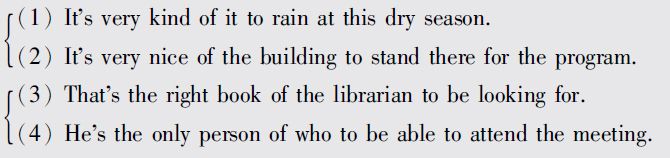
让我们先看第一组中的两个句子。这两个句子的结构实际上与我们常见的下面一类的句子是一样的:
(5)It's kind of you to say so.
(6)It's wrong of him to tell lies.
按理说,不定式是真实主语,因为,且以上述句(5)为例,我们不但同样可以说:
(7)It's kind to say so. (省去of you)
(8)It's kind of you. (省去to say so)
而且可以说:
(9)That's kind of you.
然而,和“for+宾语+不定式”一样,“of+宾语+不定式”也很自然地令人感到是一不定式复合结构(即宾语与不定式在逻辑上是主谓关系)。上述第一组的两个句子更给人以这样的感觉。所以,将“of+宾语+不定式”看作复合结构,至少为了学习上的方便,也是可取的,尽管有的语法家对此持反对态度。第二组句子中的“of+宾语+不定式”似乎亦可看作是一种不定式复合结构,只不过这里的不定式复合结构,不像在上述句子中用作真实主语,而是用作了定语。而不定式复合结构用作定语的情况并不罕见,再如:
(10)There was no need of them to think of parting .
(11)It's time for us to go .
顺便说一下,上述句(4)中的who是古旧用法,其义相当于one,再如:
(12)He smiled as who should say “Well done”. (who=one)
18 这句话从语法上怎么讲?
有一读者问: 有这样一句:
Politically, the deftness with which the ANC has neutralised the white right stands in striking contrast to the confrontational approach it has taken with Chief Buthelezi.
这里的it指代什么? 这句话从语法上怎么讲?
it显然指the ANC。现将这个句子扼要地分析如下:
Politically是一句子副词,用作方面状语。
the deftness with which the ANC has neutralised the white right是全句的主语:with which引导一个定语从句,修饰the deftness。
stands in striking contrast to可看作一短语动词,用作谓语。
the confrontational approach it has taken with Chief Buthelezi是上述短语动词的宾语; it has taken with Chief Buthelezi是一定语从句(其前省去了which或that),修饰the confrontational approach。
19 这两个句子如何分析?
有一读者问: 有这样两个句子,皆出自美国期刊:
(1)The admonition attributed to showman P.T. Barnum that one never went broke overestimating the bad taste of the American public is canonized in Vegas' cartoonish sphinxes and pyramids.
(2)The new vision was of prosperous, secure Middle East taking as its guide the growth and dynamism of the newly emergent economies of Asia.
我弄不清它们的句子结构,当然更无法确切地译出来,请赐教。
让我们先看上述句(1)。它的基本结构是“主语+谓语”。现将此句细加分析如下:
the admonition是一名词短语,用作全句的主语。
attributed to showman P.T. Barnum是一过去分词短语,用作修饰the admonition的定语。(P.T. Barnum[1810—1891]是美国著名马戏团主持人)
that one never went broke overestimating the bad taste of the American public是一同位语从句,与the admonition同位。此从句的基本结构是连词:that+用作主语的代词one+用作谓语的短语动词went broke(亦可看作系表结构)。副词never用作时间状语。overestimating the bad taste of the American public是一现在分词短语,用作时间状语。is canonized是一动词短语,用作全句的谓语。in Vegas' cartoonish sphinxes and pyramids是一介词短语,用作地点或方面状语。在翻译时,我们初步建议:admonition似可译作“批评”或“非难”; attributed to...似可译作“由……首先提出的”;never went broke overestimating...似可译作“对……作怎样高的估计都不为过”;is canonized in...似可译作“看了……之后,今天又有了现实意义”。
顺便说一下,Vegas即是Las Vegas(拉斯韦加斯),美国Nevada(内华达)州一赌城。现在再让我们看上述句(2)的结构。这个句子的基本结构显然是:主语(名词短语the new vision)+系动词was+表语(介词短语of prosperous, secure Middle East...the newly emergent economies of Asia)。这里的表语较长,再作分析如下:
of是介词。
prosperous, secure Middle East taking是一动名词短语,用作of的宾语(Middle East = Middle East's)。
as its guide是一介词短语,用作其后的the growth and...of Asia的补足语。the growth and dynamism of the newly emergent economies of Asia是一较长的名词短语,用作动名词taking的宾语。据此分析,全句的意思大致是:新的理想乃是繁荣的、安全的中东,以亚洲新兴经济的蓬勃发展为其指南。
20 这个句子如何分析?
有一读者问: 我在上海交大主编的《英语》第二册第23页的课文中发现这样一句话:
The principle of the laser is that the atoms of a crystal like the ruby crystal can be excited by a strong light and can then store this light, amplify it and emit an immensely powerful beam.
这里that后的各从句是不是并列的? 如是,第二个从句的主语是什么? can前是不是省略了laser?
这个句子里只有一个从句,即that从句,作表语用。在that从句中,主语是atoms,它有两个谓语部分,一是can be excited by a strong light,另一 个是can then store this light, amplify it and emit an immensely powerful beam, 二者用连词and连接了起来。换句话说,两个can引导的谓语在此共用一个主语atoms。如果按照某些语法家的意见把the atoms...can...and can...看作并列结构,也未尝不可,但这只意味着第二个can之前省去了the atoms。
21 这是一个省略句吗?
有一读者说他在美国作家史坦倍克(ohn Steinbeck)所著的中篇小说《珍珠》(JThe Pearl )中遇到这样一段话:
(1)Kino looked into his pearl, and Juana cast her eyelashes down and arranged her shawl to cover her face so that her excitement could not be seen. And in the incandescence of the pearl the pictures formed of the things Kino's mind had considered in the past and had given up as impossible.
问后一句是否是省略句?
从上下文看,你所举的例子中的后一句不像是省略句,因为这两句话并不是平行结构, 亦即是说,第一个句子并未用were+过去分词结构,因而说第二个句子是在formed之前省去were的省略句就很难成立。那么它是不是语法书中所谓的独立主格呢? 从整个语气来看似乎也不是。那么它该是一种什么结构呢?我们认为它是一个完整句。对它的结构应作这样的分析:
1. In the incandescence of the pearl是地点状语,修饰formed。
2. the pictures是全句的主语。
3. formed是不及物动词,是句中的谓语动词(或简称谓语)。
4. of the things...是介词短语,作定语,修饰the pictures。
5. Kino's mind had considered in the past and had given up as impossible当然是定语从句,修饰the things。
你可能要说:of短语如是修饰the pictures的定语,则应放在谓语动词formed之前,使之紧跟在the pictures之后,而它在这里却放在谓语动词之后,离开了它所修饰的名词,岂不怪哉?
这可能正是这个句子的困难所在。其实这种定语被谓语动词所隔离的情况并不罕见。有的语法家还专门为它起了一个名称,叫作隔离定语。具体到我们所讨论的这句话,之所以用隔离定语,显然是由于of the things...impossible太长的缘故。如将它置于谓语动词formed之前,全句就会头重脚轻,失去平衡。下面我们再举一些类似的句子结构供你参考:
(2)Here an accident happened of a very extraordinary kind.
(3)After the fire, very little remained of the house.
(4)Rumours spread of more demonstrations the next day.
(5)No instances have been found of an interchanging of these two sentence constructions.
(6)When I awoke on the morning of Sunday, the 22nd, the news was brought to me of Hitler's invasion of Russia.
最后请注意: 这里所谈的情况只是隔离定语中的一种而已。其他情况还有很多,这里就不一一细说了。只望你能举一反三,灵活运用。
22 怎样分析这个句子呢?
有一读者问: 如何分析下面句子的结构:
(1)Covering much of the earth's surface is a blanket of water.
这是一个倒装句,而且是一完全倒装句,因为其谓语部分被完全移置到了主语之前。这种倒装结构在当代英语里是常见的,如:
(2)Facing the gate is a screen wall.
(3)Lying on the couch is an old lady.
(4)Standing beside the wounded soldier was Doctor Bethune.
(5)Heading the procession was the military band.
(6)Sitting before the circle of attractive tents that faced the lake and putting in order a fishing-pole and reel, was Harley Baggoti, in a brightly-colored sweater and flannel trousers.
这种倒装结构虽较普遍,但有些语法家警告人们不要滥用。有一位美国语法家举出这样的例子:
(7)Encouraging the United States were Britain and France.
(8)Hiring the men will be ranchers in the vicinity.
他认为这两句应分别改为:
(9)Britain and France were encouraging the United States. (或The United States was being encouraged by Britain and France.)
(10)The men will be hired by ranchers in the vicinity.
据这位语法家说,还有用错时态的情况,如:
(11)Passing their intermediate tests were George Simms, Earnest Worth, Alben Smith, Nelson Raddle, and Alex Jones.
当然应该改为:
(12)Those who passed their intermediate tests were...
也有些语法家认为下面句子是新闻体,故不足取:
(13)Now mounting the steps is His Majesty the Emperor.
但也有的语法家比较开明,例如对下面一例:
(14)Backing up Jensen is Stephen Bosh, Chris Borgen, Joe Witte, Pat Collins, Joel Siegel, Ron Swoboda—plus the most dedicated staff of professionals in broadcast journalism today.
只说这里用动词单数是大众语言,而对句子结构并未赞一词。
综上可以看出,句(2)到句(6),由于已属常见,似乎未遭到任何语法家的指责。但对句(7)、(8)、(13)、(14),语法家们的意见就不一致了。值得注意的是这些句子中的现在分词都含有较强的“进行”含义。一些语法家如以此作为反对这种倒装结构的理由,那么,对下面常见的句子是否也持批评态度呢?
(15)Marching at the head of the column was John Brown, our commander.
我们认为,语言是活的事物。它在不断地发展,新的语言现象不断地出现。对此,我们既不能不讲语法,随意滥用,也不能抱残守缺,墨守成规。一种语言现象,如已为大多数人所接受,我们就得承认它。实际上,上述倒装结构之所以被日渐广泛应用,不仅由于它有可用来强调等优点,而且由于它有一个很突出的特点,即在许多情况下,倒装结构反而要比原来的“ 正常”语序自然得多。有的句子,甚至不可能用“正常”语序,如问题中的那个句子便是如此。自然,我们也要警惕,不要写出句(11)那样的句子来。
23 这句话如何分析?
有一读者问: 如何分析下面一句话(摘自《简·爱》[Jane Eyre ]),尤其是破折号当中的部分:
My clothes hung loose on me, for I was much wasted, but I covered deficiencies with a shawl, and once more, clean and respectable looking—no speck of the dirt, no trace of the disorder I so hated, and which seemed so to degrade me, left—I crept down a stone staircase with the air of the banisters, to a narrow passage, and found my way presently to the kitchen.
整个句子是一并列复合句,其基本结构是:主语(my clothes)+谓语(hung)+主语补足语(loose)+等立连词(for)+主语(I)+连系动词(was)+表语(wasted)+等立连词(but)+主语(I)+谓语(covered)+宾语(deficiencies)+(由于前有破折号,故省去了标点)主语(I)+谓语(crept)。
现将其他句子成分一一分析如下:
第一分句:
on me是介词短语,用作地点状语。
第二分句:
much: 副词,用作程度状语。
第三分句:
with a shawl: 介词短语,用作方式状语。
and: 连词,在此表示结果。
once more: 副词短语,用作时间状语。
clean and respectable looking: 形容词短语,用作主语补足语。
—no speck of the dirt, no trace of the disorder I so hated, and which seemed so to degrade me, left—: no speck of the dirt, no trace of the disorder是一并列名词短语,与上文中的clean and respectable looking同位;I so hated是一定语从句,其前省去了which,修饰前面的the dirt和the disorder; and是连词,用以连接两个which;which seemed so to degrade me亦是一定语从句,与前一定语从句并列,亦用以修饰前面的名词the dirt和the disorder; left是一后置的过去分词,之前有一逗号,说明它与其前的定语从句无关,而是用以直接修饰no speck of the dirt和no trace of the disorder的定语。
第四分句:
down a stone staircase: 介词短语,用作方向状语。
with the aid of the banisters: 介词短语,用作方式状语。
to a narrow low passage: 介词短语,用作方向状语。
and: 连词,用以连接crept与found。
found: 谓语,与crept并列。
my way: 名词短语,用作宾语。
presently: 副词,用作时间状语。
to the kitchen: 介词短语,用作方向状语。
24 怎样分析和理解这个长句?
有一读者问:我在读《德伯家的苔丝》 (Tess of the D'Urbervilles )一书时碰到这样一句话:
The two women valiantly disguised these forced excursions and countermarches as well as they could from Durbeyfield their cause, and from Abraham and from themselves, and so they approached by degrees their own door, the head of the family bursting suddenly into former refrain as he drew near, as if to fortify his soul a sight of the smallness of his present residence — (第4章第33段最后一句)
我感到难于理解,请你解释一下。
让我们先简要地分析一下这个较长的句子,然后就容易理解了。这是一个并列复合句,其基本结构是:主语 + 谓语 + 宾语 + 短语连词 and so + 主语 + 谓语 + 宾语。
第一个分句的主语是 the two women,谓语是 disguised,宾语是 these forced excursions and countermarches, valiantly 是一副词,用作修饰 disguised 的状语。as well as they could 是一状语从句,亦用以修饰 disguised。from Durbeyfield their cause, and from Abraham and from themselves 这三个并列的介词短语也都是修饰 disguised 的状语。 their cause 是 Durbeyfield 的同位语。
第二个分句的主语是 they,谓语是 approached,宾语是 their own door。the head of the family bursting...his present residence 是一较长的分词独立结构,起一伴随状语的作用。
从上下文我们得知,父亲Durbeyfield 在酒馆里喝醉了,母女俩 (Durbeyfield的妻子Joan和女儿Tess)搀扶着他往家走,他的儿子Abraham 也相跟着。上述句子的大意就是:
母女俩竭力掩饰着 Durbeyfield (这都是由他引起的)、Abraham 以及他们自己不得不时而晃悠时而倒退的狼狈相,等到他们好不容易快到家门时,一家之长 Durbeyfield 却像是一见到他当今所住的寒舍就要乞灵于他的口头禅似的,突然喊道:“我在 Kingsbere 有地下墓呀!(I've got a family vault at Kingsbere!)”
这里需要解释几个词汇问题。 forced excursions and countermarches 的直译应是“被迫进行的偏离方向和向后倒退”。 disguise...from 是一常见的搭配,其义是“不让……露出,掩饰,掩藏起来”。their cause 指 Durbeyfield 。英语里的 cause (起因)可指人,如:The driver was the cause of the accident (司机是肇事者).by degrees 意为“逐渐地,慢慢地”,“好不容易”,在此是意译。former refrain 意为“以前经常重复的话语”,这里译作“口头禅”也是意译。 as he drew near 似乎没有必要译出,以免与前文“快到家门时”重复。 to fortify his soul 的意思是“使自己的灵魂坚强,使自己的精神振奋”。
25 这两个句子应如何分析?
有一读者问:下面两个句子是否都对? 应如何分析?
(1)I didn't know who was he.
(2)I didn't know who he was.
两个句子都是对的,例(1)较口语化。 例(1)的who was he 是主、系、表结构,例(2)的who he was 是“表语+主语+连系动词结构”。
26 这个句子的主句在哪里?
有一读者问: 《英语世界》某期有这样一句话:
If in doubt find when the work was first published.
这个句子出现了两个从属连词if和when,是否缺乏主句?
这是一个祈使句。谓语动词是find。when从句是一间接疑问句,在此用作find的宾语,故而when不是连词,而是疑问副词,意为“何时”。if in doubt是一缩略从句,其完全形式应是if you are in doubt; in doubt是一固定说法,其意为“抱有怀疑”。所以,上述全句的意思是: 如有疑问,可查该作品的最初出版时日。
27 是表语还是状语?
有一读者问: He is in the room中的介词短语in the room是表语还是状语?
严格说来,介词短语in the room,应是状语,用以修饰is,而is在此是实义动词,意谓“存在”(exists)。但现在国内仍有一些语法将句中的is看作连系动词,将介词短语in the room看作表语。这样做大概有三个原因:一是为了教学(主要是基础英语教学)上的方便,可以少纠缠一些琐碎的语法分析(这也确是无可厚非的事);二是受了传统语法的影响,譬如在早先英国出版的纳氏(J.C. Nesfield)文法中,下列句中的副词皆被视作表语。
(1)The stars are out .
(2)The train is off .
(3)The late minister is in again.
三是因为确是有一些副词和介词短语可用作表语的例证,如:
(4)I'm very well , thank you.
(5)I see that you are in good health .
为什么我们说副词well和in good health又是表语了呢? 简言之,这是由于它们都相当于形容词的缘故。而形容词则能用作表语,直接表述主语,从而使be变成了连系动词。这样分析,对初学者来说,岂不容易造成混乱吗? 是的,所以最简单的(但不是科学的)办法就是暂时不加分析地将动词be后的词语一律看作表语,如坊间的一些语法(包括我们所编写的《英语语法手册》)所做的那样。
28 如何分析这里的as从句?
有一读者问: 有这样一句话:
(1)The displacement of workers as individual firms discard them causes social hardships.
如何分析这个句子,尤其是as individual firms discard them?
这句话的基本结构是: 主语(名词短语the displacement of workers)+谓语动词(causes)+宾语(名词短语social hardships)。as individual firms discard them是一像是定语的时间状语从句,修饰动作名词displacement。这种用作定语的状语从句并不罕见,再如:
(2)Your visit while I was ill did me a power of good. (修饰名词visit)
(3)Julia Bell's bow when she got up to recite made me think of a chicken jerking its head. (修饰名词bow)
(4)In the weeks since Toby had begun classes , he had seen very little of the head of the school. (修饰名词weeks)
29 as...as 与so...as...
有一读者问:有这样一道选择题:
The horse is getting old and can't run_________it did.
A.as fast as B. so fast as
答案是B, A为何不行?
传统的语法家曾规定否定结构须用 so...as,不用 as...as。但在当代英语里,二者皆可用于否定结构,无甚区别,但用 so...as 的情况可能要多一些。
30 如何分析这里的 as if 从句?
有一读者问:高中英语第一册有这样一句话:
He heard a noise, as if someone was breathing.
有人认为 as if someone was breathing 是状语从句,也有人认为是定语从句,修饰 noise,不知您的看法如何?
这个 as if 从句可以有两种分析方法。它既可看作状语从句,亦可看作定语从句。如看作状语从句,它就相当于 as if he heard someone breathing; 如看作定语从句,它就相当于 which was as if someone was breathing。
31 如何分析与理解 as may well be the case?
有一读者问:有这样一道选择题:
(1)She'll not join us,_________the case.
A. as well may be B. as may well be
答案是B,但我搞不懂是什么意思,并请作语法分析。
句(1)应填以 as may well be 。 as may well be the case 的意思是“这是蛮有可能的事”。现在让我们作一点语法分析。这是一个非限制性定语从句,用以修饰其前的整个主句 She'll not join us。as 在此是一关系代词,指代其前的主句。as 在从句中用作主语。as 在英语里用作关系代词是一种比较常见的现象,再如:
(2)I fear not to die fighting, as is the natural attitude of a Communist.
关系代词在其所在的从句中也常可用作宾语,如:
(3)As you know, Taiwan is an inseparable part of China. (as 在此用作宾语,亦指代主句)
may well be 是一连系动词短语。may well 则是一常见的固定说法,意谓“很可能(likely)”,再如:
(4)You may well get lost, so take a map.
the case 在此用作表语,其意是“事实,实情”,也是一常见的固定说法,再如:
(5)As is often the case , she was the first to come to class.
(6)That is not the case . (相当于 That is not true)
32 as much...as...应如何理解与分析?
有一读者问: 有这样一个句子:
(1)The impression you make often results as much from the way you move and speak as it does from what you actually contribute.
此句的结构如何分析?
这是一个复合句,其基本结构是“主语(the impression)+谓语(result from)+宾语(the way)”。此句中有两个从句: 一是you make,用作定语,修饰the impression;另一个是as it does from what you actually contribute,用作比较状语。后者又含有一个名词性从句what you actually contribute,用作does from的宾语。often是一副词,用作时间状语。as much也用作状语,表程度。全句的大意是: 你给人的印象往往不仅由你的实际作为所造成,同样也是由你的言谈举止所造成的。
请注意,as much...as在英语中可谓屡见不鲜,再如:
(2)Keats's letters are as much an indication of the man as is his poetry.
(3)Richardson's novels suffer as much from his purpose as from his own limitations.
(4)The atmosphere is as much a part of the earth as are its soils and the water of its lakes, rivers and oceans.
(5)Here he assembled the whole party, and communicated as much of his intentions as he deemed expedient.
33 如何分析这里的being blind?
有一读者问:高一英语课本中有这么一句话:
(1)They had often heard of elephants, but they had never seen one, for, being blind, how could they?
这里的连词for和现在分词短语being blind都意味着“因为”,岂不是重复了吗?
连词 for意谓“因为”,这是不言而喻的。问题在于如何看待这里的现在分词短语being blind。现在分词短语可以用作表示时间、原因、结果、条件、方式等的状语,并不是从其语法关系得出的结论,而是从其逻辑关系看待的结果。从其语法关系来看,现在分词短语和现在分词本身一样,仍具有形容词的性质。事实上,置于主语之前的现在分词短语也并非总是用作状语,而却像是用作主语补足语,如:
(2)Containing 39 percent alcohol,the liquor accounts for half of the factory's 100 tons of exports each year.
(3)Originating in Jiangsu Province, South China, over 400 years ago, Kunqu reached its peak in the Ming Dynasty (1368-1644)and dominated the Chinese opera world for about 200 years.
以being开头的现在分词短语确是常有“由于……”的内涵,但也不可一概而论,例如在上述所提问的句子里,being blind即可看作是主语补足语,不具有“由于……”的含义。
34 这句话如何分析呢?
有一读者问: 有这样一句话:
Concealed in the forest at the bottom of that military rattrap in which half a hundred men in possession of the exits might have starved an army to submission, lay five regiments of Federal infantry.
如何作语法分析?
这句话是一倒装结构。其主语部分是 five regiments of Federal infantry, 谓语动词是lay, 过去分词concealed是一伴随状语, in the forest...to submission 是一地点状语,其中又含有一定语从句 in which half a hundred men...to submission, 用以修饰 that military rattrap。 这句话的基本结构是“倒装了的主语+谓语动词+伴随状语”。
35 这里的enough是什么词类?
有一读者问: 有这样一句话:
(1)After only six months he had learned enough to read articles and reports in Russian.
有人说句中的enough是名词,有人则认为它是副词,究竟是什么词,请给以解答。
这里的enough看作名词(有的语法学家则称之为代词或名词替代词或数量词)较妥,因为动词learn在此显然是及物动词。enough用作名词的情况很多,再如:
(2)I have had enough . (enough用作宾语)
(3)Enough has been said. (enough用作主语)
下面一句中的enough才是副词。
(4)Have you played enough ?
因为play在此显然是不及物动词。
36 如何分析I have ever known to have...?
有一读者问: 有这样一个句子:
(1)The only person I have ever known to have a skeleton in the cupboard is George.
如何分析I have ever known to have a skeleton in the cupboard呢?
这是一个定语从句,用以修饰其前的the only person。如做内部分析,则其基本结构是“主语 (I)+ 谓语 (have known)+ 宾语(被省去的关系代词that或whom)”。to have a skeleton in the cupboard是一不定式短语,用作宾语补足语。换言之,它和宾语that或whom构成复合宾语。你的困难可能是对“know + 宾语 + 不定式”这一结构不很熟悉,现让我们再举几例如下:
(2)I know him to be ill.
(3)I never knew him tell a lie.
(4)I've never known it (to)snow in July before.
(5)I've known them (to)strike their children in front of visitors.
(6)Tell me, did you ever know him to wear a black over his bad eye?
(7)Have you ever known her lose her temper?
关于不定式用不用to的问题,一般言之,be之前不省去to;know意指“经历”时,不定式不用to (但也有用to的情况),而意指“知道,认为”时,不定式没有to。
顺便提一下。像上述例(2)的句子,比较文气,通常应说:
(8)I know he's ill.
37 如何分析与理解leader declared wanted by the police?
有一读者说有这样一句话:
(1)Moshood Abiola, Nigeria's opposition leader declared wanted by the police, was arrested early yesterday morning in his residence here after addressing a rally of his supporters.
请问如何分析句中的Nigeria's opposition leader declared wanted by the police?
Nigera's opposition leader是一同位语,它与其前的Moshood Abiola同位。其后的declared wanted by the police是一过去分词短语,用作定语,修饰Nigeria's opposition leader。这一短语中的wanted也是一个过去分词,意谓“被通缉的”,在此用作其逻辑主语Nigeria's opposition leader的补足语,语法上唤作主语补足语。
如对此一分词短语的上述分析可能还不甚了了,那就最好将此一分词短语扩充为一定语从句如下:
(2)who was declared wanted by the police
这样一扩充,你就可比较清楚地看出wanted是从句主语who的补足语了吧。
如果还不清楚,那就试将被动结构who was declared wanted by the police变为主动结构如下:
(3)whom the police declared wanted
即可看出wanted是从句中宾语whom的补足语,即所谓宾语补足语。主动结构中的宾语补足语,在被动结构中,不就变成主语补足语了吗?
如果你仍然有点困惑,那就在于你对“declare + 名(代)词 + 过去分词”这一结构不很熟悉了。这种结构在英语中并不罕见。现将其主动结构举二三例如下:
(4)I declare the meeting closed.
(5)They declared themselves completely puzzled by the lack of evidence.
这两个句子皆可适当变为被动语态。此外再如:
(6)She was declared elected to the committee.
顺便提之,“declare + 名(代)词”之后还可以用名词、形容词等。主动结构如:
(7)They declared him king.
(8)She declared herself innocent.
被动结构如:
(9)He was declared king.
(10)At the trial she was declared innocent.
38 如何分析like后的“名词+单词或短语”?
有一读者问: 有这样几个句子:
(1)He opened his mouth to pant, like a bottle open.
(2)The storm is dying out like the tide down.
(3)Wilma made her start like an arrow from a bow.
(4)Eistein's clothes seemed to be just pulled on to keep him covered, like a blanket to keep one warm.
(5)The pine tree still stood there like an umbrella covering the entrance.
(6)The thunder sounded like a bomb exploded on the roof of the house.
我认为上述句(3)—(6)中like后的名词皆为后置定语所修饰,但上述句(1)与句(2)中like后的词语如何分析呢? 是否是复合宾语呢?
“名词 + 某些词语(如分词、不定式、形容词、副词等)”结构是否是复合宾语,决定于二者的关系在逻辑上是否为主、谓(或主、表)关系。如二者在逻辑上是主、谓关系,构成一个不可分割的整体概念,它就是一种用作宾语的复合结构,也就包括我们所谓的复合宾语。反之,二者在逻辑上如不构成主、谓关系,不表一个不可分割的整体概念,它就不是一种复合结构,而名词后的词语就是后置定语或是别的什么了。根据上述看法,上述句(1)—(6)中介词like后的词语似乎皆可看作是复合宾语。且以句(1)中的a bottle open为例。a bottle和形容词open二者显然具有主、表关系,表一不可分割的整体概念,可和下面一句中的复合宾语the door open相类比:
(7)He left the door open.
所以,很清楚,形容词open显然是复合宾语的一部分,而不是后置定语。其他五个句子中like后的词语皆可这样分析。那么有没有“名词+后置定语”的情况呢? 当然是有的,而且很普通,这里仅举几例即可:
(8)He says he's going to take a trip abroad. (a trip 是单一宾语, abroad 是后置定语)
(9)Who's living in the room above. (the room是单一宾语,above是后置定语)
(10)He is the only person reliable. (the only person是单一宾语,reliable是后置定语)
但请注意,有时似有两可的情况,如:
(11)He spoke like a man afraid.
a man afraid可意为“生性害怕的人”(afraid用作后置定语),也可意为“一时害怕起来的人”(afraid为复合宾语的一部分,即宾语补足语),这就要视上下文而定了。
39 如何分析like something in his childhood?
有一读者问: 有这样一个句子:
He remembered like something in his childhood, that there had been a time when he had observed these rules.
请问如何分析理解like something in his childhood?
like something in his childhood在此是一插入语,其前省去了what he remembered(应该省去,以免与其前的he remembered重复)。这种插入语只用在非常口语化的文体中。它的意思是“像是他孩提时代的事”。
40 like之后为什么没有to?
有一读者问:
I would like live to study, and not study to live.
一句中的like之后为什么没有to?
句中live to study与study to live不是不定式短语,而是两个独立的祈使句(像是两种不同的规训或箴言),所以like之后不可用to。如果把这个独立的句子前后标上引号,也许就比较容易理解了。全句可直译为: 我喜欢的是为学习而生活,不是为生活而学习。
41 这里的no more...than if...何意?
有一读者问: 有这样一个句子:
I remember no more of that evening on Lake Como than if my own embarkation and landing had never taken place.
这个句子何意? 特别是than以后的if从句是什么意思?
这句话的大意是: 那天晚上,我在Lake Como上了船,靠了岸,但我什么也不记得,就像我压根儿没有起程靠岸一样。remember no more...than的意思是“我的记忆等于……”。if从句的字面意思是: 假如我从未上船靠岸的话。其含义是: 既然我根本就没有去,自然就什么印象都不会有了。
42 如何分析 one on top of the other?
有一读者问:上海交通大学主编的《英语》第一册(下)第12课中有这样一句话:
One is to put the stages one on top of the other.
如何分析 one on top of the other?
one on top of the other 是一习语,用作方式状语,修饰 put 。这一习语一般不必进行内部分析。如做语法分析的话,它是一种由“one + 介词 + the other”构成的独立结构。这种结构还有 one after another, one by one 等。与此相似的还有由“名词 + 介词 + 名词”构成的独立结构,如 face to face, hand in hand, book in hand 等。
43 如何分析句中的 responsible 与两个 for?
有一读者问:《自学指南杂志》某期刊登有林承璋教授用英语写的文章,其中有一句:
The fact that objective tests can be marked by computers is one important reason for their evident popularity among examining bodies responsible for testing large numbers of self-taught participants.
① 句中的 bodies 一词在此处的汉语意思是什么? ② responsible 修饰哪一个词? ③ 两个 for 的作用各是什么?
examining bodies 的意思是“考试机构”; responsible 是后置形容词,修饰其前的 examining bodies ,其后常跟介词 for,一起意谓“负责……”。第一个 for 与 reason 连用(这也是习惯上的搭配),二者是修饰 (for 短语)与被修饰(reason)的关系。
44 如何分析这个句子,特别是 seem by...?
有一读者问:如何分析下面的句子,特别是seem by...?
...,you seem by the importance you all—my good mama included—ascribe to this matter, absolutely to believe we have a genuine witch in the house, ...(摘自小说《简爱》[Jane Eyre ])
如果你在 seem 之后加一逗号,就不难看出,by the importance you all—my good mama included—ascribe to this matter 是一介词短语,用作手段状语:其中的 you all ascribe to this matter 是一定语从句(省去了关系代词 that),my good mama included 是一插入语。现在再看其他句子成分:you 是主语; seem absolutely to believe 可看作动词短语,用作谓语;we have a genuine witch in the house(其前省去了从属连词 that)是一宾语从句。
最后,也许有必要回过头来向你指出,by the importance...to this matter 的含义是:根据你们大家……对这件事的重视来看。
45 关于 sink or swim
有一读者问:《英语语法札记》第二集第209页讲到虚拟语气 sink or swim 时,说其后省去了主语 I,对此我不明白,请加以解释。
sink or swim 是一种古老的现在虚拟式,其义为“不论成败”,其结构本为 sink I or swim I,但现已省去主语I。这种情况多见于固定结构或说法中,再如:
(1)Say what I will to the contrary, he tells the story everywhere.(say 后省去了主语 I )
(2)Detest him as we may, we must acknowledge his greatness.(detest 后省去了主语 we)
(3)I shall go rain or shine .(rain 和 shine 后皆省去了主语 it;它也是一固定说法,其义为“风雨无阻”)
据一位语法大师说,这种省去主语的情况乃是由于受到祈使句的影响所致。顺便提一下,在现代英语中,不省去主语的情况仍不罕见,实例如:
(4)We cannot receive him, be he who he may.
(5)Home is home be it ever so homely.
46 怎样分析这里的sitting round a fire?
有一读者问:高中英语第一册有这样一句话:
(1)There, on the shore, were nine savages, sitting round a fire.
我认为这里的分词短语sitting round a fire是一定语,但有人则认为是一主语补足语,不知您的看法如何?
这里的分词短语sitting round a fire之前如无逗号,问题就简单了,自然应作为定语看。但当这种分词短语之前有了逗号时,语法家们的看法就不一致了。有的认为它是非限制性定语(这恐怕是为初学者最容易接收的),有的则认为它是主语补足语(强调其与主语的补充关系),也有的认为它是同位语(强调其与其前的名词的同位关系)。我们认为对这种分词短语可采取多种不同的分析法,不必非有一种统一的分析法不可。对学习英语的人来说,重要的是要掌握这种分词短语的用法,即其位于名词之后的其前具有逗号的用法。这种分词短语可置于句末,除上述句(1)中的sitting round a fire之外,还有如:
(2)He was a great realist, writing about ordinary men and women in their misfortunes and struggles.(he指代鲁迅)
(3)I feel it as a rare occasion, occurring as it does only once in many years.
(4)Approaching, he could hear, as always, the cries of infants, ranging in pitch and volume from full-lunged, anguished howls to tentative falsettos.
但请注意,这种分词短语之前的名词必须是它的逻辑主语,否则,这种分词短语就是状语了,如下面一句中的pulling it off即是伴随状语:
(5)He transfers cigarette and stick to his left hand, takes off hat and transfers it to left hand, and at the same time grips fingers of right glove, pulling it off!(pulling的逻辑主语并非其前的名词glove,而是全句的主语he)
然而,似乎在较多的情况下,这种以其前的名词为逻辑主语的分词短语,都是位于主语与谓语之间,如:
(6)I, leaning over the edge of the boat, looked down into the sea.
(7)Li, playing her first major international tournament, had her fast pushes and hits at their best and Mika simply scrambled.
(8)Motor cars, gliding by with their dimmed blue headlight,became few and far between.
但应注意,这种位于主、谓之间的分词短语有时却暗示原因,有点像是原因状语,尤其是分词being引导的短语,实例如:
(9)He, being a good Christian, steadily refused.
(10)The fifth, being a tall man, passed his hand over the elephant's ear, and said emphatically, “He's like nothing so much as a large fan.”(the fifth相当于the fifth blind man)
(11)Some media people, thinking they would be celebrating their victories, rushed to their residence for stories. (they与their皆指代中国运动员)
47 started 和 pleased 之间为何没有 to?
有一读者问:下面一句中 started back 与 pleased to...之间为什么没有 to?pleased to...是什么成分?
(1)..., and started back pleased to have found a covey close to the house and happy there were so many left to find on another day.(前文是 Coming out while you were poised unsteadily on the icy, springy brush they made difficult shooting and I killed two, missed five; they 指 quails)
这里的 pleased 和 happy 是形容词,故其前不可有 to。它们构成一并列主语补足语,其逻辑主语也就是其所在分句中的主语,即I。这种将形容词用作主语补足语的现象并不罕见,再如:
(2)She gazed at him speechless for a moment.
(3)Mr. Gregory put him in the bedroom, and he's crying fit to burst.
下面再举一两个含有并列主语补足语的例证:
(4)He lay there content and comfortable .
(5)The wind blew scented out of France into her nostrils and soft on her cheek.(这里的 scented 似可看作形容词)
(6)He walked frail , insignificant , shabby , miserable —...
关于主语补足语详见拙著《高级英语语法》下册第677—681页。
你还问到 pleased to...是什么成分。重要的是应知道 pleased 是一形容词,后常接不定式正如上述句(9)中的 fit 一样,再如我们常说的:
(7)I'm pleased to meet you.
至于 pleased 之后的不定式,有的语法家认为它是原因状语,有的语法家则认为它是宾语。
48 这个句子中的 that 起什么作用?
有一读者问:有这样一道选择题:
It was so inconceivable that he would have stolen the money_________the suggestion was made that he might have been threatened.
A. which B. as to C. that
正确答案为C。这句话是什么意思? that 起什么作用呢?
答案是正确的。让我们先分析一下这个句子,然后就知道这句话的意思和 that 所起的作用了。
首先要知道这句话的 it 是形式主语,其真实主语是 that he would have stolen the money (第一个 that 从句是名词性从句)。如不用形式主语,这句话就变作: That he would have stolen the money was so inconceivable that...可见全句用的是...so...that...句型,其基本结构是“主、系、表”。此一 that 从句(第二个 that 从句)的基本结构则是“主语 + 谓语”,that 是连词,the suggestion 是主语, was made (被动式)是谓语。 that he might have been threatened (第三个 that 从句)是一个由 that 引导的与 the suggestion 同位的同位语从句。(为了使从句结构取得平衡,同位语从句与其先行词被隔开了)
由此可见,这句话的意思是:说他会偷了钱是如此不可思议,以致于有人提出了他可能是受到了恫吓的看法。
49 如何分析这个that所引导的句子?
有一读者问: 我在阅读World Civilization 一书时,遇到这样一个句子:
That nature alone is good which shall not do unto another whatever is not good for its own self.
百读不解其意,请分析一下这个句子的结构,全句的意思又是什么?
让我们先分析一下这个句子,分析完毕,其意就清楚了。首先要明白这个句子的文体是古旧的圣经体。它以连词that开头,是一个名词性从句,作一独立句用,像是一个间接引语。现将此句具体分析如下:
1. 这个that从句的基本结构是:that+主语+系词+表语。
2. that是一连词,用以引导一个名词性从句。
3. nature是一名词,用作主语。
4. alone是一形容词,后置,修饰其前的名词nature。
5. is是系词(或叫做连系动词)。
6. good是一形容词,用作表语。
7. which shall not do...for its own self 是一限制性定语从句,修饰前面的名词nature。因为它比较长,不便紧跟在nature之后,故将它与nature隔离开来,这种定语从句即所谓隔离定语从句。如对句子中的从句不作内部分析的话,此句就算分析完毕。但由于你对which从句的理解也可能感到困难,所以我们愿意对which从句进而作一内部分析如下:
1. 这个which从句的基本结构是:主语+谓语+宾语。
2. which是一关系代词,用作主语,其先行词是前面的nature。
3. shall not do 是一表否定的动词短语,用作谓语。shall在此是一种古旧的用法。
4. unto another是一介词短语,用作状语,表示方向。unto是相当于to的古旧形式。由于shall not do的宾语较长,故将状语短语移至shall not do 和宾语之间。
5. whatever is not good for its own self是一名词性从句,用作宾语。
现在再让我们对这一宾语从句作一内部分析如下:
1. 这个宾语从句的基本结构是:主语+系词+表语。
2. whatever是一连接代词(或更正确地唤作缩合连接代词,相当于 anything that),用作主语。
3. is not 是系词,否定式。
4. good是一形容词,用作表语。
5. for its own self是一介词短语,用作状语,表对象。its指代前面的nature。
好,现在我们已经将整个that从句的语法关系搞清楚了。那我们就可以用大白话将它直译为:不拿任何会损己的事去损别人的本性其本身就是好的。如果用一点文言予以意译的话,也许可译作:己所不欲,不施于人,可谓善矣。
50 如何分析or that serve to...?
有一读者问: 在阅读时遇到如下难解的句子:
Test questions are reviewed to eliminate language, symbols, or content considered to be potentially offensive or inappropriate for major subgroups of the test-taking population or that serve to perpetuate any negative attitudes about these subgroups.
不知其中that指的是什么?
在此句中,language, symbols, or content这个名词短语之后有两个定语: 一是过去分词短语considered to be potentially offensive or inappropriate for major subgroups of the test-taking population,另一是that从句。二者由等立连词or所连接。that在此是一关系代词。
51 这里的that不是连词,urge也不是动词
有一读者问: 《英语世界》有这么一个句子:
(1)With them safely achieved, there may no longer be that urge to be curious and constantly learn more that is so essential.
此句第一个that从句的主语是什么? 尤其是and constantly learn的主语是什么?
that在此不是连词(它并未引导一个从句),而是指示代词,用作定语,修饰名词urge。to be curious and constantly learn more that is so essential这两个并列的不定式短语是修饰urge的定语。名词urge常后接不定式,再如:
(2)We all have the urge to learn English.
(3)They have a strong urge to communicate.
52 that从句修饰the deep吗?
有一读者问: 有这样一个句子:
(1)How much do we know about these warm-blooded giants of the deep that, through the ages have captured man's imagination?
① that之后为何用逗号? ② that从句是否修饰the deep? ③ have captured one's imagination何意?
① that之后之所以用逗号是因为要表示停顿,以与其后的介词短语在语气上有一间隔。应该指出,介词短语through the ages(多少世代以来)之后也应有一逗号,但被作者省去了。② that从句作为定语显然是用以修饰其前的these warm-blooded giants,而不是修饰the deep(大海)。③ capture one's imagination (或fancy)是一种固定说法,意为“讨得……的欢喜”或“引……的瞩目”,再如:
(2)The story of the hostages captured the nation's imagination.
53 如何分析这里的that从句?
有一读者问: 《英语沙龙》上有这样一个句子:
(1)But, with an exquisite irony; it seems likely that another government decision is going to close down the reason that the meridian goes through Greenwich in the first place—the Royal Observatory that was founded there by King Charles Ⅱ in 1675.
如何分析和理解that从句结构?
that从句在此用作真实主语,其前的it是一形式主语。that从句的基本结构是“主语(another government decision)+谓语(is going to close down)+宾语(the reason)”。the reason在此有两个同位语: 一是that the meridian goes through Greenwich,另一个是破折号之后的the Royal Observatory(其后的that从句自然是一修饰the Royal Observatory的定语)。你的困惑很可能在于the reason在此的用法和意义。让我们对此简述如下。reason,如上所述,在此有两个同位语。其意皆为“理由或原因”。同第一个同位语一起,它意味着“将子午线划在格林威治中间的首要的”“理由或原因”;和第二个同位语一起,它意味着“于1675年由查理二世在那里所创建的皇家天文台”的“理由所在或原因所在”。close down the reason是一种转喻,实际上要“关闭”的是“皇家天文台”,从而也就否定了创建皇家天文台的理由。
54 but that如何理解与分析?
有一读者问: 读英国著名小说《简·爱》(Jane Eyre)到第一章第三段时遇到这样一个句子:
(1)She regretted to be under the necessity of keeping me at a distance; but that until she heard from Bessie, and could discover by her own observation that I was endeavouring in good earnest to acquire a more sociable and childlike disposition, a more attractive and sprightly manner, —something lighter, franker, more natural as it were—she really must exclude me from privileges intended only for contented, happy, little children.
如何对此句进行语法分析? 尤其是but that起何作用,做何解释? 它有哪些用法?
先让我们将此长句分析如下:
1. 这是一个并列复合句。
2. 这个句子中的第一个分句的基本结构是: 主语(she)+谓语(regretted)+宾语(不定式短语to be under the necessity of keeping me at a distance);第二分句的基本结构是: 主语(she)+谓语(动词短语must exclude)+宾语(me)。
3. but that可看作是一等立连词。
4. 第二分句中的until she heard from Bessie, ...as it were是一由从属连词until引导的时间状语从句。此一从句的基本结构是: 主语(she)+并列谓语(heard和could discover)+宾语(that I was endeavouring...as it were)。that从句的基本结构是: 主语(I)+谓语(动词短语was, endeavouring)。that从句中的in good earnest是介词短语,用作方式状语,修饰不及物动词短语was endeavouring。其后的不定式短语(to acquire...sprightly manner)是一修饰was endeavouring的目的状语。to acquire有两个并列宾语(a more sociable and childlike disposition和a more attractive and sprightly manner)。破折号之后的something lighter, franker, more natural as it were是与其前的两个宾语同位的同位语。
5. 第二分句中she must exclude me后的from privileges是一地点状语,intended only for...children是一过去分词短语,用作定语,修饰privileges。
现在再让我们商讨一下but that的问题。but that常作为从属连词,多用于正式文体中,其含义与用法一般有以下几种:
1. 意为“除……之外”(=except that),实例如:
(2)I do not know but that I shall go.
2. 意为“若非,要不是”(=if...not),实例有如:
(3)But that I saw it, I could not have believed it.
3. 意为“非,不”(=that...not,常用于否定结构或疑问句之后),实例有如:
(4)It is impossible but that a man will make mistakes.
(5)Who knows but that he may be right?
4. =that,常用在doubt, fear, deny等词之后,实例有如:
(6)There is no doubt but that you will succeed.
但上述句(1)中的but that有点特殊。从整个句子来看,but that...显然是与第一分句she regretted to...密切相关。我们知道,表示遗憾的词如regret, sorry等常后接but...以表示转折,实例有如:
(7)I sincerely regret that I have hurt your feelings, but I didn't do it on purpose.
这么说来,这个句子只用but好了,何必用but that呢? 我们的感觉是,这里but之后之所以加上一个that是因为其后所接的第二分句较长的缘故。我们在前面说过这里的but that有点特殊,其原因亦在此。
55 如何分析to a great discovery?
有一读者问: 在高中英语第二册上有这样一句话:
This something in Madame Curie's own life was to lead science down a new path to a great discovery.
在这一句中,to a great discovery是lead的状语还是path的定语?
从语法形式上看,to a great discovery用作状语或定语都可以。但从意义上看,应该将它看作状语,to lead science down a new path to a great discovery应直译作: 沿着一条新的道路将科学引向一项伟大的发现。如将to a great discovery看作定语,其意义则变为:使科学沿着一条新的通向一项伟大发现的道路前进。这样的说法显然是不大适宜的。
56 when从句是状语还是主语?
有一读者问:
It was rather early when we arrived at the village.
句中的when从句是状语从句还是主语从句?
when从句是状语,全句的主语是指代when从句的it。
57 可姑且将what he called看作插入语
有一读者问: 有这样一个句子:
Karl Liewellyn developed what he called the law-government continuum to illustrate the point that legal systems can be constructed in an infinite number of ways.
请分析整句话的句子成分。
全句的基本结构是“主语(Karl Liewellyn)+谓语(developed)+宾语(what he called the law-government continuum)”。what he called the law-government continuum是一宾语从句,由缩合连接代词what (=that which)所引导。为方便起见,亦可将what he called看作插入语。to illustrate...of ways是一不定式短语,用作目的状语。如作内部分析,that legal systems...of ways是一同位语从句(与其前的the point同位)。
58 如何理解与分析A is to B what C is to D?
有一读者问:在读 Reader's Digest 时遇到这样一句话:
(1)Belgium is to pigeons what France is to champagne.
如何解释这里的 what?
A is to B what C is to D 是英语里一个固定句型,其义是A之与B犹如C之与D。这种句型颇为有用,又如:
(2)The pepole is to the people's army what water is to fish.
(3)Two is to three what four is to six.
(4)Reading is to the mind what food is to the body.
关于如何分析这里的 what ,语法家们的看法并不一致。有的人认为它是连接代词;有的人将它唤作“独立的关系代词”(因为它没有先行词);有的人则将它看作连词,因为它可以代之以 as ,如 A is to B what C is to D 即可以说等于 A is to B as C is to D。那么, what 引导的从句又是起什么作用呢?依照上述不同意见 ,what 如是代词,它所引导的从句就是表语(有的权威词典就是这样分析的);what 如是连词(相当于 as),它所引导的从句自然就是比较状语了。
59 如何分析 whatever it is that ...?
有一读者问:有这样一段话:
As energy is the central concept in thermodynamics, its fundamental models and laws have been developed to facilitate energy analysis, e.g., to describe energy content and energy transfer. Energy analysis is fundamentally an accounting procedure. In any accounting procedure whatever it is that is under consideration must be clearly identified.
如何分析最后一句话?尤其如何理解 that?
你的困惑可能在于 whatever it is that is under consideration。这是一个由 whatever 引导的名词性从句,在此用作主语。that is under consideration 是一定语从句,修饰其前的代词 it。整个从句的意思是:不管所考虑(或研究)的是什么,它(都必须……)。
60 who从句是主语抑或定语?
有一读者问: 在您的《薄冰英语语法》第525页有一例句:
(1)Who is not for us is against us.
您把who is not for us列入定语从句中,但我认为这是一主语从句,不知对否?
形式上who is not for us确是一个主语从句,但实际上who在此是一缩合关系代词,相当于anyone who,所以主语应是anyone, who is not for us是一修饰anyone的定语从句。这样的who是一种古旧用法,现多用在现成说法中,再如:
(2)Who breaks pays.
61 怎样分析with lines closer together?
有一读者问:
The books you read are probably in finer print with lines closer together.
句中的with lines closer together是print的定语还是独立主格结构?
with lines closer together在此当然是用作定语,修饰print。其形式像是独立主格,但其中的with不可省去,这就又不像是独立主格了。故而我们倾向于将它称作介词短语(内含省去being的现在分词短语closer together)。