Chapter 2 定语从句
2.11 缩合关系代词what
2.11 缩合关系代词what
what一词看似简单,但其实很多读者难以深入地掌握其用法。在详细讨论其用法特点之前,请大家看下面这个句子:
Dolphins might be trained to cooperate with fishermen and help them by finding, tracking, herding, or even catching fish—in all of what activities dolphins are expert. *
对于上面这个句子,读者应该会觉得似曾相识,我们曾在2.7.1小节中讨论过一个类似的句子。那么读者们有没有觉得这个句子有什么不妥的地方呢?也许很多读者看不出来。其实,这个句子是不符合英文的表达规则的,或者说是一个错误的句子。错在哪里?请把它与2.7.1小节中例句11进行比较,找出二者的差异。我们在下文将给出详细的解释。
之所以把what作为最后一个关系代词来讨论,是因为what的用法与我们在前面讨论过的所有关系代词在结构上有一个重大的区别,那就是what不能指代先行词,即what前面不能有名词,换句话说,what引导的从句并不能修饰主句中的任何先行词。请看下面的例句:
All ______ is a continuous supply of the basic necessities of life.
A. what is needed B. the things needed C.for our needs D.that is needed
正确答案 D。
妙语点睛 题干给出的是一个主句结构,其中all要被一个定语从句修饰,即all是先行词,所以不能选择A,因为不能用what来指代主句中的任何词。这里D正确,关系代词that指代all,在从句中作主语。此外,若选B,则主语是复数things,与后面的谓语is不搭配。也不能选C,因为没有all for our needs is...这样的句子结构。
分析到这里,有读者可能会提出这样的质疑:既然what引导的从句并不能修饰主句中的任何名词,不具有“定语从句要有先行词”这个特点,那么又为什么要在定语从句里讨论what的用法呢?或为什么把what叫作关系词呢?要回答这个问题,我们需要把握好看问题的角度。我们可以从句子的结构和what本身的意义这两个不同的角度来分析what的用法特点。以上是从句子的结构上来看,what引导的从句不能修饰前面的名词。但是从what本身的意义上来看,what在从句中大多数情况下是没有疑问意义的,即不翻译成“什么”,而是理解为the things that, all that或something that。因此,从what本身的含义这个角度,我们可以把what看作是一个特殊的关系代词,它是先行词和关系代词的结合体,这就是为什么在本节标题中what被称为“缩合关系代词”。或者说what本身的含义里已经含有一个“隐性”的先行词了,这也就解释了为什么what前面不能再有“显性”的先行词。下面我们来详细讨论what的用法。
2.11.1 使用关系词what的前提:what的前面不能有先行词
根据上面的分析,what本身的含义里面已经包括了一个关系代词及其先行词,所以what前面不能再有先行词出现。换句话说,如果句中已有先行词,就一定不能再用what引导定语从句。比如我们不能说下面这个句子:
You can have everything what you like. *
现在我们来比较下面两个例句:
1 1) Dolphins might be trained to cooperate with fishermen and help them by finding, tracking, herding, or even catching fish—in all of which activities dolphins are expert.
2) Dolphins might be trained to cooperate with fishermen and help them by finding, tracking, herding, or even catching fish—in all of what activities dolphins are expert. *
妙语点睛 在例句1)中,关系词which后面接了一个名词activities,整个短语which activities显然指的是前面提到的finding, tracking, herding, or even catching fish这一系列“活动”,这个动名词短语就是被关系词which所指代的先行词。因为在主句中有了这个先行词,所以就不能用what引导从句了,因此例句2)不正确。
我们再来比较下面这两个句子:
2 1) Most of the food ______ elephants eat is brought to their mouths by their trunks.
2) Most of ______ food elephants eat is brought to their mouths by their trunks.
A. what B. which C.who D.as
妙语点睛 在例句1)中,空格前面有一个名词food,即需要被定语从句修饰的先行词。而有了先行词就不能填入what,所以A不正确。因为food是指物不是指人,所以不能用who。又因为as要与the same, such或as搭配使用,所以也不能填as。故B正确。在例句2)中,空格前面没有任何名词,即没有先行词,所以要填入what。故A正确。
尽管以上两个句子的结构不同,但意思没有多大差别。
我们再来看下面这个改错题:
3 Beethoven, the great musician, wrote【A】 nine symphonies in his life, most of what【B】 were written after he had lost【C】 his hearing【D】.
正确答案 B。应改为:most of which。
妙语点睛 从表面上看来,这里的most of what中的what前面没有名词,但其实这是一个非限定性定语从句,这个定语从句是补充说明先行词nine symphonies的。因为有先行词,所以不能用what引导从句,而应改成most of which,也就相当于most of the nine symphonies。
通过对上面各例句的分析,相信读者应该了解what的用法了,即what引导的从句不能修饰某个名词。下面我们来具体讨论它的两大基本用法。
2.11.2 what单独使用,即其后面可以不接名词
在通常情况下,what是单独使用的,即其后面不接名词。此时,what可表示物,也可表示人。所以,what在意义上相当于说the thing that或the person that,此时的what一般不具有“什么”这样的疑问意义。请看例句:
1 She is not what she used to be.
妙语点睛 这里的what后面没有接名词,what用来指人,原句可以改成一个含有定语从句的句子:“She is not the girl that she used to be.”。由此可见,这里的what没有疑问意义,它相当于一个先行词和关系代词的结合体,从这个意义上来说,what引导的是一个定语从句。但从结构上来说,这里what引导的从句是充当is的表语,即名词从句中的表语从句。换句话说,what所引导的从句,既可以看作是特殊的定语从句,又可以看作是名词从句。因此,为了方便起见,我们以后把what引导的从句统称为what从句。
2 Show me what you have written.
妙语点睛 这里的what后面没有接名词,what用来指物,原句可以改成一个含有定语从句的句子:“Show me the things that you have written.”。由此可见,这里的what没有疑问意义,它相当于一个先行词和关系代词的结合体,从这个意义上来说,what引导的是一个定语从句。但从结构上来说,这里的what从句是充当show的直接宾语,即名词从句中的宾语从句。
我们再来看两个稍微复杂一点的句子:
3 Today's vessels can find their prey using satellites and sonar, which were not available 50 years ago. That means a higher proportion of what is in the sea is being caught.
图解难句
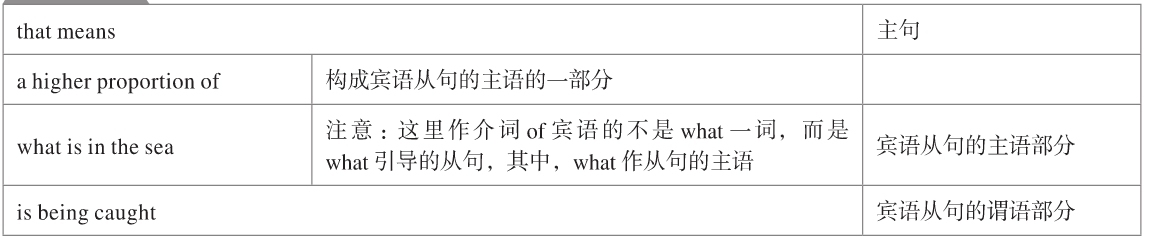
妙语点睛 这里的what后面没有接名词,what用来指物,原句可以改成一个含有定语从句的句子:“That means a higher proportion of the fish that is in the sea is being caught.”。由此可见,what没有疑问意义。还要注意断句,不能理解成a higher proportion of what是主语,谓语是is in the sea,而应该理解成是a higher proportion of这个短语后面接了一个从句what is in the sea,即充当介词of的宾语的不是what这个词,而是what从句what is in the sea。所以,这个短语不是表示“更大比例的鱼类在海洋里”,而是要理解成“海洋里更大比例的鱼类”。
4 One difficulty is that almost all of what is called behavioral science continues to trace behavior to states of mind, feelings, traits of character, human nature, and so on.
图解难句
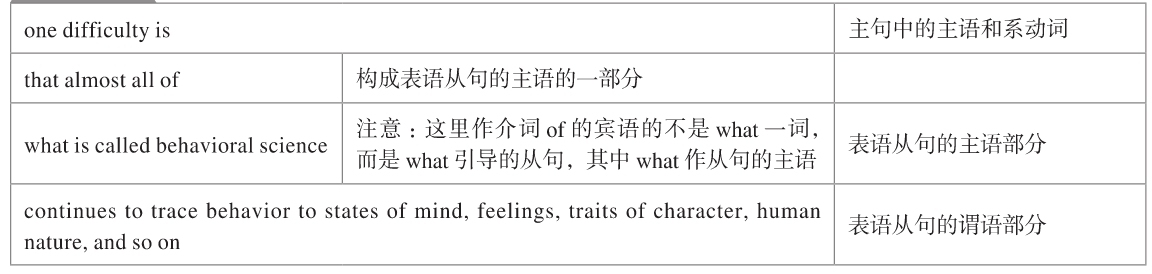
妙语点睛 这是考研英语翻译真题。这里的what后面没有接名词。和上一题中的a higher proportion of what is in the sea类似的是,用在of结构后面作宾语的是what从句what is called behavioral science,而不是what这个词。所以在翻译时应该这样断句:almost all of后面接从句what is called behavioral science,即译成“所谓的行为科学中几乎所有的都……”。而不能这样断句:almost all of what后面接谓语is called behavioral science,这样就会误译成“几乎所有的都被称为行为科学”。换句话说,我们要把what从句当作一个整体先译出来,然后再加上almost all of结构。
其次,我们再来看整个主从句的逻辑结构关系。one difficulty is...是主句的主谓语,后面接一个that引导的表语从句。在这个表语从句中,almost all of what is called behavioral science作主语,然后后面接谓语部分:continues to trace behavior to states of mind, feelings, traits of character, human nature, and so on,所以,翻译这个句子的难点就是要正确地理解主语almost all of what is called behavioral science的结构关系。
2.11.3 what的后面可以接名词
尽管what的前面不能有名词,但它后面可以接名词。当what后面接名词时,what作关系形容词,其结构是“what+名词”,相当于“all the+名词+that”,意思为“所有的……,尽可能多的……”。所以,此时的what同样没有疑问含义。这里的what一般表示物,而不表示人。我们来分析上面讨论过的这个例句:
1 Most of what food elephants eat is brought to their mouths by their trunks.
妙语点睛 这里what后面接名词food,what food相当于all the food that,表示“所有食物”,并不表示疑问意义的“什么食物”。于是,most of what food elephants eat相当于most of all the food that elephants eat,表示“大象吃的所有食物中的大部分”,并不表示疑问意义的“大象吃的大部分是什么食物”或“大象大部分吃的是什么食物”。
我们再来看其他例句:
2 What money I have has been given to you.
妙语点睛 这里what后面接名词money,what money相当于all the money that,表示“所有的钱”,并不表示疑问意义的“什么钱”。于是,what money I have相当于all the money that I have,表示“我身上所有的钱”,并不表示疑问意义的“我身上有什么钱”。
3 Lend me what reference books you have on the subject.
妙语点睛 这里what后面接名词短语reference books,what reference books相当于all the reference books that,表示“所有的参考书”,并不表示疑问意义的“什么参考书”。于是,what reference books you have相当于all the reference books that you have,表示“你所有的参考书”,并不表示疑问意义的“你有什么参考书”。
在“what+名词”这个结构中,在名词前面还可以添加其他限定词修饰名词,比如little,于是就有了“what little+名词”结构,相当于“all the little+名词+that”,表示“仅有的这点东西”。请看下面的例句:
4 The accident completely wiped out what little sight he had left.
妙语点睛 这里what后面接名词短语little sight,相当于说all the little sight that,表示“仅有的这点视力”。于是,what little sight he had left相当于all the little sight that he had left,表示“他所剩下的仅有的这点视力”。
5 After sharing what little food they had, the old couple let the two angels sleep in their bed where they could have a good night's rest.
妙语点睛 这里what后面接名词短语little food,相当于说all the little food that,表示“仅有的这点食物”。于是,what little food they had相当于all the little food that they had,表示“他们仅有的这点食物”。
2.11.4 what用在一些固定结构中
what从句常用在一些结构中,比如表示“所谓的”:what is called, what can be called, what we call, what used to call。此外还有其他结构,比如:what they described as, what they regarded as, what you may see as等等。这些结构可以作插入语,一般放在动词或介词后面作宾语。请看例句:
1 For Williams, those activities became what he calls “electronic heroin”.
2 One difficulty is that almost all of what is called behavioral science continues to trace behavior to states of mind, feelings, traits of character, human nature, and so on.
3 It's hard picking up what you may see as someone else's leftovers, especially when it's a good friend's.
妙语点睛 这句话是出自这样一个背景下:女生A喜欢上她的好朋友女生B的前男友,但因为是女生B甩了这个男友,所以女生A犹豫。
4 I was humming along on the gym treadmill when a sight almost cost me my footing. A woman was lumbering noisily toward a trainer wearing what can only be described as a garbage bag, except that it had arms and legs and a hole for her head.
妙语点睛 这句话作者写得很幽默,它描述了作者在健身房见到的一个着装怪异的人。这里what从句what can only be described as a garbage bag作wearing的宾语。注意整个分词短语wearing what can only be described as a garbage bag修饰的是woman,而不是trainer。
5 The very people responsible for ushering in what some have called a “technological renaissance”say they are working longer hours, feel more stressed, are more impatient and are even less civil in their dealing with colleagues and friends—not to mention strangers.
6 The most obvious example is late-stage cancer care. Physicians—frustrated by their inability to cure the disease and fearing loss of hope in the patient—too often offer aggressive treatment far beyond what is scientifically justified.
7 Curiously, some two-and-a-half years and two novels later, my experiment in what the Americans term “downshifting”has turned my tired excuse into an absolute reality.
8 In America, the move away from juggling to a simpler, less materialistic lifestyle is a well-established trend. Downshifting—also known in America as “voluntary simplicity”—has, ironically, even bred a new area of what might be termed anticonsumerism.
思维总结
对于what作为缩合关系代词,引导what从句的用法,首先可以总结为一句话,即“一个中心,两个基本点”。这“一个中心”就是指使用what的一个基本前提——what的前面不能有名词;“两个基本点”就是what的两个基本用法,即what的后面可以接名词或不接名词。当what的后面不接名词时,what可以指人也可以指物;当what的后面接名词时,what一般只表示物,不表示人。
其次,注意what在句中的意义。在从句中,what一般没有疑问意义,因为它相当于一个先行词和关系代词的结合体,从这个意义上来说,what引导的是一个定语从句。但从结构上来说,what从句往往相当于一个名词从句。换句话说,what所引导的从句,既可以看作是特殊的定语从句,又可以当作是名词从句。因此,为了方便起见,我们以后把what引导的从句统称为what从句。这里我们引入了“缩合关系词”这个概念,其实在英文中不只what一个缩合关系词,when和where都可以用作缩合关系词,我们在下面各节会讨论到。
思维训练2.8-2.11 Key
选择最佳答案。
1. ______ is mentioned above, the number of the students in senior high school is increasing.
A. Which B. As C.That D.It
2. ______ is known to the world, Mark Twain is a great American writer.
A. That B. Which C.As D.It
3. ______ might be expected, the response to the question was very mixed.
A. As B. That C.Which D.What
4. ______ Edward Zlotkowski, director of community service at Bentley College in Massachusetts, puts it, “There has to be coordination of programs. What's needed is a package deal.”
A. So B. Since C.As D.Thus
5. ______ is generally accepted, economical growth is determined by the smooth development of production.
A. What B. That C.It D.As
6. ______ is known to all that language shows the way ______the man looks at the world around him.
A. All, that B. It, / C.As, where D.That, in which
7. ______ can be seen from the comparison of these figures, the principle involves the active participation of the patient in the modification of his condition.
A. As B. What C.That D.It
8. It wasn't such a good dinner ______ she had promised us.
A. as B. which C.what D.who
9. As for the winter, it is inconvenient to be cold, with most of ______ furnace fuel is allowed saved for the dawn.
A. what B. that C.which D.such
10. ______ I have already mentioned, cardio-surgery is one of the amazing new surgical techniques that have been developed in recent years.
A. Which B. What C.As D.This
11. Such people ______ knew Tom thought he was a trustworthy man.
A. that B. which C.as D.what
12. The British are not so familiar with different cultures and other ways of doing things, ______ is often the case in other countries.
A. as B. what C.so D.that
13. In her time, Isadora Duncan was ______ today a liberated woman.
A. calling what we would B. who would be calling C.what we would call D.she would call it
14. They lost their way in the forest, and ______ made matters worse was that night began to fall.
A. that B. it C.what D.which
15. Water will continue to be ______ it is today—next in importance to oxygen.
A. how B. which C.as D.what
16. Much more money has been earned in the past two years than ______.
A. what had anticipated B. had expected C.had been expected D.that what had been expected
17. A microscope can reveal vastly more detail ______ is visible to the naked eye.
A. than B. that C.which D.what
18. He claims to be an expert in astronomy, but in actual fact he is quite ignorant on the subject. ______ he knows about it is out of date and inaccurate.
A. What little B. So much C.How much D.So little
19. Scientists believe the first inhabitants of the Americas arrived by crossing the land bridge that connected Siberia and ______ more than 10, 000 years ago.
A. this is Alaska now B. Alaska is now C.is now Alaska D.what is now Alaska
20. The first people to live in ______ Hawaii were the Polynesians, who sailed there in large canoes from other Pacific Islands about 2,000 years ago.
A. now where is B. what is now C.it is now D.now this is
21. ______ touching in O. Henry's stories is the gallantry with which ordinary people struggle to maintain their dignity.
A. Most is B. It mostly is C.That is most D.What is most
22. With the introduction of the electric computer, there are no complicated problems ______ can be solved.
A. that B. as C.but D.which
23. In Norway, ______ is a Baltic country, you can see the mid-night sun.
A. which B. where C.in which D.that
24. In some countries, ______ are called “public schools”are not owned by the state.
A. that B. which C.as D.what
25. In Kuwait, ______ there are many oil wells but no rivers, fresh water had to be brought in boats from 100 miles away.
A. which B. where C.that D.what
26. In some countries, ______ is called “equality”does not really mean equal rights for all people.
A. which B. what C.that D.one
27. For now, however, it does appear that the economy can sustain a higher growth rate ______ most people thought plausible just a year or two ago. In that limited respect, at least, we appear to be in a “New Economy”.
A. which B. as C.what D.than