Chapter 3状语从句
3.3 时间状语从句
3.3 时间状语从句
从本质上来讲,时间状语从句就是用来说明主句动作与从句动作发生时间上的先后关系。既然说到动作发生的时间,就必然与主句和从句的谓语的时态关系密切,而英文中的时态又与动作持续时间的长短,即延续动词(continuous verb)或短暂动词有关。因此,在学习时间状语从句时,建议读者牢牢把握下列贯穿所有时间状语从句的两个核心要点:
1. 注意主句、从句的时态搭配关系。对于不同时间状语从句的连接词,这种搭配关系是不同的。
2. 注意主句、从句的谓语动词的延续性和短暂性。延续动词所表示的动作,下文简称为“长动作(long action)”,短暂动词所表示的动作,简称为“短动作(short action)”。
学习时间状语从句的难点在于,要掌握主从句的时态搭配关系,时态搭配关系不同,句子的意思就有可能不同。比如下面这两个例句:
1 I was telephoning Harry when she arrived.
2 I telephoned Harry when she arrived.
妙语点睛 我们看到上面的两个句子仅主句的时态不同,句1用了过去进行时态(was telephoning),句2用了一般过去时态(telephoned)。时态不同则表达的意思不同,并且说明主从句动作发生的先后也不同。在句1中,telephoning(打电话)先发生,arrived(到达)后发生。句2则相反,telephoned(打电话)后发生,arrived(到达)先发生。另外,在句1中,telephoning(打电话)是一个延续性动作,arrived(到达)是短暂性动作。但在句2中,telephoned(打电话)变成了短暂性动作,这句话中只强调动作的开始,而没有强调动作的持续性。
引导时间状语从句的连词较多,主从句时态搭配以及谓语动词的动作时间长短性等用法特点也各异。因此,比较和总结不同时间连词的用法特点是我们这一节的重点内容。
需要说明的是,在接下来的各小节中,我主要是列举各个连词所引导的时间状语从句与主句之间常见的时态搭配关系,但并不想详尽罗列。有兴趣的读者不妨按照上面所说的两个核心要点来分析时间状语从句的各个连词的用法,并在以后遇到时间状语从句时,从这两方面来关注一下该从句的特点。
3.3.1 时间连词when的用法特点
连词when应该是读者最熟悉的,但它的用法比较繁琐,主要是因为主从句时态搭配关系较多。一般来讲,when的意思相当于at that time(在……时刻),因此从句的谓语动词通常是短暂动词,表示某一时刻的动作。不过,when引导的从句也可以接延续动词,这时从句往往用过去进行时态,表示某一时间段内发生的动作。下面就连词when常见的主从句时态搭配举例说明如下。
时间状语从句所表达的时间概念不外乎三种:过去、现在和将来。我们先来看when引导从句表示过去动作的五组时态搭配。
一、主句一般过去时+从句一般过去时
1 I started my dinner when he left.
2 He left when I got there.
从以上例句我们可以看出,若主从句都用一般过去时,则表示从句动作先发生。所以从句还可以用过去完成时,于是就有了下面的第二种时态搭配关系:
二、主句一般过去时+从句过去完成时
3 I started my dinner when he had left.
4 He left when I had got there.
这两句的从句都用了过去完成时,更强调从句动作先发生,意思与上面两句区别不大。不过对于某些句子来说,when引导的从句用一般过去时或过去完成时是有区别的。具体来说,在表示两个相继发生的动作时,用过去完成时可以表示在一个动作完成以后,另一个动作才开始发生,从而使得两个动作相互独立,彼此脱离开来。而用一般过去时,则可能表示一个动作“导致”另一个动作的发生,或两个动作之间有一种因果关系。例如:
5 1) When I had opened all the windows I sat down and had a cup of tea.
2) When I opened the window the cat jumped out.
妙语点睛 句1)不宜说成When I opened all the windows...,因为这里的had opened是持续了一段时间的,这从宾语all the windows可以看出来,也就是说等一系列“开窗”的动作完成之后,才有主句动作发生。在句2)中,用opened比had opened更自然,因为“开完窗”和“猫跳出去”是两个紧接着发生的动作。
6 1) When I had written my letters I did some gardening.
2) When I wrote him a letter, he came at once.
妙语点睛 句1)不宜说成When I wrote...,因为这里的had written是持续了一段时间的,这从宾语my letters可以看出来,也就是说等一系列“写”的动作完成之后,才有主句动作发生。在句2)中,用wrote比had written更自然,因为“我写信”和“他过来”有一种因果关系。
显然,若要表达主句动作先发生,则主句须用过去完成时。于是有了下面的第三种时态搭配关系:
三、主句过去完成时+从句一般过去时
7 I had started my dinner when he left.
8 He had already left when I got there.
在表示过去的动作中,when引导的从句还有一个重要的时态搭配,即一般过去时与过去进行时的搭配。关于这一点,我在《英语语法新思维中级教程——通悟语法》中详细讨论过。注意:此时的时态搭配与主句、从句没有关系,而只与动作的长短有关系。短暂性动作用一般过去时,延续性动作用过去进行时。这一时态搭配使用所表示的意义是:在一个延续背景动作进行的过程中突然发生了一个短暂动作。既然此时的时态搭配与主从句没有关系,因此可以组合成下面两种时态搭配,即“主句一般过去时+从句过去进行时”,或“主句过去进行时+从句一般过去时”。
四、主句一般过去时+从句过去进行时
9 The doorbell rang when I was telephoning.
妙语点睛 这里的短暂性动作ring用一般过去时,延续性动作telephone用过去进行时。
如上所述,这个句子也可以改成“主句过去进行时+从句一般过去时”这样的时态搭配,即:
五、主句过去进行时+从句一般过去时
10 I was telephoning when the doorbell rang.
注意:由“主句一般过去时+when+从句过去进行时”变成“主句过去进行时+when+从句一般过去时”,此时when的意思发生了改变,即由during the time(当……时候)变成了at the time(正在那时),这时when强调某个短暂性动作突然发生,所以我们可以在when引导的从句中添加suddenly一词。请比较:
11 1) The doorbell rang when suddenly I was telephoning. *
2) I was telephoning when suddenly the doorbell rang.
妙语点睛 在句1)中,由于when的意思是during the time,强调的是一个动作持续的过程,所以不能添加suddenly这样的词。而在句2)中,由于when的意思是at the time,强调的是一个短暂性动作的发生,所以可以添加suddenly一词。
我们再来看下面这个句子:
12 On a rainy day I was driving north through Vermont when suddenly I noticed a young man holding up a sign reading “Boston”.
妙语点睛 这是“主句过去进行时+从句一般过去时”的时态搭配,此时when强调短暂性动作,所以可以添加suddenly一词,在这句话中的意思是“我突然注意到”。
下面,我们来看when引导的从句表示将来动作的四组时态搭配:
六、主句一般将来时+从句一般现在时
在表示将来的动作时,主句显然要用一般将来时,而时间状语从句要用一般现在时表示将来,不能使用将来时态。主从句的这种时态搭配应该是大家最熟悉不过的了,在初中就应该学过。请看例句:
13 I’ll speak to him when he arrives.
14 I’ll tell him about it when he comes back.
七、主句一般将来时+从句现在完成时
在when引导的从句中,除了用一般现在时表示将来之外,还可用现在完成时表示一个将要发生的动作,主句依然用一般将来时。这种时态搭配一般读者是不太注意的。从句中用完成时态是为了强调:在从句动作结束了之后,主句动作才开始发生。此时从句的动作一般都是需要持续一段时间的。请比较:
15 I’ll go when I have had my dinner.
妙语点睛 如果说“I’ll go when I have my dinner.”,则表示“我吃着饭的同时就出去了。”
16 I’ll give you a call when I have finished the work.
17 The winner will be declared when every competitor has finished the course.
18 Hilary: You ought to seriously consider that never again in your life will you be surrounded by so many eligible bachelors. It's a once-in-a-lifetime opportunity!
Catherine: Love can wait. I’m too young to have my heart broken. When I’ve taken the first few steps on my career ladder then I’ll start looking for a soul mate.
Hilary: You old dinosaur you! By then all the best guys will have been taken.
我们看到,在上面第六、七两组时态搭配中,都是从句动作先于主句动作,类似于上面第一、二两组时态搭配中的从句动作先于主句动作的情况。其实,第六、七两组时态的差别类似于第一、二两组时态的差别,请读者自己体会一下。
同理,在将来的动作中,若要表示主句动作先发生,则主句要用将来完成时,这与上面的第三组时态搭配类似。
请看例句:
八、主句将来完成时+从句一般现在时
19 The performer will already have played the music when we get here.
同理,与我们上面讨论过的第四、五两组“进行时与一般时”的搭配类似,将来动作也有“进行时与一般时”的搭配。请看例句:
九、主句将来进行时+从句一般现在时
20 The performer will be playing the music when we get there.
最后,我们来看when引导从句表示一般现在动作的时态搭配。
十、主从句都用一般现在时
表示现在一般动作的时态搭配是,主从句都用一般现在时态。表示一般动作的when引导的从句往往是说明一般情况,阐明一个道理,因而常出现在名言警句、谚语或格言中。请看例句:
21 When you were born, you cried and the world rejoiced. Live your life so that when you die, the world cries and you rejoice.
妙语点睛 我们看到,这里的主从句都是用了一般现在时态。
这是一个印度的谚语,相信大家也非常熟悉。
再比如,在谈到宠物狗时,威尔·罗杰斯说过这样一句话:
22 If there are no dogs in Heaven, then when I die I want to go where they went.
说到幸福,有这样一个句子:
23 Happiness is like a visitor. You can't command her appearance. You can only appreciate her when she does show up. And you can't force happiness to happen—but you can make sure you are aware of it when it does. Happiness is an attitude, not a condition.
妙语点睛 我们看到,这里的主从句都是用了一般现在时态。
这句话说明“幸福是一种心态”这个道理。说到我们的心态,有这样一个句子:
24 When my attitudes are right, there is no barrier too high, no valley too deep, no dream too extreme, no challenge too great for me.
表示一般时态的when引导的从句还可以用于固定结构中,比如when it comes to,表示“当说到……”。请看例句:
25 Doing your homework is a sure way to improve your test scores, and this is especially true when it comes to classroom tests.
26 In general, the tests work most effectively when the qualities to be measured can be most precisely defined and least effectively when what is to be measured or predicted cannot be well defined.
妙语点睛 这是考研翻译题。通过这个真题例句,我想说明的是,when虽然是一个时间连词,但在特定的上下文中,可能会含有条件的意味,我们可以译成“如果”。
十一、whenever引导时间状语从句
我们可以用whenever引导时间状语从句,表示“无论何时”,它相当于when的强调形式。请看例句:
27 Whenever you say “I love you”, mean it. Whenever you say “I’m sorry”, look the person right in the eyes.
28 Whenever someone asks you something you don't want to answer, smile and ask, “Why do you want to know?”
29 Smile whenever you pick up the phone, for the caller will be able to notice it.
从以上所讨论的例句,我们可以看出,首先,when引导的时间从句通常表示过去时间的动作较多,其次是表示将来,很少表示一般现在的动作。在表示现在的情况时,往往是用于名言警句中。再次,在上面十组时态搭配中,最重要、最常用的是第四、五两组中的“过去进行时+一般过去时”的搭配,所以请读者格外注意。对于其他的时态搭配关系,读者可以了解一下。
3.3.2 时间连词while的用法特点
当while用作时间连词时,意思相当于during that time(在……期间),表示某一时间段内发生的动作,因此,从句谓语动词通常接延续动词。请看例句:
1 The phone rang while I was taking my bath.
妙语点睛 此句中while后面的谓语部分taking my bath是一个持续性动作。
2 The doorbell rang while we were watching TV.
妙语点睛 此句中while后面的谓语部分watching TV是一个持续性动作。
3 Happiness is an attitude, not a condition. It's cleaning the Venetian blinds while listening to an aria, or spending a pleasant hour organizing your closet. Happiness is your family assembled at dinner. It's in the present, not in the distant promise of a “someday when...”.
妙语点睛 这句话是接上一小节的例句23,继续谈论幸福。此句中while后面的谓语部分listening和spending都表示一个持续性的活动。
时间连词while和when的含义有差别,while的意思相当于during that time(在……期间),表示某一时间段内发生的动作,因此,从句的谓语动词通常接延续动词。when的意思相当于at that time(在……时刻),从句谓语动词通常是短暂动词,表示某一时刻的动作(从句也可接延续动词,这时从句往往用过去进行时态)。请比较:
4 A detective arrested a criminal and was about to handcuff (给……戴上手铐) him when a huge gust (一阵狂风) of wind blew the detective's hat off.
“Shall I go and fetch it?”the criminal asked. “Do you take me for a fool?”asked the detective. “You wait here while I go and get it!”
妙语点睛 此句中的go and get虽然是短暂动词,但两动词连用表示的是在一段期间内的活动,所以用连词while。而when的从句的谓语是blew off,表示“吹落”,显然是一个短暂性动作,所以不能用while引导。
我们再来看下面这道考题:
5 I was walking along the road ______ suddenly someone patted me on the shoulder from behind.
A. immediately B. when C.the moment D.while
正确答案 B。
妙语点睛 这是一道四级考题。我们看到,这里从句的动词patted是一个短暂性动作,所以不能选D。
6 The phenomenon provides a way for companies to remain globally competitive ______ avoiding market cycles and the growing burdens imposed by employment rules, healthcare costs and pension plans.
A. but B. while C.and D.whereas
正确答案 B。
妙语点睛 这是考研完形填空题,这道题我们在前面讨论过。我们看到这里的动词avoid相当于表示了一个状态,是延续动词,所以用while。
此外,需要再次提醒的是,while除了表示时间外,还可以有另外三种意思:表示条件的“只要”、表示对比的“然而”、表示让步的“尽管”,这些我在前文中都提到过。
3.3.3 时间连词as的用法特点
在英语中,as作为连词,可以引导各类状语从句,所以遇到as引导的从句时,我们需要小心,注意正确理解其意思。当as引导时间从句时,它相当于while,即后面要接延续动词,一般译成“正当……”,“随着……”或“一边……一边……”。与as引导的从句搭配的主句的谓语可以是延续动词,也可以是短暂动词。请看例句:
1 The arrow fell into the river as the boat was drifting on the water. The soldier tried to retrieve it.
妙语点睛 从句的谓语was drifting是延续动词,主句的谓语fell是短暂动词。
2 ______ industrial giants like General Motors and IBM struggle to survive by reducing the number of employees, Manpower, based in Milwaukee, Wisconsin, is booming.
A. For B. Because C.As D.Since
正确答案 C。
妙语点睛 这是考研完形填空题。这里as引导的从句表示时间。从句的谓语struggle与主句的谓语is booming都是延续动词。
3 Urban Japanese have long endured lengthy commutes (travels to and from work) and crowded living conditions, but as the old group and family values weaken, the discomfort is beginning to tell.
妙语点睛 从句的谓语weaken是延续动词,主句的谓语is beginning表示一个持续的过程。as在这里可以译成“随着……”。
4 Shortlists for job interviews, election ballot papers, lists of conference speakers and attendees: all tend to be drawn up alphabetically, and their recipients lose interest as they plough through them.
妙语点睛 从句的谓语plough与主句的谓语lose都是延续动词。as在这里可以译成“一边……”。
5 As the Internet becomes more and more commercialized, it is in the interest of business to universalize access—after all, the more people online, the more potential customers there are.
妙语点睛 从句的谓语becomes是延续动词,主句的谓语is表示延续状态。
3.3.4 时间连词before的用法特点
连词before引导时间从句时,同when一样,主从句也会有各种时态搭配关系,其中比较常见的一种是“主句用过去完成时,从句用一般过去时”。请看例句:
1 During several years of gambling in that casino, Williams, a state auditor earning $35,000 a year, lost approximately $175,000. He had never gambled before the casino sent him a coupon for $20 worth of gambling.
妙语点睛 这里before的后面接了一个时间从句,从句的谓语用一般过去时态sent,主句的谓语用过去完成时态had gambled。
在这里我不想详细讨论关于before的主句和从句的时态关系,而只是分析一下它的汉译特点。我们都知道,before一般译成“在……之前”,比如上面例句中的“在该赌场送给他一张价值20美元的赌票之前”。再看下面的例句:
2 Even before Alan Greenspan's admission that America's red-hot economy is cooling, lots of working folks had already seen signs of the slowdown themselves.
妙语点睛 这里before的后面接了一个名词短语Alan Greenspan's admission,其后的that引导的从句为同位语从句,补充说明admission。before在这里正常地翻译成“在……之前”。
不过,有时我们为了译文更加地道,需要将before的汉译作适当的调整,不一定将before都生硬呆板地译成“在……之前”。请看下列的例句:
3 The Greeks assumed that the structure of language had some connection with the process of thought, which took root in Europe long before people realized how diverse languages could be.
妙语点睛 这是考研翻译题。此句我们在第二章第2.1.3小节详细讨论过,这里我们再来讨论其中的第二个翻译难点,即before的翻译技巧。在英文中,before引导的从句一般接肯定形式,但翻译成汉语时,我们往往处理成否定的意思,所以这里before引导的从句before people realized how diverse languages could be可以译成“在人们尚未认识到语言的千差万别之前”。然而有的考生由于不知道before的这种汉译特点,把这句话翻译成“希腊人认为,语言的结构与思想的过程有某种联系,这种想法源于欧洲,很久以前,人们就意识到语言是多么的丰富多彩。”
4 Our magazines feature beaming celebrities and happy families in perfect homes. And since these messages have an agenda—to lure us to open our wallets—they make the very idea of happiness seem unreliable. “Celebrate!”commanded the ads for the arthritis drug Celebrex, before we found out it could increase the risk of heart attacks.
妙语点睛 这里before引导的从句虽然是表示时间,但其实是引导了一个前后对比关系:before之前的部分说,治疗关节炎的药物Celebrex的广告鼓动人们去“欢乐”,before后面的部分说,我们发现这种药物会加大罹患心脏病的危险。所以,前后两个部分有一种转折的意味。
5 The mineral elements from the soil that are usable by the plant must be dissolved in the soil solution before they can be taken into the root.
妙语点睛 这里before引导的从句虽然是表示时间,但就上下文的逻辑关系来看,我们可以把它转译成一个条件从句,译成“只有……才……”。
另外,在before引导的从句之前若有一段时间,这时候before引导的从句一般可以翻译成“在多长时间之后才……”。请看例句:
6 It took a few months of investigation before it became clear.
妙语点睛 我们看到,这里before的前面有一个时间段a few months,如果我们按照原文的语序译成“在情况变得明朗之前,花了几个月时间的调查”,就有股“英语腔”,不符合我们汉语的表达习惯,因此我们宜把它译成“在多长时间之后才……”的结构。
7 In this factory, suggestions often have to wait for months before they are fully considered.
妙语点睛 我们看到,这里before的前面有一个时间段months,所以我们宜按照上述规律来变通翻译。
3.3.5 时间连词after的用法特点
对于连词after引导时间从句,读者应该比较熟悉。它的主从句时态搭配关系也有各种情况,其中一种是与before相反,即“主句用一般过去时,从句用过去完成时”。请看例句:
I moved to America after I had learned English for ten years.
妙语点睛 这里after的后面接了一个时间从句,从句的谓语用过去完成时态had learned,主句的谓语用一般过去时态moved。
关于连词after的其他时态搭配关系,在此不再赘述。
3.3.6 时间连词since的用法特点
since作为时间连词,往往与现在完成时态有密切关系,它的详细用法,我们已在《英语语法新思维中级教程——通悟语法》里讨论过,在此不再赘述,仅举几例回顾一下。
一、现在完成时态+since+短暂动词的一般过去时
这种主从句的时态搭配关系是最常见的,应该是读者非常熟悉的。请看例句:
1 I have worked in this company since I graduated.
妙语点睛 这里的since的后面接了一个时间从句,从句谓语用一般过去时态graduated,主句谓语用现在完成时态have worked。
主句也可以用现在完成进行时态。请看例句:
2 A: I must admit that since I started the exercises I’ve been feeling less tired.
B: What did I tell you?
妙语点睛 这里since的后面接了一个时间从句,从句谓语用一般过去时态started,主句谓语用现在完成进行时态have been feeling。
以上讨论的是since后面接短暂动词要用一般过去时态。但是,若since后面接的是延续动词,那么用一般过去时态或现在完成时态均可,但意思不一样,于是就有了下面两种时态搭配:
二、现在完成时态+since+延续动词的一般过去时
若since后面的延续动词用一般过去时态,则表示从句动作“结束”以来,主句活动还在持续。请看例句:
3 He hasn't contacted me since I worked in that company.
妙语点睛 这里since的后面接了一个时间从句,从句谓语worked是延续动词,使用了一般过去时态,主句时间则是从work这个活动已经“结束”后开始算起的,即该句表示“我”不在这家公司工作了。
三、现在完成时态+since+延续动词的现在完成时
若since后面的延续动词用现在完成时态,则表示从句动作“开始”以来,主句活动在持续。请看例句:
4 He hasn't contacted me since I have worked in that company.
妙语点睛 这里的since的后面接了一个时间从句,从句谓语worked是延续动词,使用了现在完成时态have worked,主句时间则是从work这个活动“开始”后开始算起的,即该句表示“我”开始在这家公司工作以来。
再比如,在下面这个对话中,约翰和珍妮正在谈论自己想转学到剑桥大学(Cambridge University)去,但又担心不成功:
5 John: I am thinking about Cambridge University. It has an excellent reputation. But it's probably very selective.
Jenny: But you have gotten good grades in the three semesters since you have been in here at the college, haven't you?
John: Yeah, mostly As in my major and a few Bs in sciences.
Jenny: So what are you worried about? Just ask your professors to write letters of recommendation for you and get your
portfolio together, and you’ll be set.
妙语点睛 这里用了表示延续状态的be动词的完成式have been,表示约翰在现在这个学院上学已有三个学期了。若是用表示延续状态的be动词的过去式was,则表示约翰已经离开他现在的学院有三个学期了,这显然不符合上下文的语境。
其实,在since引导的时间从句中还可以用其他时态,比如现在完成进行时态。请看例句:
6 A: You look great since you’ve been taking those exercise classes.
B: Thanks. I’ve never felt better in my life.
妙语点睛 这里的since引导的从句用完成进行时态have been taking,表示的是一个“重复活动”,即说明从过去到目前为止的一段时间内“你”多次参加锻炼。
从以上的讨论我们知道,since引导的从句的谓语不仅可以使用一般过去时态,还可以用其他时态,比如完成时态或完成进行时态。since引导的从句的动词与时态的关系如下:
1. 接短暂动词,常用一般过去时态did,翻译时按英文字面意思理解即可。这是since最常见的用法。
2. 接延续动词,此时分两种情况:一是用一般过去时态did,表示从句动作已经结束,翻译时不能按照英文字面意思理解;二是用现在完成时态have done,表示从句动作开始延续,翻译时可按照英文字面意思理解。
3. 从句动作也可用完成进行时态have been doing,此时动词的延续性或短暂性不限。
3.3.7 时间连词until的用法特点
对于until一词,相信很多读者并不陌生。但要想真正掌握until的思维表达特点,进而灵活运用这个连词,则并不是很简单。记得当初我自己在学习until这个词时,就搞不清楚什么时候该用until,什么时候该用not...until。也许有的读者死记住了二者的意思,知道until表示“一直到”,而not...until表示“直到……才……”。其实,如果只是这么死记硬背,而不去理解until背后的英语思维方式,就很难从思维表达的高度来掌握until的用法。如果没有真正理解until的思维表达特点,那么到运用的时候可能还是不会,或者说本来该用until的句子,就想不到要用until。比如,我曾在学生的习作中看到下面这个句子:
I will leave my office and will only be back next Tuesday. *
这句话,用我们中国人的思维眼光来看,也许觉得很正常。或者说,看到这个句子,我就知道它一定是中国学生写出来的,因为它就是下面这个中文句子的直译:
其实,这个句子所要表达的意思就是“我不在办公室这个状态要一直持续到下周二”,这正好就是until能够表达出来的。另外要注意的是,leave是一个短暂性动作,显然它无法“一直持续到下周二”,所以要把这里的“离开(leave)”改为一种状态,即用be away from来表达这个意思。因此,这个句子用真正的英文思维方式来表达是:
I will be away from my office until next Tuesday.
而不能说:
I will leave my office until next Tuesday. *
我们再来看native speaker是如何运用until的。比如:
1 I will be away from home until 2nd June.
下面这个句子是我在申请国外大学时,对方给我的回复:
2 I am away from the office until Friday 2 January, 2004. The University is closed from 23 December 2003 until Friday 2 January 2004. Because of the Christmas holiday period we will get back to you early in January.
分析至此,我们再回头看上面那个错误的句子,很显然,烙上中文思维印记的这句话不是地道的英语思维表达方式。我们不能说这个句子的作者不知道until这个词,但在该用until的时候就是“没有想起来”,而依然按照汉语的思维方式来表达。我认为,主要原因可能还是作者只是记住until的意思,而until这个词背后的思维特点没有进入作者的思维里。那么until背后真正的思维特点是什么呢?对此,我总结出三个有关until用法的要点:
1. 既可以作为介词也可以作为连词,所以until后面可以接名词短语也可以接时间从句。
2. until的本质是表示“一个动作(主句动作)一直持续到某一个时间点(point of time)”。具体来说就是:until前面的主句或句子谓语必须是延续性的,而until后面接的从句的谓语须是短暂动词或接时间点。
3. 由上面第2点,我们可以推导出until的句型结构有:
1) 作为连词引导从句时的句型:主句的延续动词+until+从句的短暂动词;
2) 作为介词接名词短语的句型:延续动词+until+时间点(不是时间段)。
下面我们将从三个方面来详细讨论until的上述用法特点:
一、延续动词+until+短暂动词或时间点
当主句或句子的谓语动词是延续动词时,通常用肯定形式。until后面若接从句则从句谓语必定是短暂动词,或者接表示时间点的名词短语。请看例句:
3 Wait until he comes back.
妙语点睛 这里主句的谓语wait是延续动词,从句的谓语comes是短暂动词。这句话表示wait这个动作一直持续到“他回来”这个时间点为止。
4 Until I came back, he was waiting for me at my home.
妙语点睛 这里主句的谓语waiting是延续动词,从句的谓语came是短暂动词。这句话表示wait这个动作一直持续到“我回来了”这个时间点为止。
5 We’ll stay here until it stops raining.
妙语点睛 这里主句的谓语stay是延续动词,从句的谓语stops是短暂动词。这句话表示stay这个动作一直持续到“雨停了”这个时间点为止。
6 When I showed my dad my report card, I said, “Remember, Dad, Thomas Edison got bad grades in school, too.”He said, “Fine, stay in your room until you invent the light bulb (灯泡).”
妙语点睛 这里主句的谓语stay是延续动词,从句的谓语invent是短暂动词。这句话表示stay这个动作一直持续到“发明出来”这个时间点为止。
在以上例句中,until都是用作连词,引导时间状语从句。前文说过,until可以作介词,后面接时间点。比如我们上面讨论过的这个例句:
7 I will be away from my office until next Tuesday.
妙语点睛 这里的名词短语next Tuesday表示一个时间点,until是一个介词。
二、短暂动词+until+短暂动词或时间点
值得注意的是,若主句或句子谓语动词是短暂动词,则要用否定形式,因为否定之后表示的是一个状态,而状态是延续的,这就是我们常说的“not...until(直到……才……)”的结构。请看例句:
8 He didn't leave the office until his boss came back.
妙语点睛 这里的主句的谓语leave是短暂动词,不能与表示持续时间的until连用,所以必须用否定形式didn't leave表示一个持续的状态,才能与until连用。这句话表示“没有离开”这个状态一直持续到“老板回来”这个时间点为止。从句的谓语came是短暂动词。
9 I did not realize how special my mother was until I became an adult.
妙语点睛 这里主句的谓语realize是短暂动词,不能与表示持续时间的until连用,所以必须用否定形式didn't realize表示一个持续的状态,才能与until连用。这句话表示“没有意识到”这个状态一直持续到“我长大成人”这个时间点为止。从句的谓语became是短暂动词。
10 One will never realize how much and how little he knows until he starts talking.
妙语点睛 这里主句的谓语realize是短暂动词,不能与表示持续时间的until连用,所以必须用否定形式never realize表示一个持续的状态,才能与until连用。这句话表示“没有意识到”这个状态一直持续到“开始交谈”这个时间点为止。从句的谓语starts是短暂动词。
在以上的例句中,until都是用作连词,引导时间状语从句。而我们在前文说过,until还可以作介词,后面接时间点。请看例句:
11 Ice cream did not reach America until about the middle of the eighteenth century.
妙语点睛 这里的名词短语about the middle of the eighteenth century表示一个时间点,until是一个介词。主句的谓语reach是短暂动词,不能与表示持续时间的until连用,所以必须用否定形式did not reach表示一个持续的状态,才能与until连用。这句话表示“没有到”这个状态一直持续到“18世纪中叶”这个时间点为止。
12 I didn't go to bed until 12 o’clock last night.
妙语点睛 这里的名词短语12 o’clock last night表示一个时间点,until是一个介词。主句的谓语go是短暂动词,不能与表示持续时间的until连用,所以必须用否定形式didn't go表示一个持续的状态。这句话表示“没有上床睡觉”这个状态一直持续到“昨晚12点钟”这个时间点为止。
下面我们来重点讨论not...until的四种句型结构。但要注意,结构上的改变并不影响该句型的核心意思。
※ not...until的四种不同句式
由以上讨论的第二点可知,若主句或句子的谓语动词是一个短暂动词,则要用否定形式,于是便有了not...until结构。这一结构在实际使用中常常会有以下四种变体结构,下面分别进行详细讨论。
(1) 结构一:正常结构
这一结构即是最常见的结构not...until。请看例句:
13 The little boy didn't smile until he saw his mother.
14 The exact time of dying was not of great importance until recently.
(2)结构二:until置于句首
结构二是在结构一的基础上演变过来的,即只需把until后面的所有成分提到句首,便有了Until..., not结构。请看例句:
15 Until he saw his mother, the little boy didn't smile.
16 Until recently, the exact time of dying was not of great importance.
这个结构只是在结构上把until部分提到句首,变成Until..., not,所以句子的意思自然不会改变。不过,这种结构上的移位,在翻译时很容易被我们误解。比如,例句16很容易被误译成:
直到最近,死亡的确切时间都是不重要的。*
但实际上应该译成:
我们再来看更多的例句:
17 Until recently, scientists have been unable to devise a drill which would be capable of cutting through hard rock at great depths.
妙语点睛 这个句子的结构并不复杂,但很容易误解,很容易就按照英文字面的顺序被错译成“直到最近,科学家们一直不能设计出……”。很多读者刚才是不是就是这么翻译的?如果是这样翻译,那就错了,错的原因就是看不出这里until与否定词unable在语义上的相关性,实际上相当于大家熟悉的not...until结构的一个变体,即把until提到句首了。既然not...until要译成“直到……才……”,那么until..., not 同样要译成“直到……才……”。所以,这里的until recently, scientists have been unable...要译成“直到最近,科学家们才能……”。
再比如:
18 Until quite recently, most mothers in Britain did not take paid work outside the home.
妙语点睛 这个句子的结构并不复杂,但很容易误解,很容易就按照英文字面的顺序被错译成“直到最近,英国大多数的母亲都没有……”。其实,既然not...until 要译成“直到……才……”,那么until..., not 同样要译成“直到……才……”。所以,这里的Until quite recently, most mothers in Britain did not...要译成“直到最近,英国大多数的母亲才……”。
下面,我们再来看一个稍微复杂一点的句子:
19 Indeed, until adoption of the 1982 Convention, the argument could be made that there existed no adequate and comprehensive maritime treaty law as such for the larger part of the world community.
图解难句
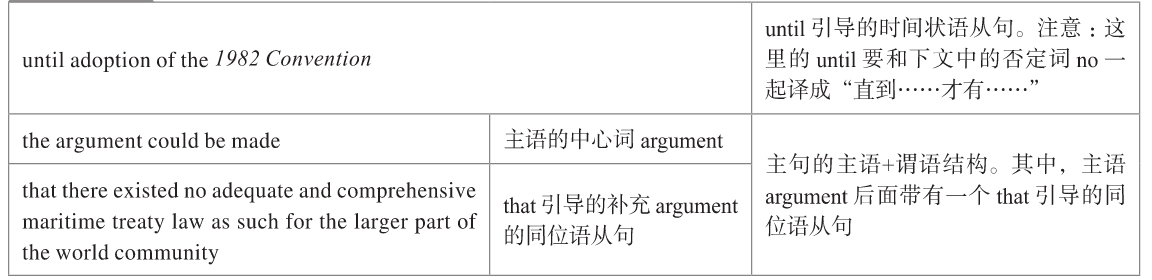
妙语点睛 这里有一个翻译难点就是,要看出until与同位语从句中的否定词no是有语义联系的,相当于大家熟悉的not...until结构的一个变体,即把until提到句首了。既然not...until要译成“直到……才……”,那么until...no同样要译成“直到……才……”。另外,就句子结构来说,主句的主语argument后面带有一个同位语从句,二者被谓语could be made隔开。
(3)结构三:倒装结构
结构三是在结构二until..., not的基础上变化过来的,即只需要把否定词not提到句首,置于until前面,于是便有了“not until..., 谓语助动词+主语+谓语动词”的结构。也就是说,此时主句要采用部分倒装结构,即将主句谓语的助动词提到主语前面,谓语动词仍放在主语后面。请看例句:
20 Not until he saw his mother did the little boy smile.
妙语点睛 这里的主句did the little boy smile采用了部分倒装结构,即将主句谓语的助动词did提到主语the little boy前面,谓语动词smile仍放在主语后面。
需要提醒注意的是,在not until倒装结构中,需部分倒装的是主句中的谓语动词,而非从句中的谓语动词。比如我们不能说:
Not until did he see his mother the little boy smiled. *
再比如:
21 Not until she had arrived home did she remember her appointment with the doctor.
妙语点睛 这里的主句did she remember her appointment with the doctor采用了部分倒装结构,即将主句谓语的助动词did提到主语she前面,谓语动词remember仍放在主语后面。从句she had arrived home并没有采用倒装结构写成had she arrived home,而依然是正常语序。
(4)结构四:强调结构
结构四是在结构三“not until..., 谓语助动词+主语+谓语动词”的基础上变化过来的,即是由结构三与强调结构It was...that复合而成,于是便有了“It was not until+时间从句或短语+that+主句部分”的结构。请看例句:
22 It was not until he saw his mother that the little boy smiled.
23 It was not until recently that the exact time of dying was of great importance.
我们看到,倒装结构演化成强调结构时,主句的谓语不再采用倒装形式。请比较:
24 1) Not until she had arrived home did she remember her appointment with the doctor.
2) It was not until she had arrived home that she remembered her appointment with the doctor.
我们看到,在强调句型中,主从句都不采用倒装结构。
25 As was discussed before, it was not ______ the 19th century that the newspaper became the dominant pre-electronic medium, following in the wake of the pamphlet and the book and in the company of the periodical.
A. after B. by C.during D.until
正确答案 D。
妙语点睛 这是考研完形填空题。这道题考的就是“It was not until+时间点+that从句”这样一个强调时间的结构。
3.3.8 表示“一……就……”的结构
在英文中,还有一些时间连词用来表达主句动作和从句动作相继发生,两者发生的时间间隔不长,相当于汉语里的“一……就……”的意思。此时,主句和从句的谓语都是短暂动词。这样的连词有两组,时态搭配用法也有所不同。
一、从句动作先于主句动作
确切地说,就是在从句动作发生之后,主句动作紧接着就发生了。表示这一时间关系的连词有:as soon as, once, the minute, the moment, the instant, immediately, directly, instantly等。这些连词的用法和句式结构是一样的,主从句时态一般一致。比如,若表示将来的动作,则主句用一般将来时,从句用一般现在时。请看例句:
1 We will leave as soon as it stops raining.
妙语点睛 首先,这里主句的谓语动词leave和从句的谓语动词stops都是短暂动词。其次,主句谓语的时态是一般将来时will leave,从句谓语的时态是一般现在时stops,但表示将来的动作。再次,从句动作stops先发生,紧接着主句动作leave发生,即“先雨停,再离开”。
若表示过去的动作,则主句和从句都用一般过去时。请看例句:
2 It began to rain as soon as I arrived home.
妙语点睛 首先,这里主句的谓语动词began和从句的谓语动词arrived都是短暂动词。其次,主句谓语的时态是一般过去时began,从句谓语的时态也是一般过去时arrived。再次,从句动作arrived先发生,紧接着主句动作began发生,即“先到家,再开始下雨”。
再比如:
3 The doorbell rang as soon as we began having dinner.
我们可以把上面例句中的连词as soon as换成其他连词,比如immediately, instantly或directly。请看例句:
4 It began to rain immediately I arrived home.
5 The doorbell rang immediately we began having dinner.
或者换成带有定冠词the的连词,比如the moment, the minute或the instant。比如下面这两个谈论朋友的句子:
6 A fair-weather friend is like a banker who lends you his umbrella when the sun is shining and takes it back the minute it rains.
7 Don't trust those who leave their friends the moment they get into difficulty!
还记得我们在前面讨论过的两个谈论幸福的句子吗?其下文是:
8 How much luckier we are and how much more happiness we experience, if we can fall in love with the life we’re living. Happiness is a choice. Reach out for it the moment it appears.
二、主句动作先于从句动作发生
确切地说,就是在主句动作发生之后,从句动作紧接着就发生了。表示这一时间关系的连词有:hardly...when, scarcely...when, no sooner...than。需要提醒注意的是,这些连词的用法和句式结构是不一样的,主从句时态一般也不一致。它们一般多用来表示过去的动作,此时,主句多用过去完成时,且常倒装,从句用一般过去时,它可与as soon as等从句、主句互换。请比较:
9 1) No sooner had I arrived home than it began to rain.
2) It began to rain as soon as I arrived home.
妙语点睛 首先,在例句1)中,连词than后面的it began to rain是从句,但在例句2)中,it began to rain是主句;在例句1)中,had I arrived home是主句,但在例句2)中,I arrived home是从句。其次,在例句1)中,主句had I arrived home用了过去完成时且是倒装结构,从句it began to rain用一般过去时;在例句2)中,主句it began to rain和从句I arrived home都用一般过去时。
再来看更多的例句:
10 A: The floor is awfully wet. What happened?
B: No sooner had I got into the shower than the phone rang.
11 No sooner had the storm started than all the lights went out.
12 No sooner had I started to type my paper than the telephone rang.
我们还可以用hardly/scarcely...when的结构来表达同样的意思,比如:
13 Hardly had I arrived home when it began to rain.
14 Hardly had I got into the shower when the phone rang.
15 Hardly had the storm started when all the lights went out.
16 Scarcely had I started to type my paper when the telephone rang.
3.3.9 时间连词by the time的用法特点
确切来说,by the time是一个介词短语,但起着连词的作用,其后可以直接加一个从句,它的意思是“在……之前”,强调的是“一个动作在另外一个动作发生之前已经完成(one event is completed before another event)”。因此,与by the time搭配的主句要用完成时态。具体来说,常见的句型结构有:
一、表示过去的动作:主句用had done+by the time+从句用did
请看例句:
1 We had already left by the time they arrived.
妙语点睛 从句中的arrived用一般过去时,对应的主句用过去完成时had left。
再比如,下面这个出自《龟兔赛跑》的句子:
2 By the time he woke up, remembered the race and started running, he saw that the tortoise had already reached the finish line and won.
妙语点睛 从句中的woke用一般过去时,对应的主句用过去完成时had reached。
二、表示将来的动作:主句用will have done+by the time+从句用do
3 We will have already left by the time they arrive.
妙语点睛 从句中的arrive表示将来的动作,对应的主句用将来完成时will have left。
3.3.10 一些表示时间的名词短语引导的时间状语从句
有一些表示时间的名词短语也可当作连词来用,引导时间状语从句。常见的有:next time, every time, each time, the day, the week等等。请看例句:
1 Next time you come, remember to bring along your sister.
2 Every time I listen to your advice, I get into trouble.
3 In the classic children's tale, the puppet Pinocchio's nose grows longer every time he tells a lie.
我们再来看下面这篇短文,讲的是“态度决定一切(attitude is everything)”的道理。
4 Each morning I wake up and say to myself, “Jerry, you have two choices today. You can choose to be in a good mood or you can choose to be in a bad mood.”I choose to be in a good mood. Each time something bad happens, I can choose to be a victim or I can choose to learn from it. I choose to learn from it. Every time someone comes to me complaining, I can choose to accept their complaining or I can point out the positive side of life. I choose the positive side of life. Life is all about choices.
5 The day he returned, his father was already dead.
曾经有一年的高考题考的是the first time和for the first time的区别。其实,两者的意思是一样的,都表示“第一次”,但在句中的用法不同。the first time起着连词的作用,后面接从句,然后再与一个主句连用;而for the first time是一个介词短语,不能引导从句,即不能连接两个句子。请看例句:
6 Cecilia: I don't think any boy dances very well here. You know the first time I danced with a boy, he danced worse than me. I asked him, “Since you can't dance, how dare you invite me to dance?”
Louise: What did he say?
Cecilia: He said, “Because I am sure you dance better than me, so that I want you to teach me.”
Louise: Oh, and what happened then?
Cecilia: He's not only my dancing partner but my soul partner, too!
妙语点睛 这里的the first time后面接从句I danced with a boy,表示时间,与主句he danced worse than me连用。所以,the first time相当于一个连词,连接主句和从句。
7 A: Hey, Dan. I hear you’re meeting Susan's parents for the first time.
B: Yeah, next weekend. Fortunately her father loves to fish so we’ll have something to talk about.
妙语点睛 这里for the first time后面并没有连接句子。
8 Queen Elizabeth II's traditional Christmas speech will be available as a podcast for the first time.
妙语点睛 这里for the first time后面并没有连接句子。
讲完英国女王的例子,我们再来讲一个有关查尔斯王子的例句。通过这个例句,我想说明的是,the first time除了引导时间从句外,还可以接定语从句。请看下面这篇短文:
9 As for the crocodile expression—I have no idea of its origin. The first time I can actually remember hearing it—in public anyway, was when Prince Charles was leaving Australia by boat. As the ship moved away from the wharf, someone yelled out to him, “See you later Alligator.”To everyone's surprise, and the delight of the media, he called back, “In a while, crocodile.”
妙语点睛 这里the first time后面连接句子“I can actually remember hearing it—in public anyway”,此时不能用for the first time。
顺便提一句,这篇短文出自我的澳大利亚朋友给我的一封回信,当时我向他询问了see you later Alligator这个表达的来历。在和好朋友告别时,我们可以很戏谑地说“See you later Alligator.”。下次若有外国朋友这么向你道别,你可以回答“In a while, crocodile.”以便押韵。
思维总结
这一节我花了不少篇幅来一一讨论各个引导词的用法特点。在一开始,我就提醒读者,在学习时间状语从句时,要牢牢把握下面两个核心要点:
1. 注意主句、从句的时态搭配关系。不同时间从句的连词,这种搭配关系是不同的。
2. 注意主句、从句的谓语动词的延续性和短暂性。
学习时间从句的难点在于掌握主从句的时态搭配关系,时态搭配关系不同,句子的意思就有可能不同。
思维训练3.3 Key: P341
一、选择最佳答案填空。
1. ______ she realized it was too late to go home.
A. No sooner it grew dark than B. Scarcely had it grown dark than
C. Hardly did it grow dark that D.It was not until dark that
2. I had just started back for the house to change my clothes ______ I heard voices.
A. as B. when C.after D.while
3. Not until ______ himself seriously ill.
A. he had completed the task did he find B. had he completed the task did he find
C. he completed the task he had found D.did he complete the task he had found
4. By the time the firemen arrived, the whole building ______.
A. has burned down B. had burned down C.will have burned down D.burned down
5. We heard a loud sound of drums beating ______ the parade marched.
A. till B. while C.the moment D.once
6. The policemen went into action ______ they heard the alarm.
A. promptly B. presently C.quickly D.directly
7. We held a meeting to sum up our experience ______ we finished the work.
A. incidentally B. while C.immediately D.before
8. ______ Charles started a job, he did it ______ it was finished.
A. Since, where B. Once, until C.Each time, once D.The moment, as
9. I was on the point of going out ______ it began to rain heavily.
A. when B. while C.as D.before
10. ______ to speak when the audience interrupted him.
A. Hardly had he begun B. No sooner had he begun
C. Not until he began D.Scarcely did he begin
11. Doing your homework is a sure way to improve your test scores, and this is especially true ______ it comes to classroom tests.
A. before B. as C.since D.when
12. On a rainy day I was driving north through Vermont ______ I noticed a young man holding up a sign reading “Boston”.
A. which B. where C.when D.that
13. I was walking along the road ______ suddenly someone patted me on the shoulder from behind.
A. immediately B. when C.the moment D.while
14. You see the lightning ______ it happens, but you hear the thunder later.
A. the instant B. for an instant C.on the instant D.in an instant
15. In 1929, three years after his flight over the North Pole, the American explorer, R. E. Byrd, successfully flew over the South Pole ______.
A. for the first time B. the first time C.first time D.at the first time
二、翻译下列句子。
16. Until California recently passed a law, American firms did not have to tell anyone, even the victim, when data went astray.