Chapter 5 动名词
5.2 动名词的作用(二):作宾语
5.2 动名词的作用(二):作宾语
动名词主要就是放在某些特定的动词后面或者介词后面作宾语,此外还可以用在某些特定的句型结构中。本节就从这三个方面来讨论动名词作宾语的用法。
5.2.1 在动词后面作宾语
这些动词(短语)后面一般要用动名词作宾语:admit, advise, anticipate, appreciate, avoid, consider, contemplate, delay, deny, detest, discuss, dislike, encourage, endure, enjoy, escape, excuse, fancy, favor, feel like, finish, forbid, forgive, give up, can't help, imagine, involve, leave off, mention, mind, miss, overlook, permit, postpone, practice, prohibit, put off, resent, resist, risk, can't stand, suggest, tolerate, understand等。
请看例句:
1 Many of the things we do involve taking some risk in order to achieve a satisfactory result.
妙语点睛 动词involve后面需要接动名词,所以用taking而不用to take。
2 Putting in a new window will involve cutting away part of the roof.
妙语点睛 动词involve后面需要接动名词,所以用cutting而不用to cut。
3 Being a bad-tempered man, he would not tolerate having his lectures interrupted.
妙语点睛 动词tolerate后面需要接动名词,所以用having而不用to have。
4 Peter, who had been driving all day, suggested stopping at the next town.
妙语点睛 动词suggest后面需要接动名词,所以用stopping而不用to stop。
5 They are considering buying the house before the prices go up.
妙语点睛 动词consider后面需要接动名词,所以用buying而不用to buy。
6 She was so angry that she felt like throwing something at him.
妙语点睛 动词短语feel like后面需要接动名词,所以用throwing而不用to throw。
一名现年28岁的澳大利亚男子蒂姆·科普三年前突发奇想,决定重走“成吉思汗之路”。2004年6月,他骑马从蒙古出发,途经哈萨克斯坦、俄罗斯、乌克兰和匈牙利,于2007年9月22日抵达匈牙利小镇乌普兹塔西泽,行程达一万公里。在结束自己的长途跋涉生活之后,他说:
7 I can't imagine saying goodbye to the horses. It's become my way of life for the last three years.
妙语点睛 该句的谓语imagine后面要接动名词saying,而不能用to say。
8 Richard Doran, a professional radio host in China, remains skeptical that such shows are actually improving mutual understanding. “They still ask if we know how to use chopsticks,”he says. “Can you imagine a European television station putting a Pakistani immigrant family on television and asking if they’d learned to use a knife and fork yet?”
妙语点睛 与上一句的imagine后面直接用动名词saying不同,在该句中,谓语动词imagine后面接了一个名词短语a European television station,然后再接两个动名词putting和asking。二者一起构成了动名词的复合结构a European television station putting...and asking...,其中名词短语a European television station充当动名词的逻辑主语。关于动名词的逻辑主语,我们将在5. 5节详细介绍。
从以上这个例句我们看出,在这类动词后面,还可以接动名词的复合结构(详见5.5节)。再比如下面这句话:
9 I will overlook your being so rude to my sister this time but don't let it happen again.
妙语点睛 该句的谓语overlook后面接了物主代词your,然后再接动名词being,二者一起构成了动名词的复合结构your being...,其中your是动名词being的逻辑主语。
5.2.2 在介词后面作宾语
在介词后面不能直接用动词原形作宾语,必须改为动名词。不过,to这个词稍微有些特殊,因为它既可以是不定式的小品词从而后面接动词原形,也可以是介词从而后面接动名词。因此,读者遇到to时,必须搞清楚它是作为介词还是作为不定式的符号。为了便于读者掌握,我总结了常见的介词to短语,都必须接动名词,而不能接动词原形。这些短语有:look forward to, object to, be/get used to, prefer doing to doing, in addition to, be accustomed to do/doing, amount to doing (意味着), take to doing (开始喜欢做), devote...to doing/be devoted to doing, dedicate...to doing/be dedicated to doing, be averse to doing, be opposed to doing, get round to doing, the alternative/approach/solution to doing等。请看例句:
1 I am looking forward to hearing from you.
2 I am used to sleeping with the lights on.
3 I am accustomed to sleeping with the lights on. / I am accustomed to sleep with the lights on.
4 The students object to increasing their tuition.
5 After a long delay I finally got round to making inquiries into the matter.
现在的上班族中间很流行“拼车(carpooling)”,于是有了下面这段话:
6 As an alternative to using a single-occupancy vehicle, carpooling involves two to five commuters sharing a vehicle. The more people in a carpool, the greater the savings. Depending on the arrangements made, one person can do all the driving and be reimbursed by the riders.
Carpooling can limit use of personal vehicle for daily commuting, reduce air pollution, save time by using High Occupancy Vehicle Lane and provide usable time for riders—read, sleep, work and talk. It is also a viable solution for employees who do not drive.
Carpooling can be encouraged through computerized matching of riders with similar commute patterns and preferences.
妙语点睛 这里的to是介词,后面接动名词using。另外,involve后面接的就是上面提到过的动名词的复合结构two to five commuters sharing a vehicle,其中two to five commuters充当动名词sharing a vehicle的逻辑主语。
7 Many people don't understand the difference between idle time and leisure time. Idle time amounts to wasting or stealing time; leisure time is earned. Procrastinating amounts to not working.
关于这样的短语,需要大家在平时的学习过程中注意不断地积累和总结。
5.2.3 在特定的句型中作宾语
英语中有很多固定的句型结构是要求接动名词作宾语的,下面我们一一列举:
一、“做某事遇到了麻烦/困难”
最常见的是表示“做某事遇到了麻烦/困难”,或“做某事很开心”的句型结构。具体如下:
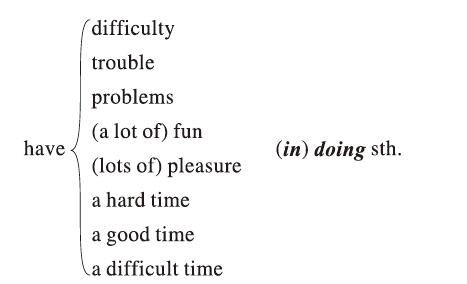
我们先来看下面这个四级考试的听力题:
1 Woman: How do you find your new apartment?
Man: Well, it's quite nice really, although I have a hard time getting used to living in a big place.
妙语点睛 我们看到,这里的短语have a hard time后面接了getting这个动名词。另外get used to的后面也要求接动名词,所以用living。
这里要提醒大家注意:How do you find...这个句型的含义是“你觉得……怎么样”,是在向对方征询意见或看法的,不要误解成“你是怎么发现……的”,比如这句话不能理解成“你是怎么找到你的新公寓的?”如果要表达后者的意思,则要用过去时,说成“How did you find...?”
再看下面这个“租房难”的例句,这是一道TOEFL听力题:
2 A: We are having all kinds of trouble finding a new apartment for next year. What about you?
B: My roommate and I decided that this year we’d stay put.
我们再来看下面这几道TOEFL听力题:
3 A: You certainly have a lot of clocks. There seems to be one in every room.
B: My family gave them to me because I have trouble keeping track of the time.
4 A: I had a hard time getting through this novel.
B: I know how you feel. Who can remember the names of 35 different characters.
5 A: I’m having a hard time keeping up in my biology class. I’m seriously considering hiring a tutor.
B: A word of advice, don't make a mistake I made last semester and wait until after the midterm exam to do it.
下面是一个美国教授谈到语言学习时说的一番话:
6 For a North American or European, languages such as Chinese, Korean, and Japanese have what is like pictograph or ideographic type of language. Native speakers of European languages often have a very difficult time in learning one of the Asian languages, as our ears are not attuned to the sounds or characters of the language. In China, I am like a child in terms of the language, and illiterate in terms of being able to read or write Chinese. If I could read and write in Chinese, I would need to recognize at least 3, 000 or more characters.
Chinese also have a hard time learning the European languages such as English, French, Spanish, Italian, or German, because each of these languages is filled with many idioms which don't make much sense in terms of the formal language that they learn.
妙语点睛 我们看到,这里的短语have a very difficult time和have a hard time后面都接了动名词 (in) learning,不能说to learn。
7 When we moved to Canada a few years ago, we had a hard time communicating with Canadians, so we started to read a lot of English books and magazines to improve our conversation and listening skills.
8 They turn the volume up full blast (以最大的音量) and begin to party. The music is so loud that we have a hard time carrying on a conversation without raising our voices.
下面这句话说出了要勇于面对变化、保持乐观的道理:
9 I have learned, however, that change always seems more difficult at the outset, and if I work hard at remaining positive and view changes as opportunities to grow, I have an easier time dealing with them.
但要注意下列短语的后面要接不定式:take the trouble to do sth., trouble to do sth., have (no) time to do sth.。比如:
10 I worked so late in the office last night that I hardly had time to catch the last bus.
妙语点睛 这里不用had time catching...*。
二、表示“情不自禁”“不得不”的短语
这些短语包括:can't help doing, can't resist doing, can't keep from doing, can't hold back from doing和can't keep back from doing等等。请看例句:
11 No one can help liking Tom; he is such a cute boy.
不过要注意下面的短语要接动词原形,但它们的意思不变:can't help but do, can't but do和can't choose but do。
三、其他句型结构
此外,还有其他一些短语,比如be worth doing, 表示“值得做”。注意这些短语要用主动形式,但表示被动的意思。
12 The book is worth reading.
还要注意这个句型结构:be worthy of being done/to be done。比如上面这个例句可以改写为:
The book is worthy of being read.
The book is worthy to be read.
再比如be busy doing这个句型结构。请看例句:
13 The money will be used to keep a space vehicle on the moon busy sending back to the earth photographs and other information about the surface of the moon.
关于这些接动名词作宾语的句型或短语,需要读者在日常的学习过程中注意积累。
思维总结
本节讨论了动名词作宾语的情况,主要内容包括三个方面:一是在动词后面作宾语,此时要记住有哪些动词要接不定式;二是在介词后面作宾语,此时尤其要分辨to是作为介词还是不定式符号;三是在特定的句型中作宾语。这三点都非常重要,要求读者全部掌握。本节是动名词的重点内容之一。
思维训练5.2 Key
一、用括号中动词的适当形式填空。
1. I’ve had a hard time ______ (learn) English.
2. I still remember ______ (take) to Beijing for the first time.
3. Love means ______ (never, have) to say you’re sorry.
4. Clint always remembers ______ (turn) off the lights when he leaves the room.
5. Now he regrets ______ (not, go) to university.
6. We regret ______ (inform) you that the flight has been canceled.
7. I regret ______ (let) slip that opportunity.
8. The teacher has had some problems ______ (decide) when they should return the final papers to the students.
9. Mr. Smith regretted ______ (blame) his secretary for the mistake, for he later discovered it was his own fault.
10. Peter went on ______ (sleep) despite the noise.
11. He welcomed the new students and then went on ______ (explain) the college regulations.
12. The boy is constantly being told not to scratch the paint off the wall, but he goes on ______ (do) it all the same.
13. After the listening test, the students then went on ______ (translate) some sentences.
14. The key to ______ (learn) English is to practice ______ (speak) the language.
15. His whole life was devoted to ______ (help) the poor.
16. After you finish the test, you can resume ______ (do) your homework.
17. This steak is raw. It needs ______ (cook) more before I can eat it.
18. This computer virus will cause your computer to stop ______ (work).
19. I don't feel like ______ (climb) the steps. Let's find the nearest escalator instead.
20. I think living in the quiet countryside beats ______ (live) in a crowded, noisy city. That's why I moved to the countryside.
二、选择最佳答案填空。
21. Last month I took my car to the garage because ______.
A. it needed servicing B. have it serviced C.it needs servicing D.to service it myself
22. I’m going to the dentist tomorrow because ______.
A. my tooth needs filling B. have a filling done C.fill my tooth D.my tooth needed filling
23. The money will be used to keep a space vehicle on the moon busy ______ back to the earth photographs and other information about the surface of the moon.
A. to send B. sending C.to be sent D.being sent
24. Peter, who had been driving all day, suggested ______ at the next town.
A. to stop B. stopping C.stop D.having stopped
25. They are considering ______ before the prices go up.
A. of buying the house B. buying the house C.with buying the house D.to buy the house
26. She was so angry that she felt like ______ something at him.
A. to throw B. throwing C.to have thrown D.having thrown
27. The children are opposed to ______ without their uncle.
A. have a party B. have held a party C.take part in a party D.having a party
28. I have no objection ______ the evening with them.
A. to spend B. spending C.of spending D.to spending
29. They don't object ______ the meeting until Friday.
A. to our postponing B. that we postpone C.for postponing D.to postpone
30. I worked so late in the office last night that I hardly had time ______ the last bus.
A. to have caught B. to catch C.catching D.having caught