Chapter 3 定语从句
3.3 关系代词与先行词的搭配关系
3.3 关系代词与先行词的搭配关系
在3.2节中,我们详细讨论了关系词在定语从句中所充当的成分,研究重心是放在定语从句本身。现在,我们把重心转向关系词与主句中的先行词之间的关系。细心的读者也许注意到了,在3.2节中所讨论的定语从句的关系词都是who。但是在英语里,还有其他的关系词,比如whom,which,that,whose,when,where和why等等。这些关系词可以分为两大类:关系代词和关系副词。关系代词主要包括who,whom,which,that和whose,这些词主要起着代词的作用,在定语从句里充当主语或宾语(但whose作定语)。关于它们的具体用法将在本节中详细讨论。关系副词则包括when,where和why,这些词主要起着副词的作用,在定语从句里充当状语(不作主语或宾语)。关于它们的用法将在3.4节中讨论。因此,本节内容安排如下:
3.3.1 先行词指“人”,用关系代词who或whom
3.3.2 表示人或物的所有关系,用whose
3.3.3 先行词指“物”,用关系代词which
3.3.4 that可以指代人,也可以指代“物”
这些关系代词与先行词有着严格的对应关系,据此可以分为三类。见下表:

3.3.1 先行词指“人”,用关系代词who或whom
一、先行词指“人”才能用who或whom
比如在3.1和3.2节中讨论的各个例句。再比如3.1节的练习中出现的这段话:
1 Friendship is a very difficult thing. It is hard to handle. It creates many different problems. In fact I would say that friendship is as hard to handle as love is, or even marriage. Of course I am not talking about easy-come-easy-go friendship. I’m talking about friends who care deeply about each other, who support each other, who make life worth living. I’m talking about friends who you can share almost everything with.
妙语点睛 这里有两组定语从句。第一组“I’m talking about friends who care deeply about each other, who support each other, who make life worth living.”。其中的先行词friends表示“人”,所以用who来引导定语从句,这里有三个定语从句并列使用。第二组“I’m talking about friends who you can share almost everything with.”。同样因为先行词表示“人”,所以用who来引导定语从句。
那么,可以指“人”的关系代词who和whom有什么不同呢?我们下面来讨论。
二、who和whom的区别
1. who的前面不能与介词搭配使用
因为who是主格形式,所以在介词的后面不能用who,比如不说with who*,而说with whom。请看例句:
2 I’m talking about friends who you can share almost everything with.
不能说“I’m talking about friends with who you can share almost everything. *”。
而应该说“I’m talking about friends with whom you can share almost everything.”。
主格形式的who除了作定语从句的主语外,还可以充当定语从句的宾语或表语。
2. whom在定语从句中不能作主语,但可作宾语或表语
3 A rich person is not one who has the most, but is one who needs the least.
妙语点睛 这里的who作从句的主语,所以不能用whom,不说whom has…*。
4 Only the people who have the patience to do simple things perfectly will acquire the skill to do difficult things easily.
妙语点睛 这里的who作从句的主语,所以不能用whom,不说whom have…*。
总之,who可以作主语,也可以代替whom作宾语或表语,但不能用在介词后面。而因为whom是宾格形式,所以不能作主语。
3.3.2 表示人或物的所有关系,用whose
whose表示所有关系,其作用就如同物主代词my,your,her,his,their和our,whose的后面要接名词。whose可指人也可指物。“whose+名词”在从句中可作主语、动词的宾语或介词的宾语。请看例句:
1
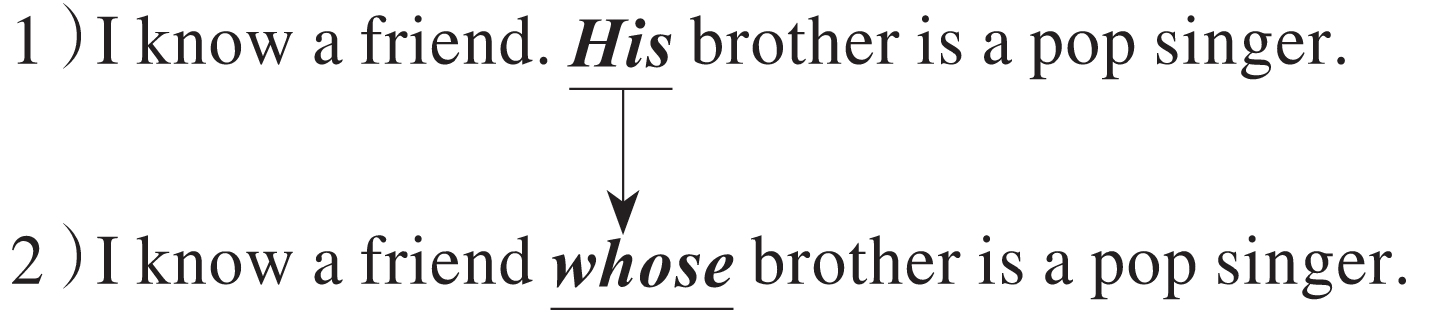
妙语点睛 例句2)里的whose代替了例句1)里的his,指friend,即表示人。
2

妙语点睛 例句2)里whose代替了例句1)里的its,指schoolroom,即表示物。
请再看其他例句:
3 When I looked through the window, I saw a girl whose beauty took my breath away.
妙语点睛 这里的whose beauty作从句的主语,whose指人即a girl。
4 It was a meeting whose importance I did not realize at the time.
妙语点睛 这里的whose importance作从句动词realize的宾语,whose指物即a meeting。
5 Atlas (in Greek mythology) was a kneeling man on whose shoulder the world rested.
妙语点睛 这里的whose shoulder作从句中的动词短语rested on的宾语,这里on被提前了。whose指人即man。
3.3.3 先行词指“物”,用关系代词which
关系词which的造句结构完全类似于前面讨论过的who,比如which可以作从句的主语或宾语,只不过which的先行词是“物”。请看下面的例句:
1

妙语点睛 这里的先行词是sentences,表示“物”,因此不能用who。要用which代替they,指代sentences,告诉对方“我们正在学习什么类型的句子”。
值得注意的是,关系词which所指代的先行词比较复杂,它除了可以指单个的名词外,还可以指代短语甚至是从句。下面将一一举例说明。
一、先行词是单个的名词
2 Anger is a wind which blows out the lamp of the mind.
妙语点睛 先行词是wind,即which指单个的名词。
3 Perhaps it is human to appreciate little that which we have and to long for that which we have not.
妙语点睛 先行词是that,即which指单个的名词。
二、先行词是一个短语
which可以指代一个短语。请看例句:
4 He likes climbing mountains, which is a good exercise.
妙语点睛 先行词是主句中的一个动名词短语climbing mountains。
三、先行词是一个句子
which可以指代前面的整个句子。请看例句:
5
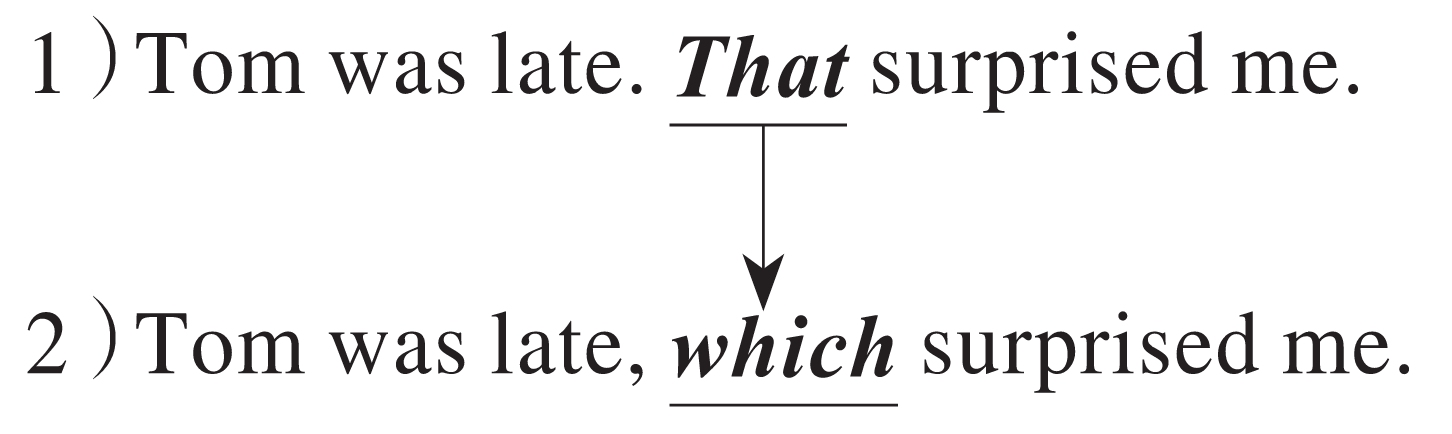
妙语点睛 例句2)中的which替换了例句1)中的that,显然是指前面的整个句子“Tom was late”。
6 He tore up my photo, which upset me.
妙语点睛 全句“he tore up my photo”作which的先行词。
再比如,一位单亲妈妈这样调侃道:
7 I became a single mother overnight, which is nothing like becoming famous overnight.
妙语点睛 全句“I became a single mother overnight”作which的先行词。
3.3.4 that可以指代“人”,也可以指代“物”
关系代词that的意义和用法主要有以下三点:一是 that既可指“人”也可指“物”,指“物”时可以替换which,指“人”时可以替换who;二是that不用在非限制性定语从句中(关于限制性和非限制性定语从句,详见3.5节);三是that不能用于介词的后面(同who一样)。
因为that的先行词既可以指“人”也可以指“物”,所以that可以用来替换who或which。比如下面这个句子:
1 Too many people spend money which they haven’t earned, to buy things which they don’t want, to impress people who they don’t like.
妙语点睛 可以用that替换其中的which和who而将这句话改写成“Too many people spend money that they haven’t earned, to buy things that they don’t want, to impress people that they don’t like.”。
这是影星威尔·史密斯(Will Smith)批评时下一些年轻人的生活方式时说的话。这里that的先行词有“物(money和things)”,也有“人(people)”。
顺便提一句,在前面3.2.4小节讨论过,作宾语的关系词可以省去,因此这句话也可说成“Too many people spend money ( ) they haven’t earned, to buy things ( ) they don’t want, to impress people ( ) they don’t like.”。
既然that可以指“物”也可以指“人”,那么就会涉及与which和who在用法上的区别的问题。为了便于记忆和使用,现列举出下面这些最好用that的情况:
1. 先行词中同时出现“人”和“物”时,用that
2 The writer and his novels that the article deals with are quite familiar to us.
妙语点睛 这里的先行词是the writer and his novels,即同时有“人(writer)”和“物(his novels)”,所以要选用that引导定语从句。
2. 先行词为指“物”的all,little,few,much,none和the first时, 用that
3 All that glitters is not gold.
妙语点睛 这里的先行词是all,所以用that来引导定语从句。另外要注意的是,这里有一个半否定的问题:all…not要译成“并非都是”,不能译成全否定的“所有都不”。
这句话是莎士比亚(Shakespeare)的剧作《威尼斯商人》(The Merchant of Venice)中的名句,它的意思是说凡事不能只看外表,外表显得贵重华丽的东西不一定真正有价值(Something which seems valuable at first may turn out to be worthless. Just because something appears valuable does not mean that it really is valuable.)。
请再看下面的例句:
4 The book contains little that is useful.
妙语点睛 这里的先行词是表示否定意义的代词little(几乎没有什么),所以用that来引导定语从句。
5 There is not much that can be done.
妙语点睛 这里的先行词是代词much,所以用that来引导定语从句。
6 As long as you stand up to the difficulties, there are none that cannot be overcome.
妙语点睛 这里的先行词是代词none,所以用that来引导定语从句。
3. 先行词是不定代词something,anything,nothing和everything时,一般用that
7 Greater expense does not always equal better gift. I would much rather receive a gift that was unique or that I knew my friend had put some thought into than something that cost a lot of money but that I didn’t need or want. I would much rather receive something that made me laugh, made me reminisce, or fit my personality than something that cost a lot but that I will just throw in my closet and forget about.
妙语点睛 首先,这段话里先行词是something的定语从句,作者都用了that来引导。其次,这里还有先行词不是something的定语从句,比如a gift that was unique or that I knew my friend had put some thought into。第三,从结构上来看,这段话里的句子稍微有些复杂,因为里面含有多个并列的定语从句,比如由or连接的that was unique和that I knew my friend had put some thought into并列(注意这里的I knew是插入语,从句的主谓结构是my friend had put…);由but连接的that cost a lot of money和that I didn’t need or want并列;由but连接的that cost a lot和that I will just throw in my closet and forget about并列,还有定语从句(something) that made me laugh, made me reminisce, or fit my personality。最后,这里有一个重要句型:I would rather…than,表示“我宁愿……而不愿……”。
4. 先行词被any,only,all,every,no,some,much,few,little,序数词,形容词的最高级,the only,the one,the very,the right和the last 等成分修饰时,用that
8 Tell us all things that you know. 把你知道的都告诉我们。
9 There is no difficulty that they can’t overcome. 没有什么困难是他们不能战胜的。
10 The only thing that we should do is find our way home. 我们应该做的只有找到回家的路。
11 The very problem that I want to solve is like this. 我想解决的问题就像这个一样。
12 He is the only man that can speak four foreign languages in our company. 他是我们公司唯一一个会说四种外语的人。
5. that不用在非限制性定语从句中
不用that引导非限制性定语从句。比如要说:
13 I became a single mother overnight, which is nothing like becoming famous overnight.
不能说“I became a single mother overnight, that is nothing like becoming famous overnight. *”。
6. that不能用于介词后面
不能在that前面使用介词。比如要说:
14 The world in which we live is made up of matter. 我们所生活的世界是由物质组成的。
或:The world which we live in is made up of matter.
或:The world that we live in is made up of matter.
但不能说“The world in that we live is made up of matter. *”。
思维总结
本节是定语从句的重点内容,主要讨论了不同关系代词的用法特点,这与先行词有关。所以,换个角度来看,就是关系词与先行词之间的对应关系的问题。
思维训练3.3 Key
一、请将下列每一组中的两个简单句合并为一个定语从句,用第二个句子作定语。
1. The girl is happy. She won the race.
2. The student is from America. He sits next to me.
3. The boy was not badly hurt. The boy fell from a tree.
4. The taxi driver was friendly. He took me to the airport.
5. I can’t remember the name of the person. I gave the money to him.
6. The employees had to retire. They had reached the age of sixty-five.
7. The teacher spoke to the boys. Their work was below standard.
8. The people were friendly. I rented their houses.
9. He is the professor. I am taking his grammar course.
10. That is the man. His son died in that air crash.
11. The man called the police. His car was stolen.
12. The man is famous. His picture is in the newspaper.
13. I have a neighbor. His dog barks all day long.
14. The girl is a good friend of mine. I borrowed her camera.
15. The church was built in 1400. We were married in the church.
16. She told me her address. I wrote it down on a piece of paper.
17. We are studying sentences. They contain adjective clauses.
18. The exhibition was not very interesting. My friend took me to see it.
19. John isn’t home yet. That worried me.
20. Jack was fired from his job. That surprised all of his co-workers.
21. My roommate always plays music at the dorm. That really gets on my nerves.
二、请判断下列句子是否正确,错误的请改正。
22. I enjoy the music that we are listening to it.
23. The people which live next to me are friendly.
24. He is the man who he taught me English.
25. I gave the book to him that he needed it.
26. The airline has a booklet who will tell you most of the important things about a trip to Europe.
27. The man which told me the news refused to give me his name.
28. The book which I bought it at the bookstore was very useful.
29. The woman was nice that I met yesterday.
30. I met a woman who her husband is a famous lawyer.
31. Let ABC be a triangle which sides are of unequal length.
32. Do you know the people who lives in that house?
33. The people who I met them at the party last night were interesting.
34. He dropped in on an old friend that day where he visited his club.
35. The day, when began brightly, ended with a violent storm.
三、请将下列定语从句中的that改为who或which,并判断哪些关系词可以省去。
36. The girl that answered the phone was polite.
37. I didn’t know any of the people that Bill invited to his party.
38. The woman that I saw in the park was feeding the pigeons.
39. I like the barber that usually cuts my hair.
40. The person that I admire most is my father.
41. The people that I met at the party last night were very nice.
42. The people that live next to me have three cars.
43. The soup that I had for lunch was too salty.
44. The pill that I took made me sleepy.
45. My daughter asked me a question that I couldn’t answer.
46. The man that my sister goes out with is tall, dark and handsome.
47. I couldn’t understand the woman that I talked to on the phone.